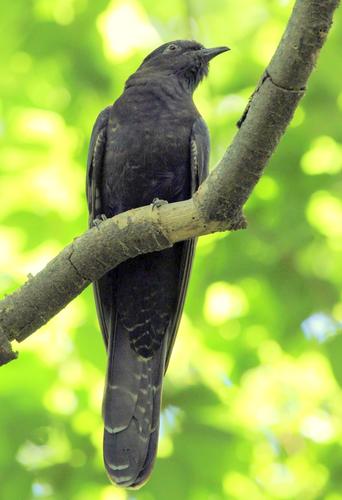
Dideric Cuckoo

Dideric Cuckoo

Chrysococcyx caprius

Silhouette: Nicolas Huet le Jeune and Jean-Gabriel Prêtre (vectorized by T. Michael Keesey) · PhyloPic

LCLeast ConcernNTVUENCR
Daily sighting probability ~10% · With luck
at Meru National Park

In 3 days ~40% in a week ~70%

21 Verified sightings at Meru National Park From 2019 to 2026
6,923 In all 43 parks
April Best month
☀️ Diurnal When it's spotted

About the Dideric Cuckoo

The diederik cuckoo (Chrysococcyx caprius), formerly dideric cuckoo or didric cuckoo, is a member of the cuckoo family of birds, Cuculidae, which also includes the roadrunners and the anis. The diederik cuckoo was described by the French polymath Georges-Louis Leclerc, Comte de Buffon in 1780 in his Histoire Naturelle des Oiseaux from a specimen collected in the Cape of Good Hope region of South Africa. The bird was also illustrated in a hand-coloured plate engraved by François-Nicolas Martinet in the Planches Enluminées D'Histoire Naturelle which was produced under the supervision of Edme-Louis Daubenton to accompany Buffon's text. Neither the plate caption nor Buffon's description included a scientific name but in 1783 the Dutch naturalist Pieter Boddaert coined the binomial name Cuculus caprius in his catalogue of the Planches Enluminées. The diederik cuckoo is now placed in the genus Chrysococcyx that was erected by the German zoologist Friedrich Boie in 1826. The species is monotypic.

The generic name Chrysococcyx combines the Ancient Greek khrusos meaning "gold" and kokkux meaning "cuckoo". The specific epithet caprius is from the Latin cupreus meaning "coppery... Wikipedia →

Sounds

Uncertain0:32

Saudi Arabia · 2025

© Ahmed Al-Ali · XC1006740 · CC BY-NC-ND 4.0

Call0:33

South Africa · 2022

© Tony Archer · XC703558 · CC BY-NC-SA 4.0

Song0:32

South Africa · 2021

© Lynette Rudman · XC685548 · CC BY-NC-SA 4.0

Global Distribution

Parks Where Found

# Park Country Daily sighting probability
1 uMkhuze Game Reserve 🇿🇦 South Africa
~30%
2 Tsavo West National Park 🇰🇪 Kenya
~20%
3 iSimangaliso Wetland Park 🇿🇦 South Africa
~20%
4 Serengeti National Park 🇹🇿 Tanzania
~20%
5 Ngorongoro Conservation Area 🇹🇿 Tanzania
~20%
6 Murchison Falls National Park 🇺🇬 Uganda
~20%
7 Tsavo East National Park 🇰🇪 Kenya
~20%
8 Kruger National Park 🇿🇦 South Africa
~20%
9 Lake Mburo National Park 🇺🇬 Uganda
~20%
10 Queen Elizabeth National Park 🇺🇬 Uganda
~20%
11 Tarangire National Park 🇹🇿 Tanzania
~20%
12 Nairobi National Park 🇰🇪 Kenya
~20%
13 Awash National Park 🇪🇹 Ethiopia
~20%
14 Lake Manyara National Park 🇹🇿 Tanzania
~20%
15 Pilanesberg National Park 🇿🇦 South Africa
~20%
16 Meru National Park 🇰🇪 Kenya
~10%
17 Kibale National Park 🇺🇬 Uganda
~10%
18 Samburu National Reserve 🇰🇪 Kenya
~10%
19 Ruaha National Park 🇹🇿 Tanzania
~10%
20 Hluhluwe-Imfolozi Park 🇿🇦 South Africa
~10%
21 Virunga National Park 🇨🇩 Democratic Republic of the Congo
~10%
22 Lake Nakuru National Park 🇰🇪 Kenya
~10%
23 Addo Elephant National Park 🇿🇦 South Africa
~10%
24 Semuliki National Park 🇺🇬 Uganda
~10%
25 Kidepo Valley National Park 🇺🇬 Uganda
~10%
26 Akagera National Park 🇷🇼 Rwanda
~10%
27 Arusha National Park 🇹🇿 Tanzania
~10%
28 Gonarezhou National Park 🇿🇼 Zimbabwe
~10%
29 Amboseli National Park 🇰🇪 Kenya
~10%
30 Mkomazi National Park 🇹🇿 Tanzania
~10%
31 Mana Pools National Park 🇿🇼 Zimbabwe
~10%
32 Kgalagadi Transfrontier Park 🇿🇦 South Africa
<5%
33 Garden Route National Park 🇿🇦 South Africa
<5%
34 Lower Zambezi National Park 🇿🇲 Zambia
<5%
35 Liwonde National Park 🇲🇼 Malawi
<5%
36 Mikumi National Park 🇹🇿 Tanzania
<5%
37 Masai Mara National Reserve 🇰🇪 Kenya
<5%
38 Kafue National Park 🇿🇲 Zambia
<5%
39 South Luangwa National Park 🇿🇲 Zambia
<5%
40 Chobe National Park 🇧🇼 Botswana
<5%
41 Bwindi Impenetrable National Park 🇺🇬 Uganda
<5%
42 Moremi Game Reserve 🇧🇼 Botswana
<5%
43 Table Mountain National Park 🇿🇦 South Africa
<5%

Cities Where Found

# City Country Daily sighting probability
1 Mombasa 🇰🇪 Kenya
~30%
2 Ouagadougou 🇧🇫 Burkina Faso
~30%
3 Yaoundé 🇨🇲 Cameroon
~30%
4 Abidjan 🇨🇮 Côte d'Ivoire
~20%
5 Johannesburg 🇿🇦 South Africa
~10%
6 Brazzaville 🇨🇬 Republic of the Congo
~10%
7 Kampala 🇺🇬 Uganda
~10%
8 Pretoria 🇿🇦 South Africa
~10%
9 Lagos 🇳🇬 Nigeria
~10%
10 Abuja 🇳🇬 Nigeria
~10%

Before you go

What are the chances of seeing a Dideric Cuckoo in Meru National Park?

With luck

About 10% of wildlife watchers report a Dideric Cuckoo sighting in Meru National Park on a given day, based on 21 verified sightings from GBIF citizen-science data from 2019 to 2026. It is the 140th most-seen of the 243 birds we can rate there. Over three days the chance rises to about 40%, and over a week to about 70%, if each day is a fresh chance.

When is the best time to see a Dideric Cuckoo in Meru National Park?

April and June

In those months about 30% of wildlife watchers report a Dideric Cuckoo in Meru National Park on a given day, against under 5% in October, the lowest month. Those are among Meru National Park's wettest months, with about 95 mm of rain a month against almost none in July. May and July–August have too few records to rate.

What time of day is best to see a Dideric Cuckoo?

Between 7 and 10 am

Across all the parks we cover, that three-hour window holds the most Dideric Cuckoo sightings with a recorded time, and about 9 in 10 of them come between 6 am and 6 pm: it is a daytime animal.

Where does the Dideric Cuckoo sighting chance come from?

GBIF citizen-science records

It is estimated from how often the Dideric Cuckoo is recorded against all the birds logged in Meru National Park (21 verified sightings from 2019 to 2026), calibrated against known sighting rates. Figures are rounded to the nearest 10% because citizen-science data supports honest approximations, not decimals, and months with records from fewer than five people show "—". How it works.

← Back to Meru National Park