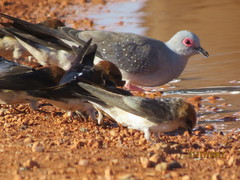

Diamond Dove

Diamond Dove

Geopelia cuneata

Silhouette: Sheatherius · PhyloPic

LCLeast ConcernNTVUENCR Endemic
Daily sighting probability ~10% · With luck
at Nitmiluk National Park

In 3 days ~20% in a week ~40%

31 Verified sightings at Nitmiluk National Park From 2019 to 2026
259 In all 6 parks
October Best month
☀️ Diurnal When it's spotted

About the Diamond Dove

The diamond dove (Geopelia cuneata) is a resident bird in Australia. The pigeon predominantly exists in areas near water but which are lightly arid or semi-arid in nature, being Central, West and Northern Australia. They are one of Australia's smallest pigeons along with the peaceful dove. They have been spotted occasionally in Southern Australia in parks and gardens when the centre of Australia is very dry.

English ornithologist John Latham first described the diamond dove in 1801. The common name "diamond" is a reference to the white speckles on its wings. They are small pigeons with a length of 19 to 21 centimeters or 9 to 11 inches. Regardless of sex, they have white spots and black edges on their wings, red eyes and orange eye-rings. The sexes look similar except the female's eye ring is less vivid and has more of a brown colour to the plumage. The male's head, neck, and breast are light blue-grey. The bill is a dark grey colour. The abdomen is a creamy colour while the back and tail is a brown-grey colour. The legs and feet are pink. The juveniles have a light grey bill; the iris and eye ring is fawn in colour; the feet and legs are... Wikipedia →

Sounds

Song1:24

Australia · 2020

© Marc Anderson · XC634961 · CC BY-NC-ND 4.0

Song0:33

Australia · 2009

© Mark Harper · XC40555 · CC BY-NC-ND 2.5

Song0:17

Australia · 2013

© Nigel Jackett · XC165147 · CC BY-NC-SA 3.0

Global Distribution

Parks Where Found

# Park Country Daily sighting probability
1 Uluru-Kata Tjuta National Park 🇦🇺 Australia
~30%
2 Nitmiluk National Park 🇦🇺 Australia
~10%
3 Kakadu National Park 🇦🇺 Australia
<5%
4 Litchfield National Park 🇦🇺 Australia
<5%
5 Flinders Ranges National Park 🇦🇺 Australia
<5%
6 Hattah-Kulkyne National Park 🇦🇺 Australia
<5%

Cities Where Found

# City Country Daily sighting probability
1 Melbourne 🇦🇺 Australia
<5%

Zoos & Centres Where Found

# Zoo / Centre Country
1 San Diego Zoo 🇺🇸 United States In captivity
2 Moscow Zoo 🇷🇺 Russia In captivity
3 Aquarium of Genoa 🇮🇹 Italy In captivity
4 Parc des oiseaux 🇫🇷 France In captivity
5 Zoobotánico Jerez 🇪🇸 Spain In captivity
6 Bronx Zoo 🇺🇸 United States In captivity
7 Ramat Gan Safari 🇮🇱 Israel In captivity
8 Alice Springs Desert Park 🇦🇺 Australia In captivity
9 Toledo Zoo 🇺🇸 United States In captivity
10 Silesian Zoological Garden 🇵🇱 Poland In captivity
11 Wildpark Höllohe 🇩🇪 Germany In captivity
12 Kyiv Zoo 🇺🇦 Ukraine In captivity
13 Jimmy’s Farm & Wildlife Park 🇬🇧 United Kingdom In captivity
14 Nyíregyháza Zoo 🇭🇺 Hungary In captivity
15 Lisbon Zoo 🇵🇹 Portugal In captivity
16 Tierwelt Herberstein 🇦🇹 Austria In captivity
17 Cleland Wildlife Park 🇦🇺 Australia In captivity
18 Refuge de l'Arche 🇫🇷 France In captivity
19 Mesker Park Zoo and Botanic Garden 🇺🇸 United States In captivity
20 Schönbrunn Zoo 🇦🇹 Austria In captivity
21 Attica Zoological Park 🇬🇷 Greece In captivity
22 Soğanlı Zoo 🇹🇷 Türkiye In captivity
23 Tiergarten Neustrelitz 🇩🇪 Germany In captivity
24 Auckland Zoo 🇳🇿 New Zealand In captivity
25 Krakow Zoo 🇵🇱 Poland In captivity
26 Plock Zoo 🇵🇱 Poland In captivity
27 Vogelpark Avifauna 🇳🇱 Netherlands In captivity
28 Adelaide Zoo 🇦🇺 Australia In captivity
29 Kuala Lumpur Bird Park 🇲🇾 Malaysia In captivity
30 Leningrad Zoo 🇷🇺 Russia In captivity
31 Parc zoologique de Jurques 🇫🇷 France In captivity
32 Reptile Gardens 🇺🇸 United States In captivity
33 Gorge Wildlife Park 🇦🇺 Australia In captivity
34 Santillana Zoo 🇪🇸 Spain In captivity
35 Birdland Park and Gardens 🇬🇧 United Kingdom In captivity
36 Small Breeds Farm Park 🇬🇧 United Kingdom In captivity
37 Vivarium Darmstadt 🇩🇪 Germany In captivity
38 Featherdale Sydney Wildlife Park 🇦🇺 Australia In captivity
39 Міні-зоопарк 🇺🇦 Ukraine In captivity
40 Zoo Lagos 🇵🇹 Portugal In captivity
41 Avifauna 🇪🇸 Spain In captivity
42 Orange County Zoo 🇺🇸 United States In captivity
43 Zoologischer Garten Hof 🇩🇪 Germany In captivity
44 Helsingborgs Djur- och Lekpark 🇸🇪 Sweden In captivity
45 Penang Bird Park 🇲🇾 Malaysia In captivity
46 Agroflori Parque de las Aves 🇧🇴 Bolivia In captivity
47 Castellar Zoo 🇪🇸 Spain In captivity
48 Parque Loro Sexi 🇪🇸 Spain In captivity
49 Stichting Dierenpark 🇳🇱 Netherlands In captivity
50 Tierpark Salzwedel 🇩🇪 Germany In captivity

Before you go

What are the chances of seeing a Diamond Dove in Nitmiluk National Park?

With luck

About 10% of wildlife watchers report a Diamond Dove sighting in Nitmiluk National Park on a given day, based on 31 verified sightings from GBIF citizen-science data from 2019 to 2026. It is the 62nd most-seen of the 103 birds we can rate there. Over three days the chance rises to about 20%, and over a week to about 40%, if each day is a fresh chance.

When is the best time to see a Diamond Dove in Nitmiluk National Park?

March–May and August–October

In those months about 10% of wildlife watchers report a Diamond Dove in Nitmiluk National Park on a given day, against under 5% in June–July and November–February, the lowest months. Those are among Nitmiluk National Park's driest months, with about 35 mm of rain a month against 270 mm in January.

What time of day is best to see a Diamond Dove?

Between 9 am and noon

Across all the parks we cover, that three-hour window holds the most Diamond Dove sightings with a recorded time, and about 9 in 10 of them come between 6 am and 6 pm: it is a daytime animal.

Is Nitmiluk National Park the best place to see a Diamond Dove?

2nd of 6

Of the 6 parks where we can rate Diamond Dove sightings, Nitmiluk National Park ranks 2nd at about 10%. The best odds are in Uluru-Kata Tjuta National Park (Australia, about 30%).

Which relatives of the Diamond Dove live in Nitmiluk National Park?

Same genus: Geopelia

The closest relatives of the Diamond Dove that you can see in Nitmiluk National Park (genus Geopelia, Australasian Doves) are Bar-shouldered Dove (about 70%) and Peaceful Dove (about 60%), with each one's daily chance of a sighting.

Where does the Diamond Dove sighting chance come from?

GBIF citizen-science records

It is estimated from how often the Diamond Dove is recorded against all the birds logged in Nitmiluk National Park (31 verified sightings from 2019 to 2026), calibrated against known sighting rates. Figures are rounded to the nearest 10% because citizen-science data supports honest approximations, not decimals, and months with records from fewer than five people show "—". How it works.

← Back to Nitmiluk National Park