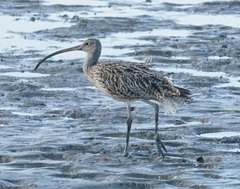
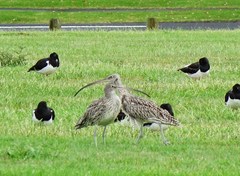
Far Eastern Curlew

Far Eastern Curlew

Numenius madagascariensis

Silhouette: PhyloPic

LCNTVUENEndangeredCR
Daily sighting probability <5% · Rare
at Noosa National Park

In 3 days ~10% in a week ~20%

17 Verified sightings at Noosa National Park From 2019 to 2026
184 In all 6 parks
August Best month
☀️ Diurnal When it's spotted

About the Far Eastern Curlew

The Far Eastern curlew (Numenius madagascariensis) is a large wader most similar in appearance to the long-billed curlew, but slightly larger. It is mostly brown, differentiated from other curlews by its plain, unpatterned brown underwing, and brown rump. It is not only the largest curlew but probably the world's largest sandpiper, at 60–66 cm (24–26 in) in length and 110 cm (43 in) across the wings. The weight is 390–1,350 g (0.86–2.98 lb), which is equalled by the Eurasian curlew; females are on average about 100 g heavier than males. The extremely long bill, at 12.8–20.1 cm (5.0–7.9 in) in length, rivals the bill size of the closely related long-billed curlew as the longest bill for a sandpiper. It overlaps in range with the eastern subspecies of the Eurasian curlew Numenius arquata orientalis, from which it is most easily told by its brown rump and lower back, rather than white.

In 1760 the French zoologist Mathurin Jacques Brisson included a description of the Far Eastern curlew in his Ornithologie based on a specimen. He used the French name Le courly de Madagascar and the Latin Numenius madagascariensis. Although Brisson coined Latin names, these do not conform... Wikipedia →

Sounds

Flight call0:08

Malaysia · 2026

© Lim Ying Hien 林勇贤 · XC1089664 · CC BY-NC-ND 4.0

Alarm call0:10

Australia · 2023

© Romuald Mikusek · XC1062830 · CC BY-NC-SA 4.0

Song0:10

China · 2024

© He Wenjin/文进 · XC897544 · CC BY-NC-SA 4.0

Global Distribution

Parks Where Found

# Park Country Daily sighting probability
1 Bako National Park 🇲🇾 Malaysia
~10%
2 Wilsons Promontory National Park 🇦🇺 Australia
<5%
3 Royal National Park 🇦🇺 Australia
<5%
4 Noosa National Park 🇦🇺 Australia
<5%
5 Bali Barat National Park 🇮🇩 Indonesia
<5%
6 Daintree National Park 🇦🇺 Australia
<5%

Cities Where Found

# City Country Daily sighting probability
1 Makassar 🇮🇩 Indonesia
~10%
2 Brisbane 🇦🇺 Australia
<5%
3 Naha 🇯🇵 Japan
<5%
4 Seoul 🇰🇷 South Korea
<5%
5 Tokyo 🇯🇵 Japan
<5%
6 Sydney 🇦🇺 Australia
<5%
7 Denpasar 🇮🇩 Indonesia
<5%
8 Osaka 🇯🇵 Japan
<5%
9 Nagoya 🇯🇵 Japan
<5%
10 Guangzhou 🇨🇳 China
<5%

Before you go

What are the chances of seeing a Far Eastern Curlew in Noosa National Park?

Rare

Under 5% of wildlife watchers report a Far Eastern Curlew sighting in Noosa National Park on a given day, based on 17 verified sightings from GBIF citizen-science data from 2019 to 2026. It is the 103rd most-seen of the 128 birds we can rate there. Over three days the chance rises to about 10%, and over a week to about 20%, if each day is a fresh chance.

When is the best time to see a Far Eastern Curlew in Noosa National Park?

August and December

In those months about 10% of wildlife watchers report a Far Eastern Curlew in Noosa National Park on a given day, against under 5% in January–July and September–November, the lowest months.

What time of day is best to see a Far Eastern Curlew?

Between 2 and 5 pm

Across all the parks we cover, that three-hour window holds the most Far Eastern Curlew sightings with a recorded time, and nearly all of them come between 6 am and 6 pm: it is a daytime animal.

Where does the Far Eastern Curlew sighting chance come from?

GBIF citizen-science records

It is estimated from how often the Far Eastern Curlew is recorded against all the birds logged in Noosa National Park (17 verified sightings from 2019 to 2026), calibrated against known sighting rates. Figures are rounded to the nearest 10% because citizen-science data supports honest approximations, not decimals, and months with records from fewer than five people show "—". How it works.

← Back to Noosa National Park