Pacific Golden-Plover

Pacific Golden-Plover

Pluvialis fulva

Silhouette: Emily Willoughby · PhyloPic

LCLeast ConcernNTVUENCR
Daily sighting probability ~10% · With luck
at Noosa National Park

In 3 days ~20% in a week ~50%

38 Verified sightings at Noosa National Park From 2019 to 2026
895 In all 18 parks
January Best month
☀️ Diurnal When it's spotted

About the Pacific Golden-Plover

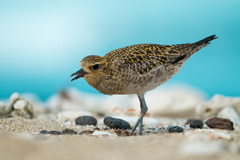
The Pacific golden plover (Pluvialis fulva) is a migratory shorebird that breeds during summer in Alaska and Siberia. During nonbreeding season, this medium-sized plover migrates widely across the Pacific. The Pacific golden plover was formally described in 1789 by the German naturalist Johann Friedrich Gmelin in his revised and expanded edition of Carl Linnaeus's Systema Naturae. He placed it with the other plovers in the genus Charadrius and coined the binomial name Charadrius fulvus. Gmelin based his description on the "Fulvous plover" that had been described in 1785 by the English ornithologist John Latham from specimens from Tahiti. The Pacific golden plover is now placed in the genus Pluvialis that was introduced by the French zoologist Mathurin Jacques Brisson in 1760. The genus name is Latin and means relating to rain, from pluvia, 'rain'. It was believed that the plovers flocked when rain was imminent. The specific epithet is also from Latin and means 'tawny' or 'yellowish-brown'. The species is monotypic: no subspecies are recognised.

Adults are about 25 cm (9.8 in) long with a wingspan averaging 61 cm (24 in) At their lightest, fat free,... Wikipedia →

Sounds

Nocturnal flight call0:20

China · 2026

© Xiangrong Yan · XC1179873 · CC BY-NC-SA 4.0

Flock calls0:38

Singapore · 2026

© Joan Theng · XC1176019 · CC BY-NC-SA 4.0

Flight call1:04

Netherlands · 2026

© guus van duin · XC1106593 · CC BY-NC-SA 4.0

Global Distribution

Parks Where Found

# Park Country Daily sighting probability
1 Wilpattu National Park 🇱🇰 Sri Lanka
~30%
2 Yala National Park 🇱🇰 Sri Lanka
~20%
3 Raja Ampat 🇮🇩 Indonesia
~10%
4 Noosa National Park 🇦🇺 Australia
~10%
5 Sundarbans National Park 🇮🇳 India
~10%
6 Udawalawe National Park 🇱🇰 Sri Lanka
<5%
7 Katmai National Park 🇺🇸 United States
<5%
8 Kaziranga National Park 🇮🇳 India
<5%
9 West Coast National Park 🇿🇦 South Africa
<5%
10 Daintree National Park 🇦🇺 Australia
<5%
11 Wilsons Promontory National Park 🇦🇺 Australia
<5%
12 Bali Barat National Park 🇮🇩 Indonesia
<5%
13 Rottnest Island 🇦🇺 Australia
<5%
14 El Vizcaíno Biosphere Reserve 🇲🇽 Mexico
<5%
15 Camargue 🇫🇷 France
<5%
16 Great Bear Rainforest 🇨🇦 Canada
<5%
17 Pacific Rim National Park Reserve 🇨🇦 Canada
<5%
18 Channel Islands National Park 🇺🇸 United States
<5%

Cities Where Found

# City Country Daily sighting probability
1 Quanzhou 🇨🇳 China
~20%
2 Naha 🇯🇵 Japan
~20%
3 Vasai-Virar 🇮🇳 India
~10%
4 Manila 🇵🇭 Philippines
~10%
5 Kochi 🇮🇳 India
~10%
6 Thiruvananthapuram 🇮🇳 India
~10%
7 Nanchang 🇨🇳 China
~10%
8 Guangzhou 🇨🇳 China
~10%
9 Makassar 🇮🇩 Indonesia
~10%
10 Thrissur 🇮🇳 India
~10%

Zoos & Centres Where Found

# Zoo / Centre Country
1 National Zoological Park 🇺🇸 United States In captivity
2 Beijing Wildlife Park 🇨🇳 China In captivity
3 Columbus Zoo and Aquarium 🇺🇸 United States In captivity
4 Honolulu Zoo 🇺🇸 United States In captivity

Before you go

What are the chances of seeing a Pacific Golden-Plover in Noosa National Park?

With luck

About 10% of wildlife watchers report a Pacific Golden-Plover sighting in Noosa National Park on a given day, based on 38 verified sightings from GBIF citizen-science data from 2019 to 2026. It is the 70th most-seen of the 128 birds we can rate there. Over three days the chance rises to about 20%, and over a week to about 50%, if each day is a fresh chance.

When is the best time to see a Pacific Golden-Plover in Noosa National Park?

March and December–January

In those months about 20% of wildlife watchers report a Pacific Golden-Plover in Noosa National Park on a given day, against under 5% in May–June and August–September, the lowest months.

What time of day is best to see a Pacific Golden-Plover?

Between 2 and 5 pm

Across all the parks we cover, that three-hour window holds the most Pacific Golden-Plover sightings with a recorded time, and nearly all of them come between 6 am and 6 pm: it is a daytime animal.

Is Noosa National Park the best place to see a Pacific Golden-Plover?

4th of 18

Of the 18 parks where we can rate Pacific Golden-Plover sightings, Noosa National Park ranks 4th at about 10%. The best odds are in Wilpattu National Park (Sri Lanka, about 30%), Yala National Park (Sri Lanka, about 20%) and Raja Ampat (Indonesia, about 10%).

Where does the Pacific Golden-Plover sighting chance come from?

GBIF citizen-science records

It is estimated from how often the Pacific Golden-Plover is recorded against all the birds logged in Noosa National Park (38 verified sightings from 2019 to 2026), calibrated against known sighting rates. Figures are rounded to the nearest 10% because citizen-science data supports honest approximations, not decimals, and months with records from fewer than five people show "—". How it works.

← Back to Noosa National Park