Ring Ouzel

Ring Ouzel

Turdus torquatus

Silhouette: Sharon Wegner-Larsen · PhyloPic

LCLeast ConcernNTVUENCR
Daily sighting probability <5% · Rare
at Ordesa y Monte Perdido National Park

In 3 days ~10% in a week ~20%

17 Verified sightings at Ordesa y Monte Perdido National Park From 2019 to 2026
1,278 In all 16 parks
March Best month
☀️ Diurnal When it's spotted

About the Ring Ouzel

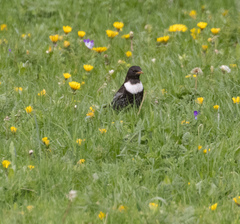
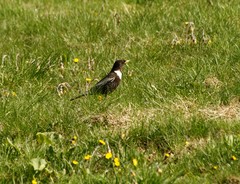
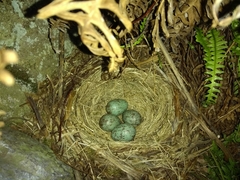
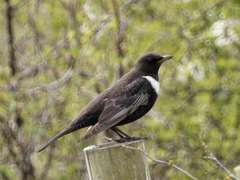
The ring ouzel (Turdus torquatus) is a mainly European member of the thrush family Turdidae. It is a medium-sized thrush, 23–24 centimetres (9.1–9.4 in) in length and weighing 90–138 grams (3.2–4.9 oz). The male is predominantly black with a conspicuous white crescent across its breast. Females are browner and duller than males, and young birds may lack the pale chest markings altogether. In all but the northernmost part of its range, this is a high-altitude species, with three subspecies breeding in mountains from Ireland east to Iran. It breeds in open mountain areas with some trees or shrubs, the latter often including juniper and other treeline conifers, rowan, bilberry, heather, and hairy alpenrose. It is a migratory bird, leaving the breeding areas to winter in southern Europe, North Africa and Turkey, typically in mountains with junipers. The typical clutch is 3–6 brown-flecked pale blue or greenish-blue eggs. They are incubated almost entirely by the female, with hatching normally occurring after 13 days. The altricial, downy chicks fledge in another 14 days and are dependent on their parents for about 12 days after fledging.

The ring ouzel is omnivorous, eating invertebrates, particularly insects and earthworms, some small vertebrates, and a wide range of fruit. Most animal prey is caught on the ground. During spring migration and the breeding season, invertebrates dominate the adult's diet and are also fed to the chicks. Later in the year, fruit becomes more important, particularly the common juniper.

With an extensive range and a large population, the ring ouzel is evaluated as least concern by the International Union for Conservation of Nature (IUCN). There are significant declines in several countries; suspected causes include climate change, human disturbance, hunting and outdoor leisure activities. Loss of junipers may also be a factor in some areas. Natural hazards include predation by mammalian carnivores and birds of prey, and locally there may also be competition from other large thrushes such as the common blackbird, mistle thrush and fieldfare. Wikipedia →

Sounds

Call0:06

France · 2026

© Thierry THOMAS · XC1185737 · CC BY-NC-SA 4.0

Song0:47

Poland · 2026

© Romuald Mikusek · XC1151621 · CC BY-NC-SA 4.0

Alarm call0:40

France · 2021

© Stanislas Wroza · XC641129 · CC BY-NC-SA 4.0

Global Distribution

Parks Where Found

# Park Country Daily sighting probability
1 Vanoise National Park 🇫🇷 France
~20%
2 Hohe Tauern National Park 🇦🇹 Austria
~20%
3 Ecrins National Park 🇫🇷 France
~10%
4 Aigüestortes National Park 🇪🇸 Spain
~10%
5 Tatra National Park 🇸🇰 Slovakia
~10%
6 Sierra Nevada National Park 🇪🇸 Spain
~10%
7 Mercantour National Park 🇫🇷 France
~10%
8 Triglav National Park 🇸🇮 Slovenia
~10%
9 Cairngorms National Park 🇬🇧 United Kingdom
~10%
10 Pyrénées National Park 🇫🇷 France
~10%
11 Ordesa y Monte Perdido National Park 🇪🇸 Spain
<5%
12 Wadden Sea National Park 🇩🇪 Germany
<5%
13 Snowdonia National Park 🇬🇧 United Kingdom
<5%
14 Sierra de Guadarrama National Park 🇪🇸 Spain
<5%
15 Bavarian Forest National Park 🇩🇪 Germany
<5%
16 Picos de Europa National Park 🇪🇸 Spain
<5%

Cities Where Found

# City Country Daily sighting probability
1 Birmingham 🇬🇧 United Kingdom
<5%
2 Liverpool 🇬🇧 United Kingdom
<5%
3 Helsinki 🇫🇮 Finland
<5%
4 London 🇬🇧 United Kingdom
<5%
5 Istanbul 🇹🇷 Turkey
<5%
6 Madrid 🇪🇸 Spain
<5%

Before you go

What are the chances of seeing a Ring Ouzel in Ordesa y Monte Perdido National Park?

Rare

Under 5% of wildlife watchers report a Ring Ouzel sighting in Ordesa y Monte Perdido National Park on a given day, based on 17 verified sightings from GBIF citizen-science data from 2019 to 2026. It is the 88th most-seen of the 105 birds we can rate there. Over three days the chance rises to about 10%, and over a week to about 20%, if each day is a fresh chance.

When is the best time to see a Ring Ouzel in Ordesa y Monte Perdido National Park?

March and May

In those months about 10% of wildlife watchers report a Ring Ouzel in Ordesa y Monte Perdido National Park on a given day, against under 5% in April and June–February, the lowest months.

What time of day is best to see a Ring Ouzel?

Between 11 am and 2 pm

Across all the parks we cover, that three-hour window holds the most Ring Ouzel sightings with a recorded time, and about 9 in 10 of them come between 6 am and 6 pm: it is a daytime animal.

Is Ordesa y Monte Perdido National Park the best place to see a Ring Ouzel?

11th of 16

Of the 16 parks where we can rate Ring Ouzel sightings, Ordesa y Monte Perdido National Park ranks 11th at under 5%. The best odds are in Vanoise National Park (France, about 20%), Hohe Tauern National Park (Austria, about 20%) and Ecrins National Park (France, about 10%).

Which relatives of the Ring Ouzel live in Ordesa y Monte Perdido National Park?

Same genus: Turdus

The closest relatives of the Ring Ouzel that you can see in Ordesa y Monte Perdido National Park (genus Turdus, Typical Thrushes) are Eurasian Blackbird (about 50%), Song Thrush (about 30%) and Mistle Thrush (about 20%), with each one's daily chance of a sighting.

Where does the Ring Ouzel sighting chance come from?

GBIF citizen-science records

It is estimated from how often the Ring Ouzel is recorded against all the birds logged in Ordesa y Monte Perdido National Park (17 verified sightings from 2019 to 2026), calibrated against known sighting rates. Figures are rounded to the nearest 10% because citizen-science data supports honest approximations, not decimals, and months with records from fewer than five people show "—". How it works.

← Back to Ordesa y Monte Perdido National Park