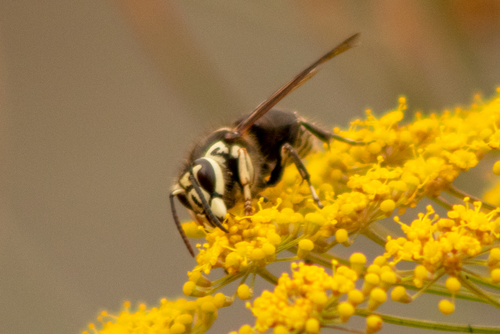
Bald-Faced Hornet
Daily sighting probability ~10% · With luck
at Pacific Rim National Park Reserve

In 3 days ~30% in a week ~50%

11 Verified sightings at Pacific Rim National Park Reserve From 2019 to 2026
338 In all 17 parks
September Best month
☀️ Diurnal When it's spotted

About the Bald-Faced Hornet

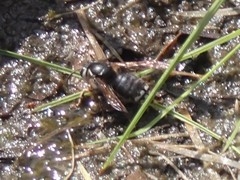
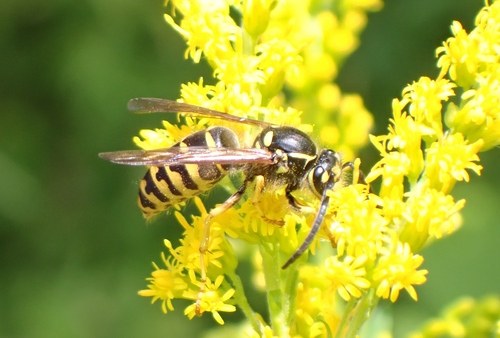
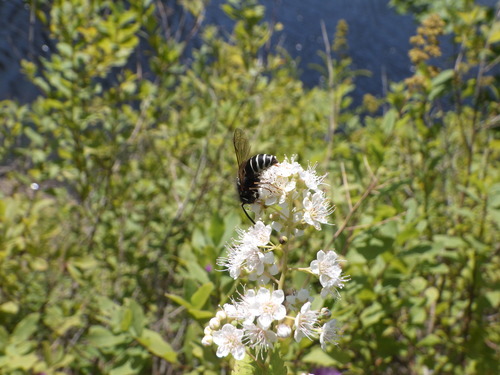
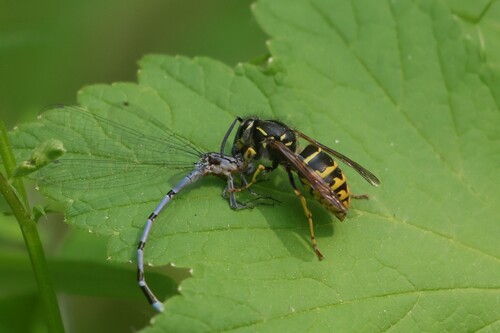
Dolichovespula maculata is a species of wasp in the genus Dolichovespula and a member of the eusocial, cosmopolitan family Vespidae. It is taxonomically an aerial yellowjacket but is known by many colloquial names, primarily bald-faced hornet, but also including bald-faced aerial yellowjacket, bald-faced wasp, bald hornet, white-faced hornet, blackjacket, white-tailed hornet, spruce wasp, naked brink, and bull wasp. Technically a species of yellowjacket wasp, it is not one of the true hornets, which are in the genus Vespa. Colonies contain 400 to 700 workers, the largest recorded colony size in its genus, Dolichovespula. It builds a characteristic large hanging paper nest up to 58 cm (23 in) in length. Workers aggressively defend their nest by repeatedly stinging invaders.

The bald-faced hornet is distributed throughout the United States and Canada, but is most common in the Southeastern United States. Males in this species are haploid and females are diploid. Worker females can, therefore, lay eggs that develop into males.

The bald-faced hornet gets its name from the characteristic white markings on its face, as the word "bald" in English is derived... Wikipedia →
Global Distribution

Parks Where Found

# Park Country Daily sighting probability
1 Congaree National Park 🇺🇸 United States
~20%
2 Isle Royale National Park 🇺🇸 United States
~10%
3 Riding Mountain National Park 🇨🇦 Canada
~10%
4 Shenandoah National Park 🇺🇸 United States
~10%
5 Acadia National Park 🇺🇸 United States
~10%
6 Great Smoky Mountains National Park 🇺🇸 United States
~10%
7 Elk Island National Park 🇨🇦 Canada
~10%
8 Grand Teton National Park 🇺🇸 United States
~10%
9 Cape Breton Highlands National Park 🇨🇦 Canada
~10%
10 Pacific Rim National Park Reserve 🇨🇦 Canada
~10%
11 Point Pelee National Park 🇨🇦 Canada
~10%
12 Sequoia and Kings Canyon National Parks 🇺🇸 United States
~10%
13 Olympic National Park 🇺🇸 United States
~10%
14 Great Bear Rainforest 🇨🇦 Canada
~10%
15 Glacier National Park 🇺🇸 United States
~10%
16 Rocky Mountain National Park 🇺🇸 United States
~10%
17 Yosemite National Park 🇺🇸 United States
~10%

Cities Where Found

# City Country Daily sighting probability
1 Philadelphia 🇺🇸 United States
~20%
2 Boston 🇺🇸 United States
~20%
3 Baltimore 🇺🇸 United States
~20%
4 Toronto 🇨🇦 Canada
~20%
5 New York City 🇺🇸 United States
~20%
6 Vancouver 🇨🇦 Canada
~20%
7 Montreal 🇨🇦 Canada
~20%
8 Chicago 🇺🇸 United States
~20%
9 Washington 🇺🇸 United States
~10%
10 Detroit 🇺🇸 United States
~10%

Before you go

What are the chances of seeing a Bald-Faced Hornet in Pacific Rim National Park Reserve?

With luck

About 10% of wildlife watchers report a Bald-Faced Hornet sighting in Pacific Rim National Park Reserve on a given day, based on 11 verified sightings from GBIF citizen-science data from 2019 to 2026. It is the 50th most-seen of the 107 insects we can rate there. Over three days the chance rises to about 30%, and over a week to about 50%, if each day is a fresh chance.

When is the best time to see a Bald-Faced Hornet in Pacific Rim National Park Reserve?

September

In that month about 30% of wildlife watchers report a Bald-Faced Hornet in Pacific Rim National Park Reserve on a given day, against under 5% in July and November–May, the lowest months.

What time of day is best to see a Bald-Faced Hornet?

Between 10 am and 1 pm

Across all the parks we cover, that three-hour window holds the most Bald-Faced Hornet sightings with a recorded time, and about 9 in 10 of them come between 6 am and 6 pm: it is a daytime animal.

Is Pacific Rim National Park Reserve the best place to see a Bald-Faced Hornet?

10th of 17

Of the 17 parks where we can rate Bald-Faced Hornet sightings, Pacific Rim National Park Reserve ranks 10th at about 10%. The best odds are in Congaree National Park (United States, about 20%), Isle Royale National Park (United States, about 10%) and Riding Mountain National Park (Canada, about 10%).

Where does the Bald-Faced Hornet sighting chance come from?

GBIF citizen-science records

It is estimated from how often the Bald-Faced Hornet is recorded against all the insects logged in Pacific Rim National Park Reserve (11 verified sightings from 2019 to 2026), calibrated against known sighting rates. Figures are rounded to the nearest 10% because citizen-science data supports honest approximations, not decimals, and months with records from fewer than five people show "—". How it works.

← Back to Pacific Rim National Park Reserve