
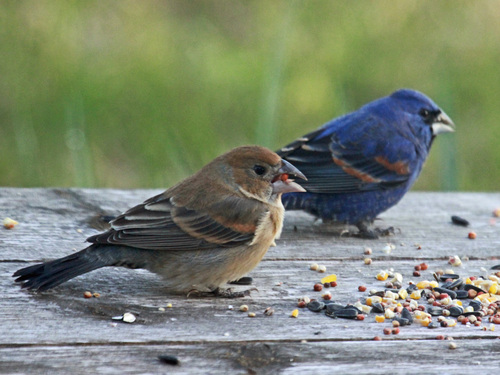
Black-faced Grosbeak

Black-faced Grosbeak

Caryothraustes poliogaster

Silhouette: Sheatherius · PhyloPic

LCLeast ConcernNTVUENCR
Daily sighting probability <5% · Rare
at Pico Bonito National Park

In 3 days ~10% in a week ~30%

43 Verified sightings at Pico Bonito National Park From 2019 to 2026
3,882 In all 13 parks
December Best month
☀️ Diurnal When it's spotted

About the Black-faced Grosbeak

The black-faced grosbeak (Caryothraustes poliogaster) is a species of bird in the family Cardinalidae, the cardinals, grosbeaks, and “tanager” allies. it is found from Mexico to Panama. The black-faced grosbeak was formally described in 1847 with the binomial Pitylus poliogaster. According to most taxonomic systems it now shares the genus Caryothraustes with the yellow-green grosbeak (C. canadensis). However, BirdLife International's Handbook of the Birds of the World (HBW) also includes the crimson-collared grosbeak and the red-and-black grosbeak in the genus. The other systems assign them to the genus Periporphyrus.

The black-faced grosbeak is about 14 to 22 cm (5.5 to 8.7 in) long; five individuals weighed an average of 35 g (1.2 oz). The sexes have the same plumage. Adults of the nominate subspecies are black on their lores, face, and throat. Their forecrown is yellow and the rest of their head is yellow with an olive tinge. Their upper back, wings, and tail are yellowish olive-green. Their... Wikipedia →

Sounds

Call1:03

Belize · 2014

© Scott Olmstead · XC664502 · CC BY-NC-SA 4.0

Song0:48

Panama · 2019

© Kent Livezey · XC459976 · CC BY-NC-SA 4.0

Call0:28

Nicaragua · 2021

© Liliana Chavarria-Duriaux · XC642845 · CC BY-NC-SA 4.0

Global Distribution

Parks Where Found

# Park Country Daily sighting probability
1 Cockscomb Basin Wildlife Sanctuary 🇧🇿 Belize
~30%
2 Braulio Carrillo National Park 🇨🇷 Costa Rica
~30%
3 Tenorio Volcano National Park 🇨🇷 Costa Rica
~20%
4 Montes Azules Biosphere Reserve 🇲🇽 Mexico
~10%
5 Tapantí-Macizo de la Muerte National Park 🇨🇷 Costa Rica
~10%
6 Pico Bonito National Park 🇭🇳 Honduras
<5%
7 Tikal National Park 🇬🇹 Guatemala
<5%
8 Calakmul Biosphere Reserve 🇲🇽 Mexico
<5%
9 Arenal Volcano National Park 🇨🇷 Costa Rica
<5%
10 La Amistad International Park (Panama) 🇵🇦 Panama
<5%
11 Poás Volcano National Park 🇨🇷 Costa Rica
<5%
12 Rincón de la Vieja National Park 🇨🇷 Costa Rica
<5%
13 Tortuguero National Park 🇨🇷 Costa Rica
<5%

Before you go

What are the chances of seeing a Black-faced Grosbeak in Pico Bonito National Park?

Rare

Under 5% of wildlife watchers report a Black-faced Grosbeak sighting in Pico Bonito National Park on a given day, based on 43 verified sightings from GBIF citizen-science data from 2019 to 2026. It is the 160th most-seen of the 271 birds we can rate there. Over three days the chance rises to about 10%, and over a week to about 30%, if each day is a fresh chance.

When is the best time to see a Black-faced Grosbeak in Pico Bonito National Park?

December

In that month about 20% of wildlife watchers report a Black-faced Grosbeak in Pico Bonito National Park on a given day, against under 5% in January–May, September and November, the lowest months. That is one of Pico Bonito National Park's wettest months, with about 290 mm of rain against 80 mm in April.

What time of day is best to see a Black-faced Grosbeak?

Between 7 and 10 am

Across all the parks we cover, that three-hour window holds the most Black-faced Grosbeak sightings with a recorded time, and about 9 in 10 of them come between 6 am and 6 pm: it is a daytime animal.

Which relatives of the Black-faced Grosbeak live in Pico Bonito National Park?

Same family: Cardinalidae

The closest relatives of the Black-faced Grosbeak that you can see in Pico Bonito National Park (family Cardinalidae, Cardinals and Allies) are Summer Tanager (about 40%), Rose-breasted Grosbeak (about 10%) and Indigo Bunting (about 10%), with each one's daily chance of a sighting.

Where does the Black-faced Grosbeak sighting chance come from?

GBIF citizen-science records

It is estimated from how often the Black-faced Grosbeak is recorded against all the birds logged in Pico Bonito National Park (43 verified sightings from 2019 to 2026), calibrated against known sighting rates. Figures are rounded to the nearest 10% because citizen-science data supports honest approximations, not decimals, and months with records from fewer than five people show "—". How it works.

← Back to Pico Bonito National Park