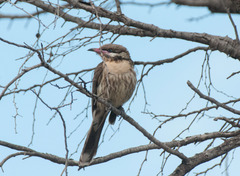
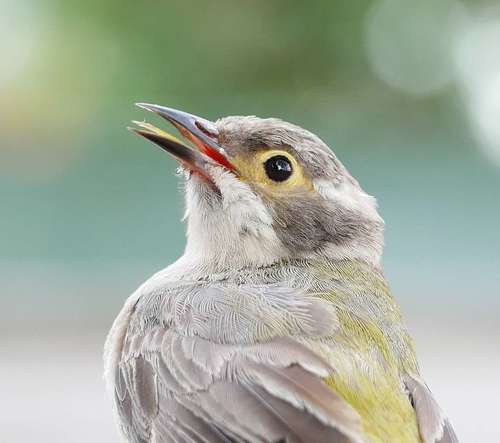
Spiny-cheeked Honeyeater

Spiny-cheeked Honeyeater

Acanthagenys rufogularis

Silhouette: Rachael Joakim · PhyloPic

LCLeast ConcernNTVUENCR Endemic
Daily sighting probability ~30% · Possible
at Pilliga National Park

In 3 days ~60% in a week ~90%

20 Verified sightings at Pilliga National Park From 2019 to 2026
1,702 In all 7 parks
November Best month
☀️ Diurnal When it's spotted

About the Spiny-cheeked Honeyeater

The spiny-cheeked honeyeater (Acanthagenys rufogularis) is the only species in the genus Acanthagenys. It is large for a honeyeater, ranging from 22 to 27 centimeters (8.7 to 10.6 inches) tall and weighing around 52 grams. The birds are sociable, aggressive, and often observed foraging in large flocks.

The spiny-cheeked honeyeater is mainly frugivorous, but will also eat nectar, blossoms, insects, reptiles, and young birds. Its habitat includes deserts, coastal scrubland, and dry woodlands. It is also found in mangroves and orchards. Its range includes most of Australia, except for Tasmania, northern tropical areas, and the southeastern coast.

The spiny-cheeked honeyeater's scientific name is Acanthagenys rufogularis. The generic name Acanthagenys derives from the Ancient Greek akantha 'spine, thorn' and genys 'cheek'; the specific epithet derives from Latin rufus 'red' and gula 'throat'.

The spiny-cheeked honeyeater, Acanthagenys rufogularis, is a medium-sized bird...

Wikipedia →

Sounds

Song0:46

Australia · 2021

© Marc Anderson · XC1004418 · CC BY-NC-ND 4.0

Call0:12

Australia · 2024

© Khristos Nizamis · XC943885 · CC BY-NC-ND 4.0

Song and call1:03

Australia · 2023

© Peter Boesman · XC859553 · CC BY-NC-ND 4.0

Global Distribution

Parks Where Found

# Park Country Daily sighting probability
1 Uluru-Kata Tjuta National Park 🇦🇺 Australia
~70%
2 Hattah-Kulkyne National Park 🇦🇺 Australia
~60%
3 Flinders Ranges National Park 🇦🇺 Australia
~50%
4 Pilliga National Park 🇦🇺 Australia
~30%
5 Phillip Island Nature Park 🇦🇺 Australia
<5%
6 Grampians National Park 🇦🇺 Australia
<5%
7 Great Otway National Park 🇦🇺 Australia
<5%

Cities Where Found

# City Country Daily sighting probability
1 Melbourne 🇦🇺 Australia
<5%

Zoos & Centres Where Found

# Zoo / Centre Country
1 Alice Springs Desert Park 🇦🇺 Australia In captivity

Before you go

What are the chances of seeing a Spiny-cheeked Honeyeater in Pilliga National Park?

Possible

About 30% of wildlife watchers report a Spiny-cheeked Honeyeater sighting in Pilliga National Park on a given day, based on 20 verified sightings from GBIF citizen-science data from 2019 to 2026. It is the 11th most-seen of the 58 birds we can rate there. Over three days the chance rises to about 60%, and over a week to about 90%, if each day is a fresh chance.

When is the best time to see a Spiny-cheeked Honeyeater in Pilliga National Park?

February, June, September and November

In those months about 30% of wildlife watchers report a Spiny-cheeked Honeyeater in Pilliga National Park on a given day, against about 20% in July–August and December, the lowest months. January, March–May and October have too few records to rate.

What time of day is best to see a Spiny-cheeked Honeyeater?

Between 10 am and 1 pm

Across all the parks we cover, that three-hour window holds the most Spiny-cheeked Honeyeater sightings with a recorded time, and nearly all of them come between 6 am and 6 pm: it is a daytime animal.

Which relatives of the Spiny-cheeked Honeyeater live in Pilliga National Park?

Same family: Meliphagidae

The closest relatives of the Spiny-cheeked Honeyeater that you can see in Pilliga National Park (family Meliphagidae, Honeyeaters) are Yellow-faced Honeyeater (about 40%), White-plumed Honeyeater (about 40%) and Noisy Friarbird (about 30%), with each one's daily chance of a sighting.

Where does the Spiny-cheeked Honeyeater sighting chance come from?

GBIF citizen-science records

It is estimated from how often the Spiny-cheeked Honeyeater is recorded against all the birds logged in Pilliga National Park (20 verified sightings from 2019 to 2026), calibrated against known sighting rates. Figures are rounded to the nearest 10% because citizen-science data supports honest approximations, not decimals, and months with records from fewer than five people show "—". How it works.

← Back to Pilliga National Park