
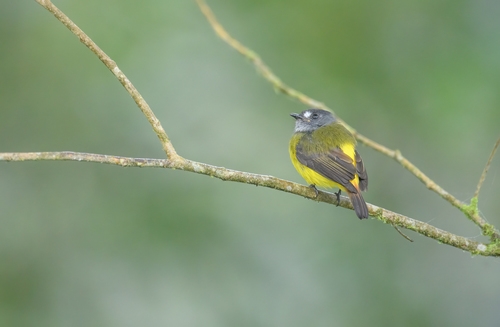
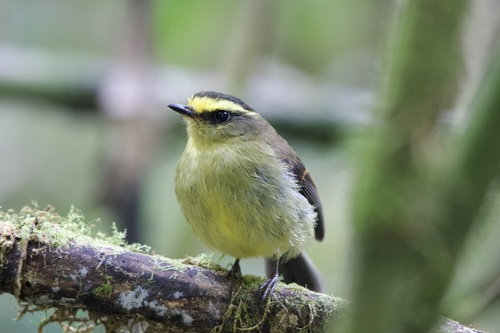
Golden-faced Tyrannulet

Golden-faced Tyrannulet

Zimmerius chrysops

Silhouette: Emily Willoughby · PhyloPic

LCLeast ConcernNTVUENCR
Daily sighting probability ~10% · With luck
at Podocarpus National Park

In 3 days ~20% in a week ~30%

77 Verified sightings at Podocarpus National Park From 2019 to 2026
3,222 In all 6 parks
December Best month
☀️ Diurnal When it's spotted

About the Golden-faced Tyrannulet

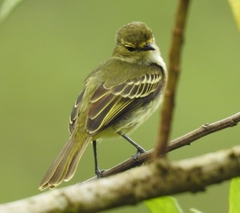
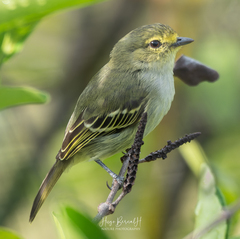
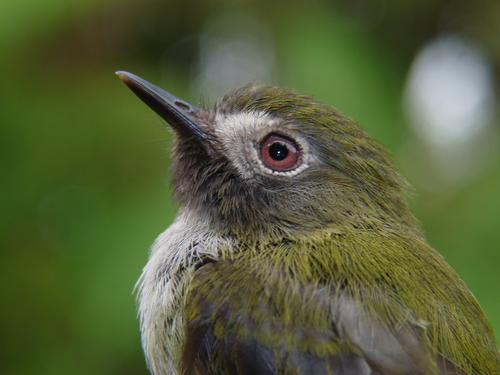
The golden-faced tyrannulet (Zimmerius chrysops) is a species of bird in the tyrant flycatcher family Tyrannidae. It is found in Colombia, Ecuador, Peru, and Venezuela. The golden-faced tyrannulet was formally described in 1859 as Tyrannulus chrysops by the English zoologist Philip Sclater based on specimens collected by the zoologist Louis Fraser in Gualaquiza and Zamora of Ecuador. The specific epithet combines the Ancient Greek χρυσος/khrusos meaning "gold" with ωψ/ōps, ωπος/ōpos meaning "face". The type locality has been restricted to Zamora. The golden-faced tyrannulet is now one of 13 species placed in the genus Zimmerius that was introduced in 1977 by the American ornithologist Melvin Alvah Traylor Jr. with the golden-faced tyrannulet as the type species. The golden-faced tyrannulet was formerly considered to be conspecific with the Peruvian tyrannulet (Zimmerius viridiflavus).

Three subspecies are recognised: Wikipedia →

Sounds

Call0:08

Ecuador · 2016

© Manuel Sánchez-Nivicela · XC1154921 · CC BY-NC-ND 4.0

Song0:20

Ecuador · 2024

© Matthew L. Brady · XC977332 · CC BY-NC-SA 4.0

Recording0:07

Colombia · 2024

© Andrés Mauricio López · XC902722 · CC BY-NC-SA 4.0

Global Distribution

Parks Where Found

# Park Country Daily sighting probability
1 Farallones de Cali National Natural Park 🇨🇴 Colombia
~50%
2 Los Nevados National Natural Park 🇨🇴 Colombia
~10%
3 Yasuní National Park 🇪🇨 Ecuador
~10%
4 Podocarpus National Park 🇪🇨 Ecuador
~10%
5 Chingaza National Natural Park 🇨🇴 Colombia
<5%
6 Sierra de la Macarena National Park 🇨🇴 Colombia
<5%

Cities Where Found

# City Country Daily sighting probability
1 Medellín 🇨🇴 Colombia
~10%
2 Cali 🇨🇴 Colombia
~10%

Before you go

What are the chances of seeing a Golden-faced Tyrannulet in Podocarpus National Park?

With luck

About 10% of wildlife watchers report a Golden-faced Tyrannulet sighting in Podocarpus National Park on a given day, based on 77 verified sightings from GBIF citizen-science data from 2019 to 2026. It is the 183rd most-seen of the 446 birds we can rate there. Over three days the chance rises to about 20%, and over a week to about 30%, if each day is a fresh chance.

When is the best time to see a Golden-faced Tyrannulet in Podocarpus National Park?

April, June, August–October and December–January

In those months about 10% of wildlife watchers report a Golden-faced Tyrannulet in Podocarpus National Park on a given day, against under 5% in February–March, May, July and November, the lowest months.

What time of day is best to see a Golden-faced Tyrannulet?

Between 8 and 11 am

Across all the parks we cover, that three-hour window holds the most Golden-faced Tyrannulet sightings with a recorded time, and about 9 in 10 of them come between 6 am and 6 pm: it is a daytime animal.

Which relatives of the Golden-faced Tyrannulet live in Podocarpus National Park?

Same family: Tyrannidae

The closest relatives of the Golden-faced Tyrannulet that you can see in Podocarpus National Park (family Tyrannidae, Tyrant Flycatchers) are Cinnamon Flycatcher (about 30%), Tropical Kingbird (about 20%) and White-banded Tyrannulet (about 20%), with each one's daily chance of a sighting.

Where does the Golden-faced Tyrannulet sighting chance come from?

GBIF citizen-science records

It is estimated from how often the Golden-faced Tyrannulet is recorded against all the birds logged in Podocarpus National Park (77 verified sightings from 2019 to 2026), calibrated against known sighting rates. Figures are rounded to the nearest 10% because citizen-science data supports honest approximations, not decimals, and months with records from fewer than five people show "—". How it works.

← Back to Podocarpus National Park