
White-bellied Woodstar

White-bellied Woodstar

Chaetocercus mulsant

Silhouette: Ferran Sayol · PhyloPic

LCLeast ConcernNTVUENCR
Daily sighting probability <5% · Rare
at Podocarpus National Park

In 3 days ~10% in a week ~30%

64 Verified sightings at Podocarpus National Park From 2019 to 2026
648 In all 5 parks
October Best month
☀️ Diurnal When it's spotted

About the White-bellied Woodstar

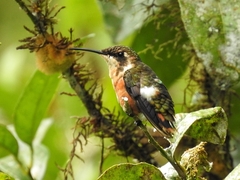
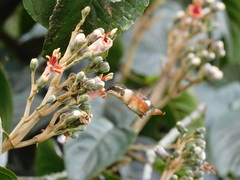
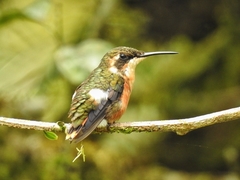
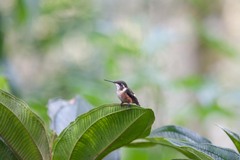
The white-bellied woodstar (Chaetocercus mulsant) is a species of hummingbird in tribe Mellisugini of subfamily Trochilinae, the "bee hummingbirds". It is found in Bolivia, Colombia, Ecuador, and Peru. The white-bellied woodstar and several other species in genus Chaetocercus were formerly placed in genus Acestrura but have been in their current position since the late 20th century. The species is monotypic.

The white-bellied woodstar is about 8.5 cm (3.3 in) long and weighs about 3.8 to 4 g (0.13 to 0.14 oz). Both sexes have a straightish black bill. The male's upperparts are dark bluish green which continues onto the flanks. A downcurving white line behind the eye meets the white upper breast. Its gorget is iridescent reddish violet. The belly is white as are patches on the flanks. The forked tail is bluish green and its outermost feathers are shafts with no vanes. The female is bronzy green above. It has a grayish "mask" and a buff stripe behind the eye. Its throat is pale cinnamon, the belly white, and the flanks tawny. Its tail is rounded; the central feathers are green and the others cinnamon with a wide black band near the end... Wikipedia →

Sounds

Flight call0:10

Ecuador · 2023

© Manuel Sánchez-Nivicela · XC1143766 · CC BY-NC-ND 4.0

Wing noise0:18

Colombia · 2020

© Jerome Fischer · XC574324 · CC BY-NC-SA 4.0

Call0:09

Ecuador · 2008

© Mitch Lysinger · XC260535 · CC BY-NC-SA 4.0

Global Distribution

Parks Where Found

# Park Country Daily sighting probability
1 Los Nevados National Natural Park 🇨🇴 Colombia
~10%
2 Chingaza National Natural Park 🇨🇴 Colombia
<5%
3 Podocarpus National Park 🇪🇨 Ecuador
<5%
4 Farallones de Cali National Natural Park 🇨🇴 Colombia
<5%
5 Manu National Park 🇵🇪 Peru
<5%

Cities Where Found

# City Country Daily sighting probability
1 Quito 🇪🇨 Ecuador
~30%
2 Bogota 🇨🇴 Colombia
~10%
3 Medellín 🇨🇴 Colombia
<5%

Before you go

What are the chances of seeing a White-bellied Woodstar in Podocarpus National Park?

Rare

Under 5% of wildlife watchers report a White-bellied Woodstar sighting in Podocarpus National Park on a given day, based on 64 verified sightings from GBIF citizen-science data from 2019 to 2026. It is the 206th most-seen of the 446 birds we can rate there. Over three days the chance rises to about 10%, and over a week to about 30%, if each day is a fresh chance.

When is the best time to see a White-bellied Woodstar in Podocarpus National Park?

April, October and December

In those months about 10% of wildlife watchers report a White-bellied Woodstar in Podocarpus National Park on a given day, against under 5% in January–March, May–September and November, the lowest months.

What time of day is best to see a White-bellied Woodstar?

Between 8 and 11 am

Across all the parks we cover, that three-hour window holds the most White-bellied Woodstar sightings with a recorded time, and about 8 in 10 of them come between 6 am and 6 pm: it is a daytime animal.

Is Podocarpus National Park the best place to see a White-bellied Woodstar?

3rd of 5

Of the 5 parks where we can rate White-bellied Woodstar sightings, Podocarpus National Park ranks 3rd at under 5%. The best odds are in Los Nevados National Natural Park (Colombia, about 10%) and Chingaza National Natural Park (Colombia, under 5%).

Where does the White-bellied Woodstar sighting chance come from?

GBIF citizen-science records

It is estimated from how often the White-bellied Woodstar is recorded against all the birds logged in Podocarpus National Park (64 verified sightings from 2019 to 2026), calibrated against known sighting rates. Figures are rounded to the nearest 10% because citizen-science data supports honest approximations, not decimals, and months with records from fewer than five people show "—". How it works.

← Back to Podocarpus National Park