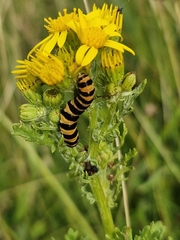
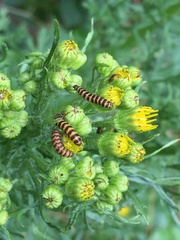
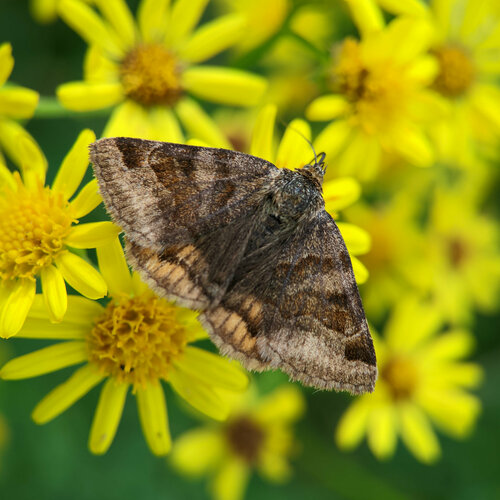
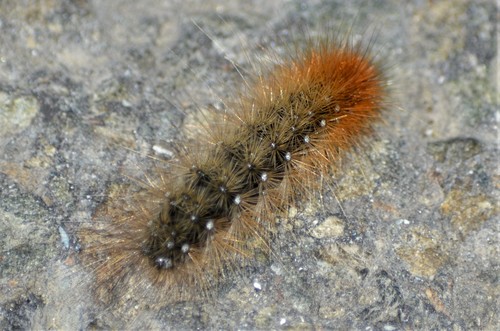
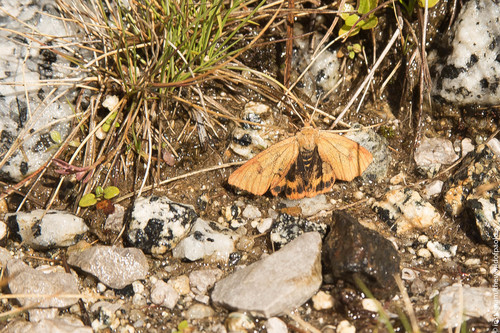
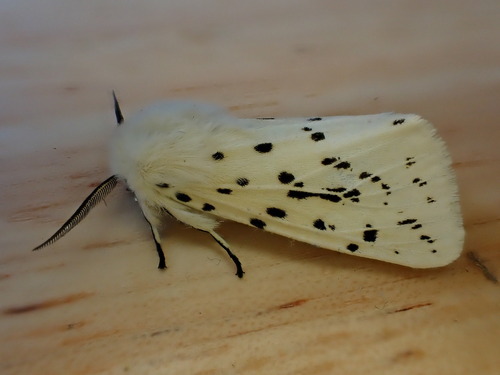
Cinnabar Moth

Cinnabar Moth

Tyria jacobaeae

Daily sighting probability ~10% · With luck
at Pyrénées National Park

In 3 days ~20% in a week ~50%

43 Verified sightings at Pyrénées National Park From 2019 to 2026
532 In all 10 parks
June Best month
☀️ Diurnal When it's spotted

About the Cinnabar Moth

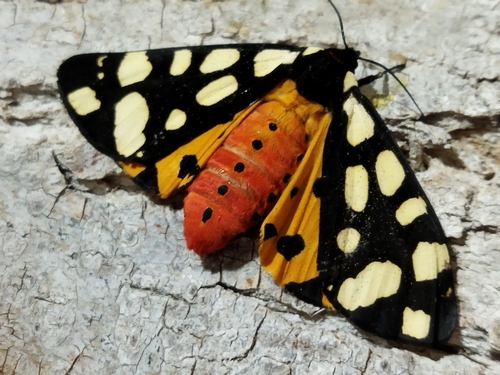
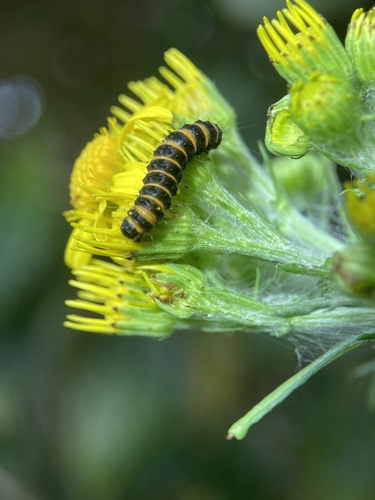
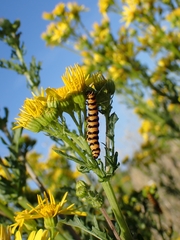
The cinnabar moth (Tyria jacobaeae) is a brightly coloured Arctiinae moth found as a native species in Europe and western and central Asia then east across the Palearctic to Siberia to China. It has been introduced into New Zealand, Australia and North America to control ragwort, on which its larvae feed, as a result of this diet the Cinnabar larvae and adult is poisonous to most of its natural predators, its red coloration acting to signal this to predators (Aposematism).

The moth is named after the red mineral cinnabar because of the red patches on its predominantly black wings. The species was first described by Carl Linnaeus in his 1758 10th edition of Systema Naturae. Cinnabar moths are about 20 mm (0.79 in) long and have a wingspan of 34–46 mm (1.3–1.8 in).

While generally nocturnal, the species is also often spotted in daylight hours. Cinnabar moths are day-flying insects with distinctive pinkish-red and black wings. There is little variation in patterning, although on rare occasions the red markings may be replaced with yellow, or the forewing is entirely red with a black border, or the wings are completely black. Like many other brightly coloured moths, it... Wikipedia →
Global Distribution

Parks Where Found

# Park Country Daily sighting probability
1 Wadden Sea National Park 🇩🇪 Germany
~20%
2 Snowdonia National Park 🇬🇧 United Kingdom
~20%
3 Cape Breton Highlands National Park 🇨🇦 Canada
~20%
4 Aigüestortes National Park 🇪🇸 Spain
~20%
5 Arthur's Pass National Park 🇳🇿 New Zealand
~20%
6 Sierra de Guadarrama National Park 🇪🇸 Spain
~20%
7 Monfragüe National Park 🇪🇸 Spain
~20%
8 Sierra Nevada National Park 🇪🇸 Spain
~10%
9 Pyrénées National Park 🇫🇷 France
~10%
10 Cévennes National Park 🇫🇷 France
<5%

Cities Where Found

# City Country Daily sighting probability
1 Liverpool 🇬🇧 United Kingdom
~40%
2 Manchester 🇬🇧 United Kingdom
~40%
3 Birmingham 🇬🇧 United Kingdom
~30%
4 London 🇬🇧 United Kingdom
~30%
5 Leeds 🇬🇧 United Kingdom
~20%
6 Essen 🇩🇪 Germany
~20%
7 Portland 🇺🇸 United States
~20%
8 Cologne 🇩🇪 Germany
~10%
9 Amsterdam 🇳🇱 Netherlands
~10%
10 Rotterdam [The Hague] 🇳🇱 Netherlands
~10%

Before you go

What are the chances of seeing a Cinnabar Moth in Pyrénées National Park?

With luck

About 10% of wildlife watchers report a Cinnabar Moth sighting in Pyrénées National Park on a given day, based on 43 verified sightings from GBIF citizen-science data from 2019 to 2026. It is the 225th most-seen of the 1277 insects we can rate there. Over three days the chance rises to about 20%, and over a week to about 50%, if each day is a fresh chance.

When is the best time to see a Cinnabar Moth in Pyrénées National Park?

May to August

In those months about 10% of wildlife watchers report a Cinnabar Moth in Pyrénées National Park on a given day, against under 5% in September to April, the lowest months.

What time of day is best to see a Cinnabar Moth?

Between 11 am and 2 pm

Across all the parks we cover, that three-hour window holds the most Cinnabar Moth sightings with a recorded time, and about 9 in 10 of them come between 6 am and 6 pm: it is a daytime animal.

Which relatives of the Cinnabar Moth live in Pyrénées National Park?

Same family: Erebidae

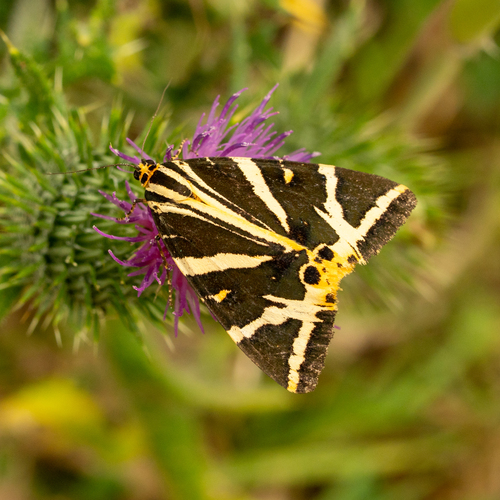
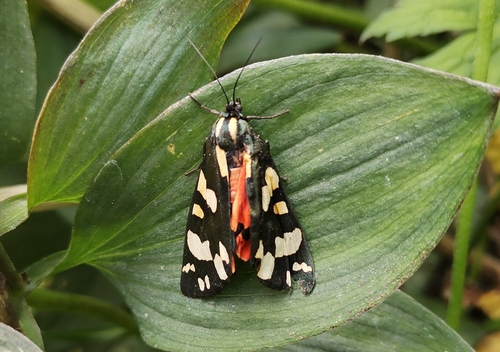
The closest relatives of the Cinnabar Moth that you can see in Pyrénées National Park (family Erebidae, Underwing, Tiger, Tussock, and Allied Moths) are Jersey Tiger (about 20%), Scarlet Tiger (about 20%) and Burnet Companion (about 10%), with each one's daily chance of a sighting.

Where does the Cinnabar Moth sighting chance come from?

GBIF citizen-science records

It is estimated from how often the Cinnabar Moth is recorded against all the insects logged in Pyrénées National Park (43 verified sightings from 2019 to 2026), calibrated against known sighting rates. Figures are rounded to the nearest 10% because citizen-science data supports honest approximations, not decimals, and months with records from fewer than five people show "—". How it works.

← Back to Pyrénées National Park