Goat Moth

Goat Moth

Cossus cossus

Daily sighting probability <5% · Rare
at Pyrénées National Park

In 3 days ~10% in a week ~30%

11 Verified sightings at Pyrénées National Park From 2019 to 2026
180 In all 10 parks
December Best month
☀️🌙 Day & Night When it's spotted

About the Goat Moth

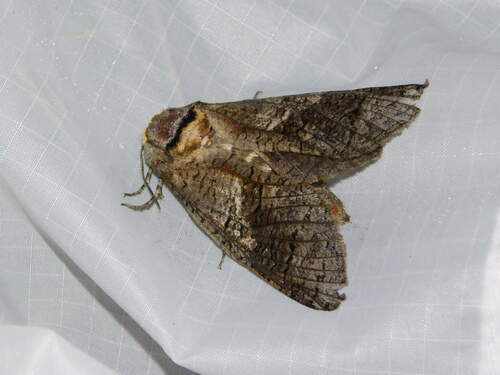
Cossus cossus, the goat moth, is a moth of the family Cossidae. It is found in Northern Africa, Asia and Europe. This is a large heavy moth with a wingspan of 68–96 mm. The wings are greyish brown and marked with fine dark cross lines. The moth flies from April to August depending on the location.

The caterpillars have a red/purple stripe across the back and a black head. They reach a length of 9–10 cm. The caterpillars feed in the trunks and branches of a wide variety of trees (see list below), taking three to five years to mature. The caterpillar holes can be found low on the stem (maximum 1.0–1.5 m above the ground). When ready to pupate the caterpillar leaves the tree to find a suitable spot.

The species prefer humid environments. Both the larva and moth have a smell reminiscent of goat, hence its name. Pliny reported in Natural History that a grub which he gives the name cossus was considered a Roman delicacy after it was fed with flour. Some writers have equated this with Cossus cossus, but Pliny specifies that his cossus is found in oak trees, which makes this identification unlikely.

It has a preference for Populus,... Wikipedia →
Global Distribution

Parks Where Found

# Park Country Daily sighting probability
1 Gauja National Park 🇱🇻 Latvia
~20%
2 Białowieża National Park 🇵🇱 Poland
~20%
3 Triglav National Park 🇸🇮 Slovenia
~10%
4 Bavarian Forest National Park 🇩🇪 Germany
~10%
5 Tatra National Park 🇸🇰 Slovakia
~10%
6 Wadden Sea National Park 🇩🇪 Germany
~10%
7 Cévennes National Park 🇫🇷 France
~10%
8 Fertő-Hanság National Park 🇭🇺 Hungary
~10%
9 Sierra de Guadarrama National Park 🇪🇸 Spain
~10%
10 Pyrénées National Park 🇫🇷 France
<5%

Cities Where Found

# City Country Daily sighting probability
1 Helsinki 🇫🇮 Finland
~20%
2 Prague 🇨🇿 Czechia
~10%
3 Stockholm 🇸🇪 Sweden
~10%
4 Vienna 🇦🇹 Austria
~10%
5 Essen 🇩🇪 Germany
~10%
6 Minsk 🇧🇾 Belarus
~10%
7 Saint Petersburg 🇷🇺 Russia
~10%
8 Nizhny Novgorod 🇷🇺 Russia
~10%
9 Berlin 🇩🇪 Germany
~10%
10 Warsaw 🇵🇱 Poland
~10%

Before you go

What are the chances of seeing a Goat Moth in Pyrénées National Park?

Rare

Under 5% of wildlife watchers report a Goat Moth sighting in Pyrénées National Park on a given day, based on 11 verified sightings from GBIF citizen-science data from 2019 to 2026. It is the 703rd most-seen of the 1277 insects we can rate there. Over three days the chance rises to about 10%, and over a week to about 30%, if each day is a fresh chance.

When is the best time to see a Goat Moth in Pyrénées National Park?

March–June, October and December

In those months about 10% of wildlife watchers report a Goat Moth in Pyrénées National Park on a given day, against under 5% in January–February, July–September and November, the lowest months.

What time of day is best to see a Goat Moth?

Between noon and 3 pm

Across all the parks we cover, that three-hour window holds the most Goat Moth sightings with a recorded time, and about 7 in 10 of them come between 6 am and 6 pm: it is seen both by day and at night.

Is Pyrénées National Park the best place to see a Goat Moth?

10th of 10

Of the 10 parks where we can rate Goat Moth sightings, Pyrénées National Park ranks 10th at under 5%. The best odds are in Gauja National Park (Latvia, about 20%), Białowieża National Park (Poland, about 20%) and Triglav National Park (Slovenia, about 10%).

Where does the Goat Moth sighting chance come from?

GBIF citizen-science records

It is estimated from how often the Goat Moth is recorded against all the insects logged in Pyrénées National Park (11 verified sightings from 2019 to 2026), calibrated against known sighting rates. Figures are rounded to the nearest 10% because citizen-science data supports honest approximations, not decimals, and months with records from fewer than five people show "—". How it works.

← Back to Pyrénées National Park