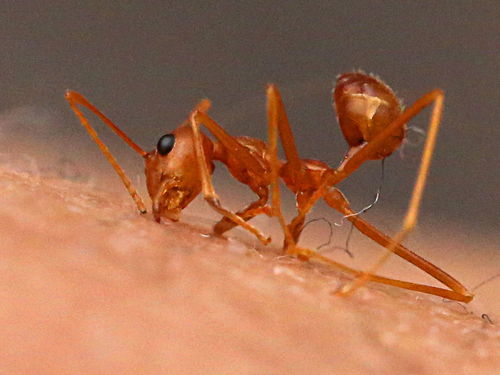
Yellow Crazy Ant

Yellow Crazy Ant

Anoplolepis gracilipes

Daily sighting probability ~20% · Possible
at Raja Ampat

In 3 days ~40% in a week ~70%

9 Verified sightings at Raja Ampat From 2019 to 2026
94 In all 9 parks
July Best month
☀️ Diurnal When it's spotted

About the Yellow Crazy Ant

The yellow crazy ant (Anoplolepis gracilipes), also known as the long-legged ant or Maldive ant, is a species of ant, thought to be native to Asia. They have been accidentally introduced to numerous places in the world's tropics.

The yellow crazy ant has colloquially been given the modifier "crazy" on account of the ant's erratic movements when disturbed. Its long legs and antennae make it one of the largest invasive ant species in the world. Like several other invasive ants, such as the red imported fire ant (Solenopsis invicta), the big-headed ant (Pheidole megacephala), the little fire ant (Wasmannia auropunctata), and the Argentine ant (Linepithema humile), the yellow crazy ant is a "tramp ant", a species that easily becomes established and dominant in new habitat due to traits such as aggression toward other ant species, little aggression toward members of its own species, efficient recruitment, and large colony size.

It is on a list of "one hundred of the world's worst invasive species" formulated by the International Union for Conservation of Nature (IUCN), having invaded ecosystems from Hawaii to the Seychelles, and formed supercolonies on Christmas Island in the Indian Ocean.

In 2023, a scientific article postulated a unique reproductive cycle for A. gracilipes, suggesting that males are obligate chimeras. Wikipedia →


Global Distribution

Parks Where Found

# Park Country Daily sighting probability
1 Cat Tien National Park 🇻🇳 Vietnam
~20%
2 Raja Ampat 🇮🇩 Indonesia
~20%
3 Taman Negara National Park 🇲🇾 Malaysia
~20%
4 Taroko National Park 🇹🇼 Taiwan
~10%
5 Minneriya National Park 🇱🇰 Sri Lanka
~10%
6 Sepilok 🇲🇾 Malaysia
~10%
7 Kinabalu Park 🇲🇾 Malaysia
~10%
8 Khao Yai National Park 🇹🇭 Thailand
~10%
9 Kaeng Krachan National Park 🇹🇭 Thailand
~10%

Cities Where Found

# City Country Daily sighting probability
1 Naha 🇯🇵 Japan
~30%
2 Yogyakarta 🇮🇩 Indonesia
~30%
3 Thiruvananthapuram 🇮🇳 India
~20%
4 Malang 🇮🇩 Indonesia
~20%
5 Kuala Lumpur 🇲🇾 Malaysia
~20%
6 Kollam 🇮🇳 India
~20%
7 Thrissur 🇮🇳 India
~20%
8 Kozhikode 🇮🇳 India
~20%
9 Tasikmalaya 🇮🇩 Indonesia
~20%
10 Colombo [Sri Jayawardenepura Kotte] 🇱🇰 Sri Lanka
~20%

Before you go

What are the chances of seeing a Yellow Crazy Ant in Raja Ampat?

Possible

About 20% of wildlife watchers report a Yellow Crazy Ant sighting in Raja Ampat on a given day, based on 9 verified sightings from GBIF citizen-science data from 2019 to 2026. It is the 21st most-seen of the 46 insects we can rate there. Over three days the chance rises to about 40%, and over a week to about 70%, if each day is a fresh chance.

When is the best time to see a Yellow Crazy Ant in Raja Ampat?

March, July and October

In those months about 30% of wildlife watchers report a Yellow Crazy Ant in Raja Ampat on a given day, against under 5% in May–June, August and November–February, the lowest months.

What time of day is best to see a Yellow Crazy Ant?

Between noon and 3 pm

Across all the parks we cover, that three-hour window holds the most Yellow Crazy Ant sightings with a recorded time, and about 8 in 10 of them come between 6 am and 6 pm: it is a daytime animal.

Is Raja Ampat the best place to see a Yellow Crazy Ant?

Among the best

Of the 9 parks where we can rate Yellow Crazy Ant sightings, Raja Ampat ranks 2nd at about 20%, level with the leaders once rounded. The best odds are in Cat Tien National Park (Vietnam, about 20%).

Where does the Yellow Crazy Ant sighting chance come from?

GBIF citizen-science records

It is estimated from how often the Yellow Crazy Ant is recorded against all the insects logged in Raja Ampat (9 verified sightings from 2019 to 2026), calibrated against known sighting rates. Figures are rounded to the nearest 10% because citizen-science data supports honest approximations, not decimals, and months with records from fewer than five people show "—". How it works.

← Back to Raja Ampat