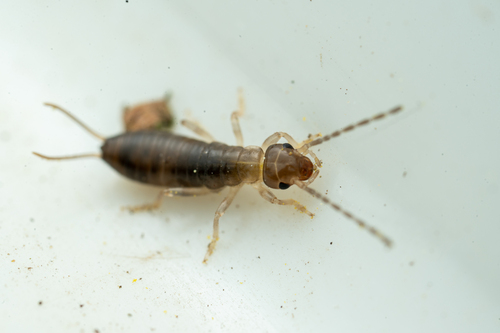
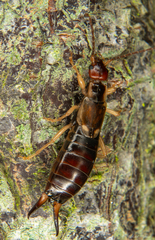
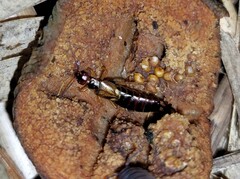
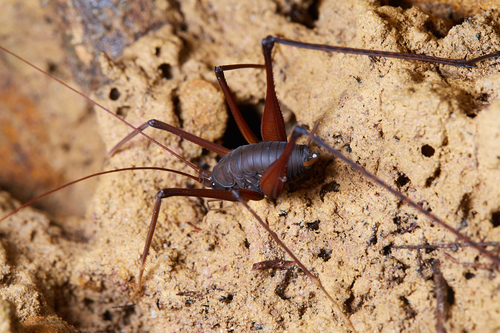

Western Earwig

Western Earwig

Forficula dentata

Daily sighting probability ~10% · With luck
at Redwood National Park

In 3 days ~20% in a week ~50%

14 Verified sightings at Redwood National Park From 2019 to 2026
111 In all 9 parks
June Best month
☀️🌙 Day & Night When it's spotted

About the Western Earwig

Forficula dentata is a species of earwig in the family Forficulidae, commonly referred to as the Western earwig or European earwig. It was first described by Danish zoologist, Johan Christian Fabricius, in 1775. It is a cryptic species belonging to the Forficula auricularia species complex. Originally thought to be a synonym of F. auricularia, it has since been classified its own unique species. Being cryptic, it is often misidentified as F. auricularia or Forficula mediterranea, which differ in their distribution.

The distribution of F. dentata includes the British Isles, parts of Western Europe, Australia, New Zealand, Chile, the Western United States and Canada. Other populations of this species include the Belarusian Central Botanic Gardens, Belarus; Newfoundland, Canada; and an individual near Gimmingen, Germany. Wikipedia →

Global Distribution

Parks Where Found

# Park Country Daily sighting probability
1 Monfragüe National Park 🇪🇸 Spain
~10%
2 Pacific Rim National Park Reserve 🇨🇦 Canada
~10%
3 Redwood National Park 🇺🇸 United States
~10%
4 Egmont National Park 🇳🇿 New Zealand
~10%
5 Channel Islands National Park 🇺🇸 United States
~10%
6 Great Bear Rainforest 🇨🇦 Canada
~10%
7 Sierra de Guadarrama National Park 🇪🇸 Spain
~10%
8 Sequoia and Kings Canyon National Parks 🇺🇸 United States
~10%
9 Olympic National Park 🇺🇸 United States
~10%

Cities Where Found

# City Country Daily sighting probability
1 Portland 🇺🇸 United States
~10%
2 Melbourne 🇦🇺 Australia
~10%
3 La Paz 🇧🇴 Bolivia
~10%
4 Madrid 🇪🇸 Spain
~10%
5 Seattle 🇺🇸 United States
~10%
6 Vancouver 🇨🇦 Canada
~10%
7 Hobart 🇦🇺 Australia
~10%
8 Auckland 🇳🇿 New Zealand
~10%
9 Santiago 🇨🇱 Chile
~10%
10 Sacramento 🇺🇸 United States
~10%

Closest Relatives at Redwood National Park

No species of the same family or order lives in Redwood National Park, so these are its closest relatives here: other insects.

Before you go

What are the chances of seeing a Western Earwig in Redwood National Park?

With luck

About 10% of wildlife watchers report a Western Earwig sighting in Redwood National Park on a given day, based on 14 verified sightings from GBIF citizen-science data from 2019 to 2026. It is the 52nd most-seen of the 101 insects we can rate there. Over three days the chance rises to about 20%, and over a week to about 50%, if each day is a fresh chance.

When is the best time to see a Western Earwig in Redwood National Park?

January and June

In those months about 20% of wildlife watchers report a Western Earwig in Redwood National Park on a given day, against under 5% in February, April and August–December, the lowest months.

What time of day is best to see a Western Earwig?

Between 1 and 4 pm

Across all the parks we cover, that three-hour window holds the most Western Earwig sightings with a recorded time, and about 6 in 10 of them come between 6 am and 6 pm: it is seen both by day and at night.

Is Redwood National Park the best place to see a Western Earwig?

Among the best

Of the 9 parks where we can rate Western Earwig sightings, Redwood National Park ranks 3rd at about 10%, level with the leaders once rounded. The best odds are in Monfragüe National Park (Spain, about 10%) and Pacific Rim National Park Reserve (Canada, about 10%).

Where does the Western Earwig sighting chance come from?

GBIF citizen-science records

It is estimated from how often the Western Earwig is recorded against all the insects logged in Redwood National Park (14 verified sightings from 2019 to 2026), calibrated against known sighting rates. Figures are rounded to the nearest 10% because citizen-science data supports honest approximations, not decimals, and months with records from fewer than five people show "—". How it works.

← Back to Redwood National Park