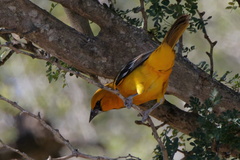
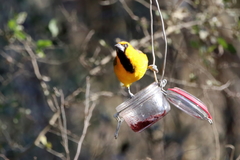
Altamira Oriole

Altamira Oriole

Icterus gularis

Silhouette: Matt Wilkins · PhyloPic

LCLeast ConcernNTVUENCR
Daily sighting probability <5% · Rare
at Ría Lagartos Biosphere Reserve

In 3 days ~10% in a week ~30%

36 Verified sightings at Ría Lagartos Biosphere Reserve From 2019 to 2026
2,377 In all 15 parks
May Best month
☀️ Diurnal When it's spotted

About the Altamira Oriole

The Altamira oriole (Icterus gularis) is a New World oriole. The bird is widespread in subtropical lowlands of the Mexican Gulf Coast and northern Central America, the Pacific coast and inland. They have since spread to southern Texas, but this was not until 1939.

At 25 cm (9.8 in) and 56 g (2.0 oz), this is the largest oriole in genus Icterus. The bird nests in open woodland, with the nest being a very long woven pouch, attached to the end of a horizontal tree branch, sometimes to telephone wires.

This bird forages high in trees, sometimes in the undergrowth. They mainly eat insects and berries. These birds are permanent residents, and unlike the migratory orioles that breed in the US, the species is sexually monomorphic—both the males and the females have elaborate coloration and patterning.

Both males and females have a black mandible and throat, as well as a black back and long black tail. Wings are black, but the remiges and rectrices (flight feathers) are fringed with white. These form a single white wing bar and white wing spots when folded. The secondary coverts form orange epaulets. The underside is almost uniformly orange or yellowish-orange. In general,... Wikipedia →

Sounds

Call0:42

Mexico · 2026

© Richard E. Webster · XC1183407 · CC BY-NC-SA 4.0

Song1:25

Mexico · 2024

© Étienne Leroy · XC956290 · CC BY-NC-SA 4.0

Llamado y canto0:14

Mexico · 2006

© Antonio Celis Murillo · XC5557 · CC BY-NC-ND 2.5

Global Distribution

Parks Where Found

# Park Country Daily sighting probability
1 Sian Ka'an Biosphere Reserve 🇲🇽 Mexico
~40%
2 Celaque National Park 🇭🇳 Honduras
~30%
3 Celestún Biosphere Reserve 🇲🇽 Mexico
~20%
4 Lago de Yojoa 🇭🇳 Honduras
~20%
5 Cañón del Sumidero National Park 🇲🇽 Mexico
~20%
6 El Triunfo 🇲🇽 Mexico
~20%
7 Calakmul Biosphere Reserve 🇲🇽 Mexico
~20%
8 La Tigra National Park 🇭🇳 Honduras
~10%
9 Cerro Azul Meámbar National Park 🇭🇳 Honduras
~10%
10 Ría Lagartos Biosphere Reserve 🇲🇽 Mexico
<5%
11 Pico Bonito National Park 🇭🇳 Honduras
<5%
12 Arrecifes de Cozumel National Park 🇲🇽 Mexico
<5%
13 Cumbres de Monterrey National Park 🇲🇽 Mexico
<5%
14 Cusuco National Park 🇭🇳 Honduras
<5%
15 Masaya Volcano National Park 🇳🇮 Nicaragua
<5%

Cities Where Found

# City Country Daily sighting probability
1 San Salvador 🇸🇻 El Salvador
~30%
2 San Pedro Sula 🇭🇳 Honduras
~20%
3 Tegucigalpa 🇭🇳 Honduras
~20%
4 Guatemala City 🇬🇹 Guatemala
<5%
5 Monterrey 🇲🇽 México
<5%
6 Managua 🇳🇮 Nicaragua
<5%
7 Mexico City 🇲🇽 México
<5%

Zoos & Centres Where Found

# Zoo / Centre Country
1 Xcaret 🇲🇽 Mexico In captivity

Before you go

What are the chances of seeing an Altamira Oriole in Ría Lagartos Biosphere Reserve?

Rare

Under 5% of wildlife watchers report an Altamira Oriole sighting in Ría Lagartos Biosphere Reserve on a given day, based on 36 verified sightings from GBIF citizen-science data from 2019 to 2026. It is the 114th most-seen of the 216 birds we can rate there. Over three days the chance rises to about 10%, and over a week to about 30%, if each day is a fresh chance.

When is the best time to see an Altamira Oriole in Ría Lagartos Biosphere Reserve?

May

In that month about 20% of wildlife watchers report an Altamira Oriole in Ría Lagartos Biosphere Reserve on a given day, against under 5% in January–March, July and September–October, the lowest months. That is one of Ría Lagartos Biosphere Reserve's driest months, with about 40 mm of rain against 150 mm in June.

What time of day is best to see an Altamira Oriole?

Between 6 and 9 am

Across all the parks we cover, that three-hour window holds the most Altamira Oriole sightings with a recorded time, and about 9 in 10 of them come between 6 am and 6 pm: it is a daytime animal.

Where does the Altamira Oriole sighting chance come from?

GBIF citizen-science records

It is estimated from how often the Altamira Oriole is recorded against all the birds logged in Ría Lagartos Biosphere Reserve (36 verified sightings from 2019 to 2026), calibrated against known sighting rates. Figures are rounded to the nearest 10% because citizen-science data supports honest approximations, not decimals, and months with records from fewer than five people show "—". How it works.

← Back to Ría Lagartos Biosphere Reserve