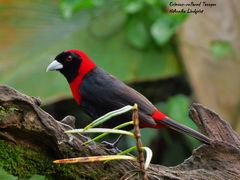
Crimson-collared Tanager

Crimson-collared Tanager

Ramphocelus sanguinolentus

Silhouette: Sheatherius · PhyloPic

LCLeast ConcernNTVUENCR
Daily sighting probability <5% · Rare
at Rincón de la Vieja National Park

In 3 days ~10% in a week ~20%

30 Verified sightings at Rincón de la Vieja National Park From 2019 to 2026
8,403 In all 15 parks
May Best month
☀️ Diurnal When it's spotted

About the Crimson-collared Tanager

The crimson-collared tanager (Ramphocelus sanguinolentus) is a species of bird in the family Thraupidae, the tanagers and allies. It is found from Mexico to Panama. The crimson-collared tanager was formally described in 1831 with the binomial Tanagra (Tachyphonus) sanguinolentus. In 1850 Charles Lucien Bonaparte transferred it to the genus Ramphocelus that had been erected in 1805. In 1873 Philip Sclater and Osbert Salvin erected the genus Phlogothraupis with sanguinolentus as its sole member. As of September 2026, the most recent lists by major taxonomic systems assign it to Bonaparte's Ramphocelus. However, it appears to be less closely related to the other members of the genus than they are to each other.

The specific epithet sanguinolentus is from the Latin sanguis, which means blood. The crimson-collared tanager is 15 to 20 cm (6 to 8 in) long and weighs 35 to 48 g (1.2 to 1.7 oz). The sexes and the subspecies have the same plumage though R. s. apricus is smaller than the nominate. Adults are mostly black... Wikipedia →

Sounds

Call0:12

Costa Rica · 2019

© Hans Matheve · XC517724 · CC BY-NC-ND 4.0

Song0:53

Guatemala · 2023

© Max Noack · XC791722 · CC BY-NC-SA 4.0

Call0:29

Costa Rica · 2017

© Yoann Blanchon · XC405385 · CC BY-NC-SA 4.0

Global Distribution

Parks Where Found

# Park Country Daily sighting probability
1 Poás Volcano National Park 🇨🇷 Costa Rica
~60%
2 Cusuco National Park 🇭🇳 Honduras
~30%
3 Cerro Azul Meámbar National Park 🇭🇳 Honduras
~30%
4 Lago de Yojoa 🇭🇳 Honduras
~20%
5 Cockscomb Basin Wildlife Sanctuary 🇧🇿 Belize
~20%
6 Arenal Volcano National Park 🇨🇷 Costa Rica
~20%
7 Tenorio Volcano National Park 🇨🇷 Costa Rica
~20%
8 Montes Azules Biosphere Reserve 🇲🇽 Mexico
~10%
9 Braulio Carrillo National Park 🇨🇷 Costa Rica
~10%
10 Tapantí-Macizo de la Muerte National Park 🇨🇷 Costa Rica
~10%
11 Monteverde Cloud Forest Reserve 🇨🇷 Costa Rica
<5%
12 Pico Bonito National Park 🇭🇳 Honduras
<5%
13 Rincón de la Vieja National Park 🇨🇷 Costa Rica
<5%
14 La Amistad International Park (Panama) 🇵🇦 Panama
<5%
15 Cañón del Sumidero National Park 🇲🇽 Mexico
<5%

Zoos & Centres Where Found

# Zoo / Centre Country
1 Aviario Nacional de Colombia 🇨🇴 Colombia In captivity
2 Ralph Perkins II Wildlife Center and Woods Garden 🇺🇸 United States In captivity

Before you go

What are the chances of seeing a Crimson-collared Tanager in Rincón de la Vieja National Park?

Rare

Under 5% of wildlife watchers report a Crimson-collared Tanager sighting in Rincón de la Vieja National Park on a given day, based on 30 verified sightings from GBIF citizen-science data from 2019 to 2026. It is the 211th most-seen of the 341 birds we can rate there. Over three days the chance rises to about 10%, and over a week to about 20%, if each day is a fresh chance.

When is the best time to see a Crimson-collared Tanager in Rincón de la Vieja National Park?

May and July

In those months about 10% of wildlife watchers report a Crimson-collared Tanager in Rincón de la Vieja National Park on a given day, against under 5% in June and August–April, the lowest months.

What time of day is best to see a Crimson-collared Tanager?

Between 6 and 9 am

Across all the parks we cover, that three-hour window holds the most Crimson-collared Tanager sightings with a recorded time, and about 9 in 10 of them come between 6 am and 6 pm: it is a daytime animal.

Where does the Crimson-collared Tanager sighting chance come from?

GBIF citizen-science records

It is estimated from how often the Crimson-collared Tanager is recorded against all the birds logged in Rincón de la Vieja National Park (30 verified sightings from 2019 to 2026), calibrated against known sighting rates. Figures are rounded to the nearest 10% because citizen-science data supports honest approximations, not decimals, and months with records from fewer than five people show "—". How it works.

← Back to Rincón de la Vieja National Park

