Long-nosed Bandicoot

Long-nosed Bandicoot

Perameles nasuta

Silhouette: Steven Traver · PhyloPic

LCLeast ConcernNTVUENCR Endemic
Daily sighting probability ~10% · With luck
at Royal National Park

In 3 days ~20% in a week ~40%

5 Verified sightings at Royal National Park From 2019 to 2026
195 In all 6 parks
September Best month
🌙 Nocturnal When it's spotted

About the Long-nosed Bandicoot

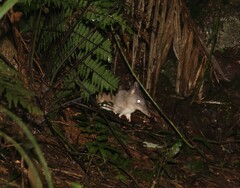
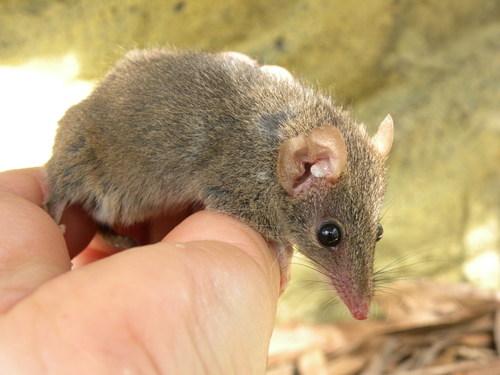
The long-nosed bandicoot (Perameles nasuta), a marsupial, is a species of bandicoot found in eastern Australia, from north Queensland along the east coast to Victoria. Around 40 centimetres (16 in) long, it is sandy- or grey-brown with a long snouty nose. Omnivorous, it forages for invertebrates, fungi and plants at night.

French naturalist Étienne Louis Geoffroy described the long-nosed bandicoot in 1804. Swiss naturalist Heinrich Rudolf Schinz described a large specimen from near Bathurst in the Blue Mountains as a new species, Perameles lawson, in 1825, though the specimen was lost at sea in shipwreck. French naturalist Pierre Boitard described Isoodon musei in 1841, both are now classified as P. nasuta.

Two subspecies are recognised: P. nasuta subspecies nasuta is found from western Victoria through eastern New South Wales and north to central Queensland, and P. nasuta subspecies pallescens, found from central Queensland through to the Cape York Peninsula.

The long-nosed bandicoot is the largest member of its genus, which also includes the eastern barred bandicoot and the western barred bandicoot. It is most closely related to the eastern barred bandicoot, the two... Wikipedia →

Sounds

Call0:29

Australia · 2021

© Marc Anderson · XC979176 · CC BY-NC-ND 4.0

Recording0:27

Australia · 2026

© Blake · iNaturalist · CC BY-NC 4.0

Recording0:09

Australia · 2023

© Reiner Richter · iNaturalist · CC BY-NC 4.0

Global Distribution

Parks Where Found

# Park Country Daily sighting probability
1 Booderee National Park 🇦🇺 Australia
~30%
2 Lamington National Park 🇦🇺 Australia
~30%
3 Springbrook National Park 🇦🇺 Australia
~30%
4 Blue Mountains National Park 🇦🇺 Australia
~10%
5 Royal National Park 🇦🇺 Australia
~10%
6 Great Otway National Park 🇦🇺 Australia
~10%

Cities Where Found

# City Country Daily sighting probability
1 Sydney 🇦🇺 Australia
~10%
2 Brisbane 🇦🇺 Australia
<5%

Closest Relatives at Royal National Park

No species of the same family or order lives in Royal National Park, so these are its closest relatives here: other mammals.

Before you go

What are the chances of seeing a Long-nosed Bandicoot in Royal National Park?

With luck

About 10% of wildlife watchers report a Long-nosed Bandicoot sighting in Royal National Park on a given day, based on 5 verified sightings from GBIF citizen-science data from 2019 to 2026. It is the 14th most-seen of the 15 mammals we can rate there. Over three days the chance rises to about 20%, and over a week to about 40%, if each day is a fresh chance.

When is the best time to see a Long-nosed Bandicoot in Royal National Park?

September

In that month about 20% of wildlife watchers report a Long-nosed Bandicoot in Royal National Park on a given day, against under 5% in March–August and October–December, the lowest months.

What time of day is best to see a Long-nosed Bandicoot?

Between 7 and 10 pm

Across all the parks we cover, that three-hour window holds the most Long-nosed Bandicoot sightings with a recorded time, and about 7 in 10 of them come between 6 pm and 6 am: it is mostly seen at night.

Is Royal National Park the best place to see a Long-nosed Bandicoot?

5th of 6

Of the 6 parks where we can rate Long-nosed Bandicoot sightings, Royal National Park ranks 5th at about 10%. The best odds are in Booderee National Park (Australia, about 30%), Lamington National Park (Australia, about 30%) and Springbrook National Park (Australia, about 30%).

Where does the Long-nosed Bandicoot sighting chance come from?

GBIF citizen-science records

It is estimated from how often the Long-nosed Bandicoot is recorded against all the mammals logged in Royal National Park (5 verified sightings from 2019 to 2026), calibrated against known sighting rates. Figures are rounded to the nearest 10% because citizen-science data supports honest approximations, not decimals, and months with records from fewer than five people show "—". How it works.

← Back to Royal National Park