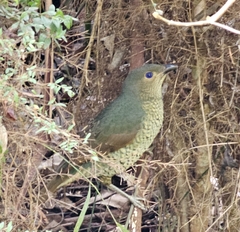
Satin Bowerbird

Satin Bowerbird

Ptilonorhynchus violaceus

Silhouette: Ferran Sayol · PhyloPic

LCLeast ConcernNTVUENCR Endemic
Daily sighting probability ~40% · Likely
at Royal National Park

In 3 days ~80% in a week >90%

1,015 Verified sightings at Royal National Park From 2019 to 2026
9,172 In all 8 parks
October Best month
☀️ Diurnal When it's spotted

About the Satin Bowerbird

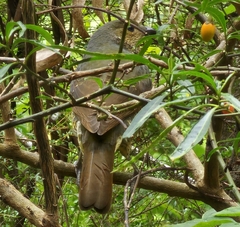
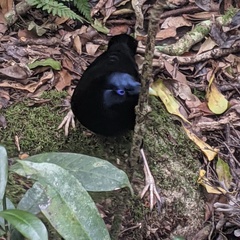
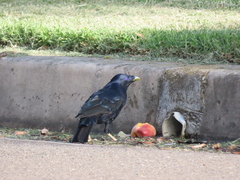
The satin bowerbird (Ptilonorhynchus violaceus) is a species of passerine bird in the bowerbird family Ptilonorhynchidae that is endemic to eastern Australia. It is the only species placed in the genus Ptilonorhynchus. The satin bowerbird was formally described in 1816 by the French ornithologist Louis Vieillot. He placed it with the choughs in the genus Pyrrhocorax and coined the binomial name Pyrrhocorax violaceus. Vieillot specified the type locality as "Nouvelle-Hollande" which is taken to be Sydney in New South Wales, Australia. The satin bowerbird is now the only species placed in the genus Ptilonorhynchus that was introduced in 1820 by German naturalist Heinrich Kuhl. He specified the type species as Ptilonorhynchus holosericeus, which is a junior synonym of Vieillot's Pyrrhocorax violaceus. The genus name Ptilonorhynchus combines the Ancient Greek πτιλον/ptilon meaning "feather" with ῥυγχος/rhunkhos meaning "bill". The specific epithet violaceus is Latin meaning "violet-coloured".

A molecular phylogenetic study published in 2020 found that the genus Ptilonorhynchus was sister to the genus Chlamydera. Two subspecies are recognised: P. v. violaceus (Vieillot,... Wikipedia →

Sounds

Call0:07

Australia · 2026

© Marc Anderson · XC1084932 · CC BY-NC-ND 4.0

Song0:22

Australia · 2023

© Marta Celej · XC854454 · CC BY-NC-SA 4.0

Alarm call0:21

Australia · 2011

© Fernand Deroussen · XC155104 · CC BY-NC-ND 3.0

Global Distribution

Parks Where Found

# Park Country Daily sighting probability
1 Lamington National Park 🇦🇺 Australia
~80%
2 Blue Mountains National Park 🇦🇺 Australia
~50%
3 Royal National Park 🇦🇺 Australia
~40%
4 Booderee National Park 🇦🇺 Australia
~30%
5 Springbrook National Park 🇦🇺 Australia
~30%
6 Kosciuszko National Park 🇦🇺 Australia
~20%
7 Great Otway National Park 🇦🇺 Australia
~20%
8 Daintree National Park 🇦🇺 Australia
<5%

Cities Where Found

# City Country Daily sighting probability
1 Sydney 🇦🇺 Australia
<5%
2 Melbourne 🇦🇺 Australia
<5%

Zoos & Centres Where Found

# Zoo / Centre Country
1 Healesville Sanctuary 🇦🇺 Australia In captivity
2 Currumbin Wildlife Sanctuary 🇦🇺 Australia In captivity
3 Melbourne Zoo 🇦🇺 Australia In captivity
4 Adelaide Zoo 🇦🇺 Australia In captivity
5 Australian Reptile Park 🇦🇺 Australia In captivity
6 Featherdale Sydney Wildlife Park 🇦🇺 Australia In captivity
7 Ipswich Nature Centre 🇦🇺 Australia In captivity
8 Sea Life Sydney Aquarium 🇦🇺 Australia In captivity
9 Wild Life Sydney 🇦🇺 Australia In captivity
10 Birdworld Kuranda 🇦🇺 Australia In captivity
11 Kuranda Koala Gardens 🇦🇺 Australia In captivity
12 Ranger Red’s Zoo & Conservation Park 🇦🇺 Australia In captivity
13 Wildlife Habitat Port Douglas 🇦🇺 Australia In captivity

Before you go

What are the chances of seeing a Satin Bowerbird in Royal National Park?

Likely

About 40% of wildlife watchers report a Satin Bowerbird sighting in Royal National Park on a given day, based on 1,015 verified sightings from GBIF citizen-science data from 2019 to 2026. It is the 22nd most-seen of the 178 birds we can rate there. Over three days the chance rises to about 80%, and over a week to over 90%, if each day is a fresh chance.

When is the best time to see a Satin Bowerbird in Royal National Park?

October

In that month about 60% of wildlife watchers report a Satin Bowerbird in Royal National Park on a given day, against about 20% in April and June, the lowest months.

What time of day is best to see a Satin Bowerbird?

Between 1 and 4 pm

Across all the parks we cover, that three-hour window holds the most Satin Bowerbird sightings with a recorded time, and nearly all of them come between 6 am and 6 pm: it is a daytime animal.

Where does the Satin Bowerbird sighting chance come from?

GBIF citizen-science records

It is estimated from how often the Satin Bowerbird is recorded against all the birds logged in Royal National Park (1,015 verified sightings from 2019 to 2026), calibrated against known sighting rates. Figures are rounded to the nearest 10% because citizen-science data supports honest approximations, not decimals, and months with records from fewer than five people show "—". How it works.

← Back to Royal National Park