Ringtail

Ringtail

Bassariscus astutus

Silhouette: Margot Michaud · PhyloPic

LCLeast ConcernNTVUENCR
Daily sighting probability ~10% · With luck
at Saguaro National Park

In 3 days ~20% in a week ~40%

13 Verified sightings at Saguaro National Park From 2019 to 2026
104 In all 7 parks
January Best month
☀️🌙 Day & Night When it's spotted

About the Ringtail

The ringtail (Bassariscus astutus) is a mammal of the raccoon family native to arid regions of North America. It is widely distributed and well-adapted to its distributed areas. It has been legally trapped for its fur. Globally, it is listed as Least Concern on the IUCN Red List but is a Conservation Strategy Species in Oregon and Fully Protected in California. The ringtail is the state mammal of Arizona.

The species is known by a variety of common names, such as ring-tailed cat, miner's cat, civet cat, and cacomistle (or cacomixtle), though as a relative of the raccoon, the ringtail is only distantly related to Feliform true cats and civets, and "cacomistle" can also refer to B. sumichrasti.

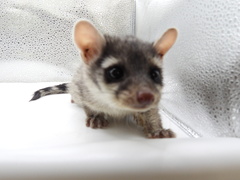
The ringtail is black to dark brown in color with pale underparts. The animal has a pointed muzzle with long whiskers, similar to that of a fox (its Latin name means 'clever little fox') and its body resembles that of a cat. The ringtail's face resembles a mask as dark brown and black hair surround its eyes.

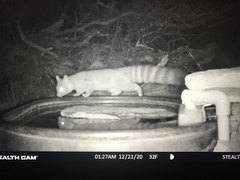
These animals are characterized by a long black and white "ringed" tail with 14–16 stripes, which is about the same length as its body. Ringtails are primarily nocturnal... Wikipedia →

Sounds

Recording0:25

Mexico · 2024

© Azucena Briones Muñoz · iNaturalist · CC BY-NC 4.0

Recording0:04

United States · 2014

russnamitz · iNaturalist · CC0

Recording0:10

United States · 2025

© taday · iNaturalist · CC BY-NC 4.0

Global Distribution

Parks Where Found

# Park Country Daily sighting probability
1 Cumbres de Monterrey National Park 🇲🇽 Mexico
~10%
2 Zion National Park 🇺🇸 United States
~10%
3 Sequoia and Kings Canyon National Parks 🇺🇸 United States
~10%
4 Big Bend National Park 🇺🇸 United States
~10%
5 Grand Canyon National Park 🇺🇸 United States
~10%
6 Saguaro National Park 🇺🇸 United States
~10%
7 Yosemite National Park 🇺🇸 United States
~10%

Cities Where Found

# City Country Daily sighting probability
1 Toluca 🇲🇽 México
~30%
2 Mexico City 🇲🇽 México
~30%
3 Puebla 🇲🇽 México
~20%
4 Austin 🇺🇸 United States
~10%
5 Monterrey 🇲🇽 México
~10%
6 Phoenix 🇺🇸 United States
<5%
7 San Antonio 🇺🇸 United States
<5%

Zoos & Centres Where Found

# Zoo / Centre Country
1 Cincinnati Zoo and Botanical Garden 🇺🇸 United States In captivity
2 Abilene Zoological Gardens 🇺🇸 United States In captivity
3 Living Desert Zoo and Gardens 🇺🇸 United States In captivity
4 Ecological Center of Sonora 🇲🇽 Mexico In captivity
5 Phoenix Zoo 🇺🇸 United States In captivity
6 Oklahoma City Zoo and Botanical Garden 🇺🇸 United States In captivity
7 Burgers' Ocean 🇳🇱 Netherlands In captivity
8 Royal Burgers' Zoo 🇳🇱 Netherlands In captivity
9 Fort Worth Zoo 🇺🇸 United States In captivity
10 Oregon Zoo 🇺🇸 United States In captivity
11 Memphis Zoo 🇺🇸 United States In captivity
12 San Antonio Zoo 🇺🇸 United States In captivity
13 Mesker Park Zoo and Botanic Garden 🇺🇸 United States In captivity
14 Chapultepec Zoo 🇲🇽 Mexico In captivity
15 Little Rock Zoo 🇺🇸 United States In captivity
16 Zoológico Los Coyotes 🇲🇽 Mexico In captivity
17 The Abilene Zoo 🇺🇸 United States In captivity
18 Stone Zoo 🇺🇸 United States In captivity
19 ZooAmerica 🇺🇸 United States In captivity
20 Big Bear Alpine Zoo 🇺🇸 United States In captivity
21 Orange County Zoo 🇺🇸 United States In captivity
22 Wonders of Wildlife Museum & Aquarium 🇺🇸 United States In captivity

Before you go

What are the chances of seeing a Ringtail in Saguaro National Park?

With luck

About 10% of wildlife watchers report a Ringtail sighting in Saguaro National Park on a given day, based on 13 verified sightings from GBIF citizen-science data from 2019 to 2026. It is the 17th most-seen of the 24 mammals we can rate there. Over three days the chance rises to about 20%, and over a week to about 40%, if each day is a fresh chance.

When is the best time to see a Ringtail in Saguaro National Park?

January–February, May, July–August and October–November

In those months about 10% of wildlife watchers report a Ringtail in Saguaro National Park on a given day, against under 5% in March–April, June, September and December, the lowest months.

What time of day is best to see a Ringtail?

Between 8 and 11 pm

Across all the parks we cover, that three-hour window holds the most Ringtail sightings with a recorded time, and about 6 in 10 of them come between 6 pm and 6 am: it is seen both by day and at night.

Which relatives of the Ringtail live in Saguaro National Park?

Same family: Procyonidae

The closest relatives of the Ringtail that you can see in Saguaro National Park (family Procyonidae, Raccoons, Coatis, and Allies) are Common Raccoon (about 10%) and White-nosed Coati (about 10%), with each one's daily chance of a sighting.

Where does the Ringtail sighting chance come from?

GBIF citizen-science records

It is estimated from how often the Ringtail is recorded against all the mammals logged in Saguaro National Park (13 verified sightings from 2019 to 2026), calibrated against known sighting rates. Figures are rounded to the nearest 10% because citizen-science data supports honest approximations, not decimals, and months with records from fewer than five people show "—". How it works.

← Back to Saguaro National Park