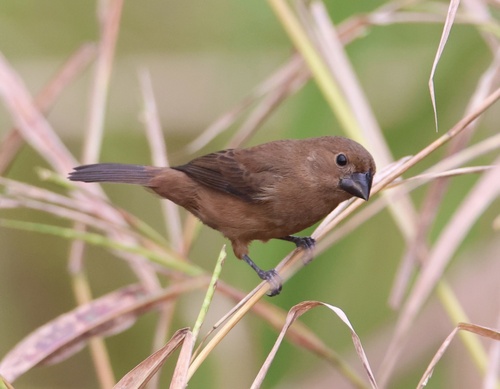
Flame-rumped Tanager

Flame-rumped Tanager

Ramphocelus flammigerus

Silhouette: Sheatherius · PhyloPic

LCLeast ConcernNTVUENCR
Daily sighting probability ~20% · Possible
at San Lorenzo Protected Forest

In 3 days ~40% in a week ~70%

40 Verified sightings at San Lorenzo Protected Forest From 2019 to 2026
4,795 In all 10 parks
June Best month
☀️ Diurnal When it's spotted

About the Flame-rumped Tanager

The flame-rumped tanager (Ramphocelus flammigerus) is a passerine bird in the family Thraupidae, the tanagers and allies. It is found from Panama to Peru. Its two subspecies have at times been treated as full species. The flame-rumped tanager was formally described in 1833 by the English naturalists William Jardine and Prideaux John Selby based on a specimen collected on "some part of the district upon the Columbia River". They assigned the binomial name Ramphopis flamigerus, whose specific epithet is a misspelling of the Latin word flammigerus meaning "flame-bearing" or "fiery". It is now one of eight species in the genus Ramphocelus that was introduced in 1805 by the French zoologist Anselme Gaëtan Desmarest.

BirdLife International's Handbook of the Birds of the World lumped the two taxa in 2024. The Clements... Wikipedia →

Sounds

Recording0:50

Colombia · 2024

© Andrés Mauricio López · XC902718 · CC BY-NC-SA 4.0

Begging call0:09

Colombia · 2018

© Jerome Fischer · XC468188 · CC BY-NC-SA 4.0

Call0:42

Colombia · 2012

© Jeremy Minns · XC101403 · CC BY-NC-ND 2.5

Global Distribution

Parks Where Found

# Park Country Daily sighting probability
1 Farallones de Cali National Natural Park 🇨🇴 Colombia
~70%
2 Utría National Natural Park 🇨🇴 Colombia
~50%
3 San Lorenzo Protected Forest 🇵🇦 Panama
~20%
4 Soberanía National Park 🇵🇦 Panama
~10%
5 Machalilla National Park 🇪🇨 Ecuador
~10%
6 Darién National Park 🇵🇦 Panama
<5%
7 Los Nevados National Natural Park 🇨🇴 Colombia
<5%
8 Chagres National Park 🇵🇦 Panama
<5%
9 Bastimentos Island National Marine Park 🇵🇦 Panama
<5%
10 La Amistad International Park (Panama) 🇵🇦 Panama
<5%

Cities Where Found

# City Country Daily sighting probability
1 Medellín 🇨🇴 Colombia
<5%
2 Cali 🇨🇴 Colombia
<5%

Zoos & Centres Where Found

# Zoo / Centre Country
1 Aviario Nacional de Colombia 🇨🇴 Colombia In captivity
2 Dallas World Aquarium 🇺🇸 United States In captivity

Before you go

What are the chances of seeing a Flame-rumped Tanager in San Lorenzo Protected Forest?

Possible

About 20% of wildlife watchers report a Flame-rumped Tanager sighting in San Lorenzo Protected Forest on a given day, based on 40 verified sightings from GBIF citizen-science data from 2019 to 2026. It is the 88th most-seen of the 249 birds we can rate there. Over three days the chance rises to about 40%, and over a week to about 70%, if each day is a fresh chance.

When is the best time to see a Flame-rumped Tanager in San Lorenzo Protected Forest?

June

In that month about 40% of wildlife watchers report a Flame-rumped Tanager in San Lorenzo Protected Forest on a given day, against under 5% in December, the lowest month.

What time of day is best to see a Flame-rumped Tanager?

Between 2 and 5 pm

Across all the parks we cover, that three-hour window holds the most Flame-rumped Tanager sightings with a recorded time, and about 9 in 10 of them come between 6 am and 6 pm: it is a daytime animal.

Is San Lorenzo Protected Forest the best place to see a Flame-rumped Tanager?

3rd of 10

Of the 10 parks where we can rate Flame-rumped Tanager sightings, San Lorenzo Protected Forest ranks 3rd at about 20%. The best odds are in Farallones de Cali National Natural Park (Colombia, about 70%) and Utría National Natural Park (Colombia, about 50%).

Where does the Flame-rumped Tanager sighting chance come from?

GBIF citizen-science records

It is estimated from how often the Flame-rumped Tanager is recorded against all the birds logged in San Lorenzo Protected Forest (40 verified sightings from 2019 to 2026), calibrated against known sighting rates. Figures are rounded to the nearest 10% because citizen-science data supports honest approximations, not decimals, and months with records from fewer than five people show "—". How it works.

← Back to San Lorenzo Protected Forest