


Large Grey Babbler

Large Grey Babbler

Turdoides malcolmi

Silhouette: Jiekun He · PhyloPic

Daily sighting probability <5% · Rare
at Satpura National Park

In 3 days ~10% in a week ~20%

30 Verified sightings at Satpura National Park From 2019 to 2026
1,874 In all 8 parks
December Best month
🌅 Crepuscular When it's spotted

About the Large Grey Babbler

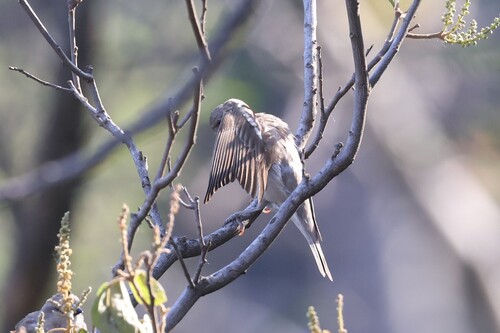
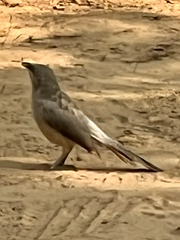
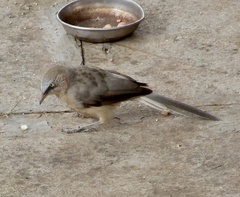
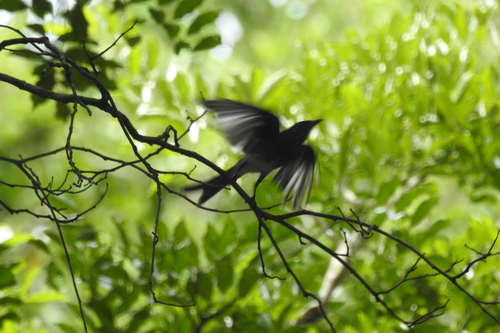
The large grey babbler (Argya malcolmi) is a member of the family Leiothrichidae found across India and far western Nepal. They are locally common in the scrub, open forest and gardenland. They are usually seen in small groups and are easily distinguished from other babblers in the region by their nasal call and the whitish outer feathers to their long tail. It is one of the largest babblers in the region.

This long-tailed and large babbler has a brown body with creamy white outer tail feathers which are easily visible as they fly with fluttery wing beats low over the ground. The lores are dark and forehead is grey with white shaft streaks on the feathers. The rump and uppertail covers are pale grey. The mantle has dusky blotches and no shaft streaks. The three outer tail feathers are white and the fourth pair has the outer web white. The wings are darker brown. The iris is yellow and the upper mandible is dark brown while the lower mandible is yellowish. The tail is faintly cross barred. Abnormal specimens showing albinism or leucism have been reported.

The species was first described from the Deccan Plateau region. The scientific name was given by Colonel W H Sykes... Wikipedia →

Sounds

Recording0:07

India · 2025

© R Sreeja · iNaturalist · CC BY 4.0

Recording0:08

India · 2024

© Nandini · iNaturalist · CC BY-NC 4.0

Recording0:12

India · 2024

© SONU KUMAR · iNaturalist · CC BY-NC 4.0

Global Distribution

Parks Where Found

# Park Country Daily sighting probability
1 Ranthambore National Park 🇮🇳 India
~40%
2 Keoladeo National Park 🇮🇳 India
~30%
3 Gir National Park 🇮🇳 India
~10%
4 Bandhavgarh National Park 🇮🇳 India
~10%
5 Bandipur National Park 🇮🇳 India
~10%
6 Kanha National Park 🇮🇳 India
~10%
7 Satpura National Park 🇮🇳 India
<5%
8 Mudumalai National Park 🇮🇳 India
<5%

Cities Where Found

# City Country Daily sighting probability
1 Jaipur 🇮🇳 India
~50%
2 Solapur 🇮🇳 India
~40%
3 Jodhpur 🇮🇳 India
~40%
4 Rajkot 🇮🇳 India
~30%
5 Gwalior 🇮🇳 India
~30%
6 Nashik 🇮🇳 India
~30%
7 Pune 🇮🇳 India
~30%
8 Indore 🇮🇳 India
~20%
9 Chhatrapati Sambhajinagar 🇮🇳 India
~10%
10 Hyderabad 🇮🇳 India
~10%

Before you go

What are the chances of seeing a Large Grey Babbler in Satpura National Park?

Rare

Under 5% of wildlife watchers report a Large Grey Babbler sighting in Satpura National Park on a given day, based on 30 verified sightings from GBIF citizen-science data from 2019 to 2026. It is the 181st most-seen of the 259 birds we can rate there. Over three days the chance rises to about 10%, and over a week to about 20%, if each day is a fresh chance.

When is the best time to see a Large Grey Babbler in Satpura National Park?

December

In that month about 10% of wildlife watchers report a Large Grey Babbler in Satpura National Park on a given day, against under 5% in January to November, the lowest months. That is one of Satpura National Park's driest months, with about 10 mm of rain against 690 mm in July.

What time of day is best to see a Large Grey Babbler?

Between 3 and 6 am

Across all the parks we cover, that three-hour window holds the most Large Grey Babbler sightings with a recorded time, and about 6 in 10 of them come between 6 pm and 6 am: it is most active around dawn and dusk.

Is Satpura National Park the best place to see a Large Grey Babbler?

7th of 8

Of the 8 parks where we can rate Large Grey Babbler sightings, Satpura National Park ranks 7th at under 5%. The best odds are in Ranthambore National Park (India, about 40%), Keoladeo National Park (India, about 30%) and Gir National Park (India, about 10%).

Where does the Large Grey Babbler sighting chance come from?

GBIF citizen-science records

It is estimated from how often the Large Grey Babbler is recorded against all the birds logged in Satpura National Park (30 verified sightings from 2019 to 2026), calibrated against known sighting rates. Figures are rounded to the nearest 10% because citizen-science data supports honest approximations, not decimals, and months with records from fewer than five people show "—". How it works.

← Back to Satpura National Park