

Rufous Treepie

Rufous Treepie

Dendrocitta vagabunda

Silhouette: Sheatherius · PhyloPic

LCLeast ConcernNTVUENCR
Daily sighting probability ~60% · Likely
at Satpura National Park

In 3 days >90%

1,058 Verified sightings at Satpura National Park From 2019 to 2026
22,678 In all 22 parks
February Best month
☀️ Diurnal When it's spotted

About the Rufous Treepie

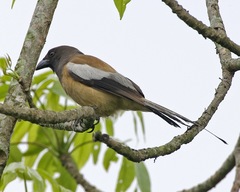
The rufous treepie (Dendrocitta vagabunda) is a treepie, native to the Indian subcontinent and adjoining parts of Southeast Asia. It is a member of the crow family, Corvidae. It is long tailed and has loud musical calls making it very conspicuous. It is found commonly in open scrub, agricultural areas, forests as well as urban gardens. Like other corvids it is very adaptable, omnivorous and opportunistic in feeding.

The sexes are alike and the main colour of the body is cinnamon with a black head and the long graduated tail is bluish grey and is tipped in black. The wing has a white patch. The only confusable species is the grey treepie which however lacks the bright rufous mantle. The bill is stout with a hooked tip. The underparts and lower back are a warm tawny-brown to orange-brown in colour with white wing coverts and black primaries. The bill, legs and feet are black.

The widespread populations show variations and several subspecies are recognized. The nominate subspecies is found in the northeastern part of peninsular India south to Hyderabad. The desert form is paler and called pallida, vernayi of the Eastern Ghats is brighter while parvula of the Western... Wikipedia →

Sounds

Call0:38

Thailand · 2025

© Jukree Sisonmak · XC1135774 · CC BY-NC-SA 4.0

Duet0:19

India · 2026

© Ding Li Yong · XC1088161 · CC BY-NC-ND 4.0

Song0:35

Thailand · 2015

© Peter Ericsson · XC239890 · CC BY-NC-SA 4.0

Global Distribution

Parks Where Found

# Park Country Daily sighting probability
1 Ranthambore National Park 🇮🇳 India
~80%
2 Kanha National Park 🇮🇳 India
~70%
3 Satpura National Park 🇮🇳 India
~60%
4 Keoladeo National Park 🇮🇳 India
~60%
5 Bandhavgarh National Park 🇮🇳 India
~60%
6 Chitwan National Park 🇳🇵 Nepal
~60%
7 Royal Bardia National Park 🇳🇵 Nepal
~60%
8 Kaziranga National Park 🇮🇳 India
~50%
9 Nagarhole National Park 🇮🇳 India
~40%
10 Periyar National Park 🇮🇳 India
~40%
11 Gir National Park 🇮🇳 India
~40%
12 Sundarbans National Park 🇮🇳 India
~40%
13 Manas National Park 🇮🇳 India
~30%
14 Bandipur National Park 🇮🇳 India
~30%
15 Mudumalai National Park 🇮🇳 India
~30%
16 Jim Corbett National Park 🇮🇳 India
~30%
17 Doi Inthanon National Park 🇹🇭 Thailand
~10%
18 Eravikulam National Park 🇮🇳 India
<5%
19 Royal Manas National Park 🇧🇹 Bhutan
<5%
20 Namdapha National Park 🇮🇳 India
<5%
21 Langtang National Park 🇳🇵 Nepal
<5%
22 Kaeng Krachan National Park 🇹🇭 Thailand
<5%

Cities Where Found

# City Country Daily sighting probability
1 Hajipur 🇮🇳 India
~80%
2 Asansol 🇮🇳 India
~80%
3 Thiruvananthapuram 🇮🇳 India
~80%
4 Bareilly 🇮🇳 India
~70%
5 Tamluk 🇮🇳 India
~70%
6 Jaipur 🇮🇳 India
~70%
7 Patna 🇮🇳 India
~60%
8 Thrissur 🇮🇳 India
~60%
9 Madurai 🇮🇳 India
~60%
10 Kollam 🇮🇳 India
~60%

Zoos & Centres Where Found

# Zoo / Centre Country
1 Aquaelegance 🇮🇳 India In captivity

Before you go

What are the chances of seeing a Rufous Treepie in Satpura National Park?

Likely

About 60% of wildlife watchers report a Rufous Treepie sighting in Satpura National Park on a given day, based on 1,058 verified sightings from GBIF citizen-science data from 2019 to 2026. It is the 2nd most-seen of the 259 birds we can rate there. Over three days the chance rises to over 90%, if each day is a fresh chance.

When is the best time to see a Rufous Treepie in Satpura National Park?

February

In that month about 80% of wildlife watchers report a Rufous Treepie in Satpura National Park on a given day, against about 40% in June, the lowest month. That is one of Satpura National Park's driest months, with about 10 mm of rain against 690 mm in July.

What time of day is best to see a Rufous Treepie?

Between 8 and 11 am

Across all the parks we cover, that three-hour window holds the most Rufous Treepie sightings with a recorded time, and about 9 in 10 of them come between 6 am and 6 pm: it is a daytime animal.

Is Satpura National Park the best place to see a Rufous Treepie?

3rd of 22

Of the 22 parks where we can rate Rufous Treepie sightings, Satpura National Park ranks 3rd at about 60%. The best odds are in Ranthambore National Park (India, about 80%) and Kanha National Park (India, about 70%). All parks ranked.

Which relatives of the Rufous Treepie live in Satpura National Park?

Same family: Corvidae

The closest relatives of the Rufous Treepie that you can see in Satpura National Park (family Corvidae, Crows, Jays, and Magpies) are Large-billed Crow (about 30%) and House Crow (about 10%), with each one's daily chance of a sighting.

Where does the Rufous Treepie sighting chance come from?

GBIF citizen-science records

It is estimated from how often the Rufous Treepie is recorded against all the birds logged in Satpura National Park (1,058 verified sightings from 2019 to 2026), calibrated against known sighting rates. Figures are rounded to the nearest 10% because citizen-science data supports honest approximations, not decimals, and months with records from fewer than five people show "—". How it works.

← Back to Satpura National Park