

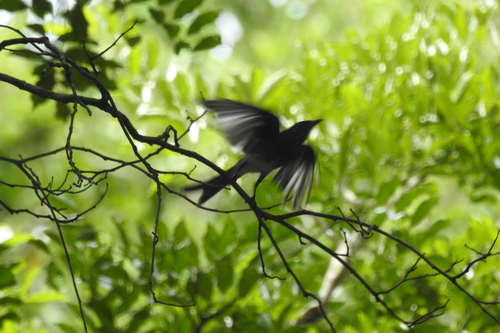
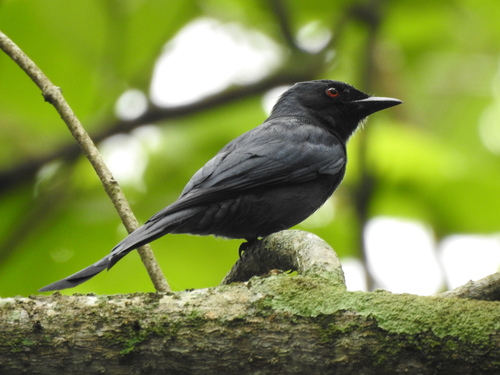
Greater Racket-tailed Drongo

Greater Racket-tailed Drongo

Dicrurus paradiseus

Silhouette: Rohit N · PhyloPic

LCLeast ConcernNTVUENCR
Daily sighting probability ~50% · Likely
at Satpura National Park

In 3 days ~80% in a week >90%

617 Verified sightings at Satpura National Park From 2019 to 2026
27,376 In all 35 parks
May Best month
🌅 Crepuscular When it's spotted

About the Greater Racket-tailed Drongo

The greater racket-tailed drongo (Dicrurus paradiseus) is a medium-sized Asian bird which is distinctive in having elongated outer tail feathers with webbing restricted to the tips. They are placed along with other drongos in the family Dicruridae. They are conspicuous in the forest habitats often perching in the open and by attracting attention with a wide range of loud calls that include perfect imitations of many other birds. One hypothesis suggested is that these vocal imitations may help in the formation of mixed-species foraging flocks, a feature seen in forest bird communities where many insect feeders forage together. These drongos will sometimes steal insect prey caught or disturbed by other foragers in the flock and another idea is that vocal mimicry helps them in diverting the attention of smaller birds to aid their piracy. They are diurnal but are active well before dawn and late at dusk. Owing to their widespread distribution and distinctive regional variation, they have become iconic examples of speciation by isolation and genetic drift.

In 1760 the French zoologist Mathurin Jacques Brisson included a description of the greater racket-tailed drongo in his... Wikipedia →

Sounds

Call0:58

Vietnam · 2026

© Ding Li Yong · XC1107613 · CC BY-NC-ND 4.0

Song0:28

Malaysia · 2025

© Étienne Leroy · XC1076675 · CC BY-NC-SA 4.0

Alarm call0:08

India · 2016

© Yogesh Patel · XC303710 · CC BY-NC-SA 4.0

Global Distribution

Parks Where Found

# Park Country Daily sighting probability
1 Periyar National Park 🇮🇳 India
~80%
2 Cat Tien National Park 🇻🇳 Vietnam
~70%
3 Kanha National Park 🇮🇳 India
~70%
4 Way Kambas National Park 🇮🇩 Indonesia
~70%
5 Bandhavgarh National Park 🇮🇳 India
~60%
6 Nagarhole National Park 🇮🇳 India
~60%
7 Kaeng Krachan National Park 🇹🇭 Thailand
~50%
8 Taman Negara National Park 🇲🇾 Malaysia
~50%
9 Sepilok 🇲🇾 Malaysia
~50%
10 Satpura National Park 🇮🇳 India
~50%
11 Khao Luang National Park 🇹🇭 Thailand
~40%
12 Royal Bardia National Park 🇳🇵 Nepal
~40%
13 Khao Yai National Park 🇹🇭 Thailand
~40%
14 Bako National Park 🇲🇾 Malaysia
~40%
15 Namdapha National Park 🇮🇳 India
~30%
16 Gunung Leuser National Park 🇮🇩 Indonesia
~20%
17 Bandipur National Park 🇮🇳 India
~20%
18 Tanjung Puting National Park 🇮🇩 Indonesia
~20%
19 Doi Inthanon National Park 🇹🇭 Thailand
~20%
20 Royal Manas National Park 🇧🇹 Bhutan
~20%
21 Manas National Park 🇮🇳 India
~20%
22 Danum Valley Conservation Area 🇲🇾 Malaysia
~20%
23 Mudumalai National Park 🇮🇳 India
~20%
24 Chitwan National Park 🇳🇵 Nepal
~20%
25 Cuc Phuong National Park 🇻🇳 Vietnam
~10%
26 Kinabatangan Wildlife Sanctuary 🇲🇾 Malaysia
~10%
27 Kaziranga National Park 🇮🇳 India
~10%
28 Bali Barat National Park 🇮🇩 Indonesia
~10%
29 Eravikulam National Park 🇮🇳 India
~10%
30 Khao Sok National Park 🇹🇭 Thailand
<5%
31 Yala National Park 🇱🇰 Sri Lanka
<5%
32 Kinabalu Park 🇲🇾 Malaysia
<5%
33 Wilpattu National Park 🇱🇰 Sri Lanka
<5%
34 Jim Corbett National Park 🇮🇳 India
<5%
35 Minneriya National Park 🇱🇰 Sri Lanka
<5%

Cities Where Found

# City Country Daily sighting probability
1 Thrissur 🇮🇳 India
~50%
2 Kozhikode 🇮🇳 India
~40%
3 Kochi 🇮🇳 India
~30%
4 Kuala Lumpur 🇲🇾 Malaysia
~30%
5 Singapore 🇸🇬 Singapore
~30%
6 Kollam 🇮🇳 India
~10%
7 Ponnani 🇮🇳 India
~10%
8 Bangkok 🇹🇭 Thailand
~10%
9 Coimbatore 🇮🇳 India
<5%
10 Thiruvananthapuram 🇮🇳 India
<5%

Zoos & Centres Where Found

# Zoo / Centre Country
1 San Diego Zoo 🇺🇸 United States In captivity
2 Bird Paradise 🇸🇬 Singapore In captivity
3 Rainforest Wild Asia 🇸🇬 Singapore In captivity

Before you go

What are the chances of seeing a Greater Racket-tailed Drongo in Satpura National Park?

Likely

About 50% of wildlife watchers report a Greater Racket-tailed Drongo sighting in Satpura National Park on a given day, based on 617 verified sightings from GBIF citizen-science data from 2019 to 2026. It is the 11th most-seen of the 259 birds we can rate there. Over three days the chance rises to about 80%, and over a week to over 90%, if each day is a fresh chance.

When is the best time to see a Greater Racket-tailed Drongo in Satpura National Park?

February and May

In those months about 60% of wildlife watchers report a Greater Racket-tailed Drongo in Satpura National Park on a given day, against about 10% in August, the lowest month. Those are among Satpura National Park's driest months, with about 10 mm of rain a month against 690 mm in July.

What time of day is best to see a Greater Racket-tailed Drongo?

Between 3 and 6 am

Across all the parks we cover, that three-hour window holds the most Greater Racket-tailed Drongo sightings with a recorded time, and about half of them come between 6 pm and 6 am: it is most active around dawn and dusk.

Which relatives of the Greater Racket-tailed Drongo live in Satpura National Park?

Same genus: Dicrurus

The closest relatives of the Greater Racket-tailed Drongo that you can see in Satpura National Park (genus Dicrurus, Drongos) are Black Drongo (about 60%), White-bellied Drongo (about 40%) and Ashy Drongo (about 10%), with each one's daily chance of a sighting.

Where does the Greater Racket-tailed Drongo sighting chance come from?

GBIF citizen-science records

It is estimated from how often the Greater Racket-tailed Drongo is recorded against all the birds logged in Satpura National Park (617 verified sightings from 2019 to 2026), calibrated against known sighting rates. Figures are rounded to the nearest 10% because citizen-science data supports honest approximations, not decimals, and months with records from fewer than five people show "—". How it works.

← Back to Satpura National Park