Striped Racer

Striped Racer

Masticophis lateralis

Silhouette: Alex Slavenko · PhyloPic

LCLeast ConcernNTVUENCR Endemic
Daily sighting probability ~10% · With luck
at Sequoia and Kings Canyon National Parks

In 3 days ~30% in a week ~60%

11 Verified sightings at Sequoia and Kings Canyon National Parks From 2019 to 2026
30 In all 3 parks
June Best month
☀️ Diurnal When it's spotted

About the Striped Racer

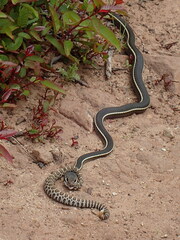
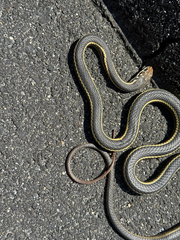
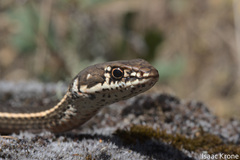
The California whipsnake (Masticophis lateralis), also known as the striped racer, is a colubrid snake found in habitats of the coast, desert, and foothills of California. As with many species and subspecies, taxonomic reclassification is an ongoing process, and differing sources often disagree. The genus Masticophis may soon be absorbed by the closely related genus Coluber, which contains the racer (Coluber constrictor).

The chaparral whipsnake is a common subspecies in California and northern Baja California, Mexico. The subspecies is often associated with broken (variable) habitat types that range from northwestern to extreme southern California and further south into Northwestern Mexico.

The Alameda whipsnake subspecies is endemic to California. The subspecies is considered threatened there. Its range is relatively small, and much of the subspecies' habitat is threatened by development. It was first collected by Archie Mossman and later described by Riemer in 1954. The Alameda Whipsnake is a threatened... Wikipedia →

Sounds

Recording0:31

United States · 2015

© illiad669s · iNaturalist · CC BY-NC 4.0

Global Distribution

Parks Where Found

# Park Country Daily sighting probability
1 Sequoia and Kings Canyon National Parks 🇺🇸 United States
~10%
2 Joshua Tree National Park 🇺🇸 United States
~10%
3 Yosemite National Park 🇺🇸 United States
~10%

Cities Where Found

# City Country Daily sighting probability
1 San Diego 🇺🇸 United States
~10%
2 Los Angeles 🇺🇸 United States
~10%

Closest Relatives at Sequoia and Kings Canyon National Parks

Before you go

What are the chances of seeing a Striped Racer in Sequoia and Kings Canyon National Parks?

With luck

About 10% of wildlife watchers report a Striped Racer sighting in Sequoia and Kings Canyon National Parks on a given day, based on 11 verified sightings from GBIF citizen-science data from 2019 to 2026. It is the 14th most-seen of the 17 reptiles we can rate there. Over three days the chance rises to about 30%, and over a week to about 60%, if each day is a fresh chance.

When is the best time to see a Striped Racer in Sequoia and Kings Canyon National Parks?

April and June

In those months about 20% of wildlife watchers report a Striped Racer in Sequoia and Kings Canyon National Parks on a given day, against under 5% in July and October–March, the lowest months. Those are among Sequoia and Kings Canyon National Parks's driest months, with about 40 mm of rain a month against 190 mm in January.

What time of day is best to see a Striped Racer?

Between 10 am and 1 pm

Across all the parks we cover, that three-hour window holds the most Striped Racer sightings with a recorded time, and about 9 in 10 of them come between 6 am and 6 pm: it is a daytime animal.

Is Sequoia and Kings Canyon National Parks the best place to see a Striped Racer?

Yes

Of the 3 parks where we can rate Striped Racer sightings, Sequoia and Kings Canyon National Parks has the highest daily chance: about 10%. Next come Joshua Tree National Park (United States, about 10%) and Yosemite National Park (United States, about 10%).

Where does the Striped Racer sighting chance come from?

GBIF citizen-science records

It is estimated from how often the Striped Racer is recorded against all the reptiles logged in Sequoia and Kings Canyon National Parks (11 verified sightings from 2019 to 2026), calibrated against known sighting rates. Figures are rounded to the nearest 10% because citizen-science data supports honest approximations, not decimals, and months with records from fewer than five people show "—". How it works.

← Back to Sequoia and Kings Canyon National Parks