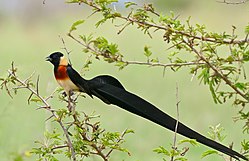

Long-tailed Paradise Whydah

Long-tailed Paradise Whydah

Vidua paradisaea

Silhouette: Sheatherius · PhyloPic

LCLeast ConcernNTVUENCR
Daily sighting probability ~10% · With luck
at Serengeti National Park

In 3 days ~20% in a week ~40%

225 Verified sightings at Serengeti National Park From 2019 to 2026
3,037 In all 29 parks
April Best month
☀️ Diurnal When it's spotted

About the Long-tailed Paradise Whydah

The long-tailed paradise whydah or eastern paradise whydah (Vidua paradisaea) is a bird in the family Viduidae of the order Passeriformes. It is a small passerine with a short, stubby bill, found across eastern and southern Africa from Ethiopia south to South Africa and west to Angola. It is mostly granivorous, and feed on seeds that have ripened and fallen on the ground. The ability to distinguish between males and females is quite difficult unless it is breeding season. During this time, the males moult into breeding plumage where they have a distinctive long tail. This can be up to three times longer than its own body or even more. Males are able to mimic songs where females can use that to discover their mate. However, there are some cases where females don't use songs to choose their mate but they use either male characteristics like plumage or they can have a shortage of options with song mimicry. Paradise whydahs are brood parasites. They do not destroy the host eggs that are originally there, but lay their own eggs alogside in the other bird's nest. Overall, these whydahs are considered least concern, based on the IUCN Red List of threatened species. Wikipedia →

Sounds

Wing noise0:06

Ethiopia · 2014

© Andrew Spencer · XC278217 · CC BY-NC-ND 4.0

Song0:18

Ethiopia · 2018

© Pritam Baruah · XC445054 · CC BY-NC-SA 4.0

Song0:15

South Africa · 2013

© Peter Boesman · XC280833 · CC BY-NC-ND 4.0

Global Distribution

Parks Where Found

# Park Country Daily sighting probability
1 Tsavo East National Park 🇰🇪 Kenya
~30%
2 Tsavo West National Park 🇰🇪 Kenya
~30%
3 Mkomazi National Park 🇹🇿 Tanzania
~30%
4 Awash National Park 🇪🇹 Ethiopia
~20%
5 Meru National Park 🇰🇪 Kenya
~20%
6 Ruaha National Park 🇹🇿 Tanzania
~20%
7 uMkhuze Game Reserve 🇿🇦 South Africa
~10%
8 Kruger National Park 🇿🇦 South Africa
~10%
9 South Luangwa National Park 🇿🇲 Zambia
~10%
10 Gonarezhou National Park 🇿🇼 Zimbabwe
~10%
11 Mana Pools National Park 🇿🇼 Zimbabwe
~10%
12 Tarangire National Park 🇹🇿 Tanzania
~10%
13 Lake Manyara National Park 🇹🇿 Tanzania
~10%
14 Mikumi National Park 🇹🇿 Tanzania
~10%
15 Hluhluwe-Imfolozi Park 🇿🇦 South Africa
~10%
16 Chobe National Park 🇧🇼 Botswana
~10%
17 Serengeti National Park 🇹🇿 Tanzania
~10%
18 Liwonde National Park 🇲🇼 Malawi
~10%
19 Waterberg Plateau Park 🇳🇦 Namibia
<5%
20 Lower Zambezi National Park 🇿🇲 Zambia
<5%
21 Kidepo Valley National Park 🇺🇬 Uganda
<5%
22 Etosha National Park 🇳🇦 Namibia
<5%
23 Samburu National Reserve 🇰🇪 Kenya
<5%
24 Kafue National Park 🇿🇲 Zambia
<5%
25 Hwange National Park 🇿🇼 Zimbabwe
<5%
26 Moremi Game Reserve 🇧🇼 Botswana
<5%
27 Ngorongoro Conservation Area 🇹🇿 Tanzania
<5%
28 Pilanesberg National Park 🇿🇦 South Africa
<5%
29 Amboseli National Park 🇰🇪 Kenya
<5%

Zoos & Centres Where Found

# Zoo / Centre Country
1 Brookfield Zoo 🇺🇸 United States In captivity
2 Memphis Zoo 🇺🇸 United States In captivity
3 Schönbrunn Zoo 🇦🇹 Austria In captivity
4 National Aviary 🇺🇸 United States In captivity
5 Bird Kingdom 🇨🇦 Canada In captivity
6 Bloedel Conservatory 🇨🇦 Canada In captivity

Before you go

What are the chances of seeing a Long-tailed Paradise Whydah in Serengeti National Park?

With luck

About 10% of wildlife watchers report a Long-tailed Paradise Whydah sighting in Serengeti National Park on a given day, based on 225 verified sightings from GBIF citizen-science data from 2019 to 2026. It is the 209th most-seen of the 469 birds we can rate there. Over three days the chance rises to about 20%, and over a week to about 40%, if each day is a fresh chance.

When is the best time to see a Long-tailed Paradise Whydah in Serengeti National Park?

April

In that month about 20% of wildlife watchers report a Long-tailed Paradise Whydah in Serengeti National Park on a given day, against under 5% in May to November, the lowest months. That is one of Serengeti National Park's wettest months, with about 140 mm of rain against 5 mm in July.

What time of day is best to see a Long-tailed Paradise Whydah?

Between 7 and 10 am

Across all the parks we cover, that three-hour window holds the most Long-tailed Paradise Whydah sightings with a recorded time, and about 9 in 10 of them come between 6 am and 6 pm: it is a daytime animal.

Is Serengeti National Park the best place to see a Long-tailed Paradise Whydah?

17th of 29

Of the 29 parks where we can rate Long-tailed Paradise Whydah sightings, Serengeti National Park ranks 17th at about 10%. The best odds are in Tsavo East National Park (Kenya, about 30%), Tsavo West National Park (Kenya, about 30%) and Mkomazi National Park (Tanzania, about 30%).

Which relatives of the Long-tailed Paradise Whydah live in Serengeti National Park?

Same genus: Vidua

The closest relatives of the Long-tailed Paradise Whydah that you can see in Serengeti National Park (genus Vidua, Indigobirds and Whydahs) are Pin-tailed Whydah (about 20%), Steel-blue Whydah (about 20%) and Straw-tailed Whydah (about 10%), with each one's daily chance of a sighting.

Where does the Long-tailed Paradise Whydah sighting chance come from?

GBIF citizen-science records

It is estimated from how often the Long-tailed Paradise Whydah is recorded against all the birds logged in Serengeti National Park (225 verified sightings from 2019 to 2026), calibrated against known sighting rates. Figures are rounded to the nearest 10% because citizen-science data supports honest approximations, not decimals, and months with records from fewer than five people show "—". How it works.

← Back to Serengeti National Park