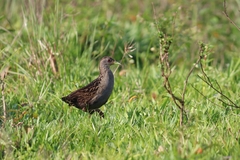
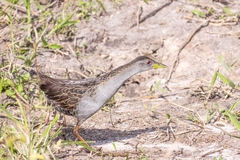
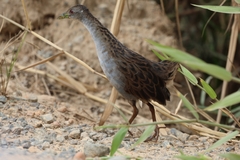
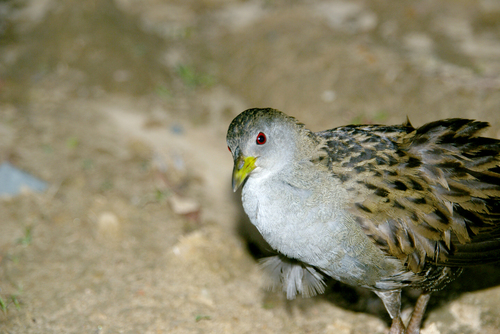
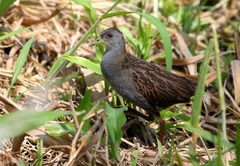
Ash-throated Crake

Ash-throated Crake

Porzana albicollis

Silhouette: T. Michael Keesey (vectorization) and HuttyMcphoo (photography) · PhyloPic

LCLeast ConcernNTVUENCR
Daily sighting probability <5% · Rare
at Serra da Canastra National Park

In 3 days ~10% in a week ~20%

16 Verified sightings at Serra da Canastra National Park From 2019 to 2026
387 In all 9 parks
September Best month
☀️ Diurnal When it's spotted

About the Ash-throated Crake

The ash-throated crake (Mustelirallus albicollis) is a species of bird in the subfamily Rallinae of the rail, crake, and coot family Rallidae. It is found in every mainland South American country except Chile. The taxonomy of genus Mustelirallus and that of the ash-throated crake in particular have not been settled. The International Ornithological Committee (IOC), the South American Classification Committee of the American Ornithological Society (SACC), and the Clements taxonomy moved the species from genus Porzana in 2015. The SACC and Clements also moved the Colombian crake and paint-billed crake from genus Neocrex to Mustelirallus while the IOC retains them in Neocrex. In addition, BirdLife International's Handbook of the Birds of the World (HBW) retains the ash-throated crake in Porzana and the other two in Neocrex.

This article uses the IOC/SACC/Clements genus. The SACC does not include subspecies in its published list. The ash-throated crake is 21 to 24 cm (8.3 to 9.4 in) long and weighs 90 to 120 g... Wikipedia →

Sounds

Recording0:14

Brazil · 2023

© eduardovieira17 · iNaturalist · CC BY-NC 4.0

Recording0:19

Brazil · 2024

© Gabriel lima · iNaturalist · CC BY-NC 4.0

Recording0:08

Brazil · 2021

© Lucas Moreira · iNaturalist · CC BY-NC 4.0

Global Distribution

Parks Where Found

# Park Country Daily sighting probability
1 Iberá National Park 🇦🇷 Argentina
~10%
2 Emas National Park 🇧🇷 Brazil
~10%
3 Serra dos Órgãos National Park 🇧🇷 Brazil
<5%
4 Serra da Canastra National Park 🇧🇷 Brazil
<5%
5 Chapada Diamantina National Park 🇧🇷 Brazil
<5%
6 Iguazú National Park 🇦🇷 Argentina
<5%
7 Chapada dos Guimarães National Park 🇧🇷 Brazil
<5%
8 Iguaçu National Park 🇧🇷 Brazil
<5%
9 Itatiaia National Park 🇧🇷 Brazil
<5%

Cities Where Found

# City Country Daily sighting probability
1 Curitiba 🇧🇷 Brazil
<5%
2 São Paulo 🇧🇷 Brazil
<5%
3 Asuncion 🇵🇾 Paraguay
<5%
4 Rio de Janeiro 🇧🇷 Brazil
<5%

Before you go

What are the chances of seeing an Ash-throated Crake in Serra da Canastra National Park?

Rare

Under 5% of wildlife watchers report an Ash-throated Crake sighting in Serra da Canastra National Park on a given day, based on 16 verified sightings from GBIF citizen-science data from 2019 to 2026. It is the 220th most-seen of the 294 birds we can rate there. Over three days the chance rises to about 10%, and over a week to about 20%, if each day is a fresh chance.

When is the best time to see an Ash-throated Crake in Serra da Canastra National Park?

April, September and November

In those months about 10% of wildlife watchers report an Ash-throated Crake in Serra da Canastra National Park on a given day, against under 5% in May–August, October and December–March, the lowest months.

What time of day is best to see an Ash-throated Crake?

Between 7 and 10 am

Across all the parks we cover, that three-hour window holds the most Ash-throated Crake sightings with a recorded time, and about 8 in 10 of them come between 6 am and 6 pm: it is a daytime animal.

Is Serra da Canastra National Park the best place to see an Ash-throated Crake?

4th of 9

Of the 9 parks where we can rate Ash-throated Crake sightings, Serra da Canastra National Park ranks 4th at under 5%. The best odds are in Iberá National Park (Argentina, about 10%), Emas National Park (Brazil, about 10%) and Serra dos Órgãos National Park (Brazil, under 5%).

Where does the Ash-throated Crake sighting chance come from?

GBIF citizen-science records

It is estimated from how often the Ash-throated Crake is recorded against all the birds logged in Serra da Canastra National Park (16 verified sightings from 2019 to 2026), calibrated against known sighting rates. Figures are rounded to the nearest 10% because citizen-science data supports honest approximations, not decimals, and months with records from fewer than five people show "—". How it works.
← Back to Serra da Canastra National Park