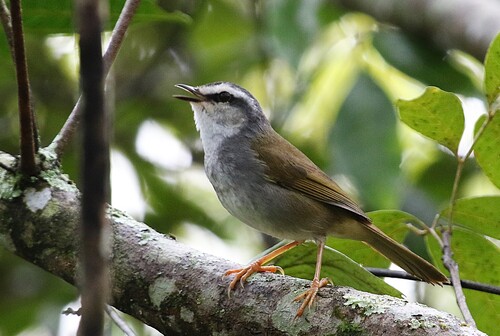

Flavescent Warbler

Flavescent Warbler

Myiothlypis flaveola

Silhouette: Andy Wilson · PhyloPic

LCLeast ConcernNTVUENCR
Daily sighting probability ~20% · Possible
at Serra da Canastra National Park

In 3 days ~40% in a week ~70%

89 Verified sightings at Serra da Canastra National Park From 2019 to 2026
685 In all 7 parks
March Best month
☀️ Diurnal When it's spotted

About the Flavescent Warbler

The flavescent warbler (Myiothlypis flaveola) is a species of bird in the family Parulidae, the New World warblers. It is found in Argentina, Bolivia, Brazil, Colombia, Guyana, Paraguay, and Venezuela. Its specific epithet and English name derive from the Latin flaveolus meaning yellowish.

The flavescent warbler was formally described in 1865 with its present binomial Myiothlypis flaveolus. For a time it and a few other species were placed in genus Phaeothlypis and also in Basileuterus. By 2012 the IOC had returned it to Myiothlypis. BirdLife International's Handbook of the Birds of the World (HBW) did so in 2016.

The flavescent warbler's further taxonomy is unsettled. However, HBW does not recognize M. f. pallidirostris and treats the flavescent warbler as monotypic. Some authors have suggested that M. f. pallidirostris could be a separate species.

This article follows the majority two-subspecies model. The flavescent warbler is about 14.5 cm (5.7 in) long and weighs 9 to 16 g (0.32 to... Wikipedia →

Sounds

Song0:12

Brazil · 2026

© JAYRSON ARAUJO DE OLIVEIRA · XC1164949 · CC BY-NC-SA 4.0

Call0:58

Brazil · 2022

© Dante Buzzetti · XC746765 · CC BY-NC-SA 4.0

Canto0:28

Brazil · 2013

© Caio Brito · XC427660 · CC BY-NC-SA 4.0

Global Distribution

Parks Where Found

# Park Country Daily sighting probability
1 Chapada Diamantina National Park 🇧🇷 Brazil
~30%
2 Chapada dos Guimarães National Park 🇧🇷 Brazil
~30%
3 Serra da Canastra National Park 🇧🇷 Brazil
~20%
4 Parque Estadual Encontro das Águas 🇧🇷 Brazil
~10%
5 Emas National Park 🇧🇷 Brazil
~10%
6 Henri Pittier National Park 🇻🇪 Venezuela
<5%
7 Amboró National Park 🇧🇴 Bolivia
<5%

Cities Where Found

# City Country Daily sighting probability
1 Campo Grande 🇧🇷 Brazil
~10%
2 Belo Horizonte 🇧🇷 Brazil
~10%
3 Campinas 🇧🇷 Brazil
~10%
4 Goiânia 🇧🇷 Brazil
<5%
5 Valencia 🇻🇪 Venezuela
<5%
6 Caracas 🇻🇪 Venezuela
<5%
7 Brasilia 🇧🇷 Brazil
<5%
8 Asuncion 🇵🇾 Paraguay
<5%

Before you go

What are the chances of seeing a Flavescent Warbler in Serra da Canastra National Park?

Possible

About 20% of wildlife watchers report a Flavescent Warbler sighting in Serra da Canastra National Park on a given day, based on 89 verified sightings from GBIF citizen-science data from 2019 to 2026. It is the 114th most-seen of the 294 birds we can rate there. Over three days the chance rises to about 40%, and over a week to about 70%, if each day is a fresh chance.

When is the best time to see a Flavescent Warbler in Serra da Canastra National Park?

March

In that month about 30% of wildlife watchers report a Flavescent Warbler in Serra da Canastra National Park on a given day, against about 10% in April, June–July, September and December–January, the lowest months.

What time of day is best to see a Flavescent Warbler?

Between 8 and 11 am

Across all the parks we cover, that three-hour window holds the most Flavescent Warbler sightings with a recorded time, and about 9 in 10 of them come between 6 am and 6 pm: it is a daytime animal.

Is Serra da Canastra National Park the best place to see a Flavescent Warbler?

3rd of 7

Of the 7 parks where we can rate Flavescent Warbler sightings, Serra da Canastra National Park ranks 3rd at about 20%. The best odds are in Chapada Diamantina National Park (Brazil, about 30%) and Chapada dos Guimarães National Park (Brazil, about 30%).

Where does the Flavescent Warbler sighting chance come from?

GBIF citizen-science records

It is estimated from how often the Flavescent Warbler is recorded against all the birds logged in Serra da Canastra National Park (89 verified sightings from 2019 to 2026), calibrated against known sighting rates. Figures are rounded to the nearest 10% because citizen-science data supports honest approximations, not decimals, and months with records from fewer than five people show "—". How it works.

← Back to Serra da Canastra National Park