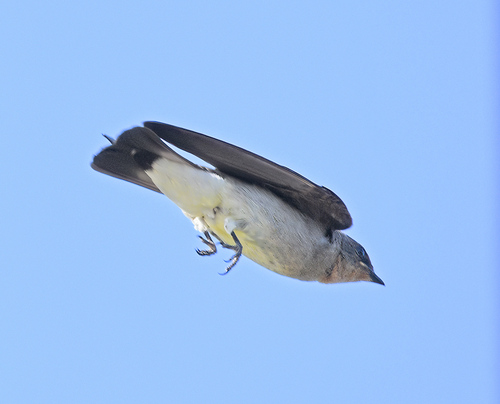
Ultramarine Grosbeak

Ultramarine Grosbeak

Cyanoloxia brissonii

Silhouette: Sheatherius · PhyloPic

LCLeast ConcernNTVUENCR
Daily sighting probability <5% · Rare
at Serra da Canastra National Park

In 3 days <5% in a week ~10%

6 Verified sightings at Serra da Canastra National Park From 2019 to 2026
783 In all 9 parks
May Best month
☀️ Diurnal When it's spotted

About the Ultramarine Grosbeak

The ultramarine grosbeak (Cyanoloxia brissonii) is a species of grosbeak in the family Cardinalidae. It is found in a wide range of semi-open habitats in eastern and central South America, with a disjunct population in northern South America.

These birds are 15 cm long. Adult males exhibit a dark-blue plumage with bright-blue highlights on the head and upper-wings and black on the face, wings and tail. The females and the juveniles are brown. Both sexes show black legs and large, thick bill.

The Ultramarine Grosbeak is sedentary, only noted to have short-distance local migrations. Individuals of this species are solitary and often territorial, rarely associating with conspecifics or loosely aggregating in mixed-species flocks.

Ultramarine Grosbeaks occur in open or semi-open edge habitats, in dense scrub such as thickets, preferably at the edge of swamps, secondary forests, and agricultural fields or plantations. The distribution of these birds is disjunct; their range extends from northeast and central Brazil to Bolivia, Paraguay, and Argentina and throughout the Gran Chaco. An isolated population can be found in southwestern Colombia... Wikipedia →

Sounds

Song0:50

Brazil · 2026

© Robson Silva e Silva · XC1084418 · CC BY-NC-SA 4.0

Recording0:26

Paraguay · 2024

© Guillermo Menéndez (gmmv80) · XC956284 · CC BY-NC-SA 4.0

Mineiro0:49

Brazil · 2023

© Jose Luiz · XC879731 · CC BY-NC-SA 4.0

Global Distribution

Parks Where Found

# Park Country Daily sighting probability
1 El Impenetrable National Park 🇦🇷 Argentina
~40%
2 El Palmar National Park 🇦🇷 Argentina
~40%
3 Chapada Diamantina National Park 🇧🇷 Brazil
~10%
4 Iberá National Park 🇦🇷 Argentina
<5%
5 Henri Pittier National Park 🇻🇪 Venezuela
<5%
6 Iguazú National Park 🇦🇷 Argentina
<5%
7 Iguaçu National Park 🇧🇷 Brazil
<5%
8 Serra da Canastra National Park 🇧🇷 Brazil
<5%
9 Itatiaia National Park 🇧🇷 Brazil
<5%

Cities Where Found

# City Country Daily sighting probability
1 Rosario 🇦🇷 Argentina
~20%
2 Buenos Aires 🇦🇷 Argentina
<5%
3 Cordoba 🇦🇷 Argentina
<5%
4 Caracas 🇻🇪 Venezuela
<5%
5 Cali 🇨🇴 Colombia
<5%

Zoos & Centres Where Found

# Zoo / Centre Country
1 Zürich Zoo 🇨🇭 Switzerland In captivity
2 Burgers' Ocean 🇳🇱 Netherlands In captivity
3 Royal Burgers' Zoo 🇳🇱 Netherlands In captivity
4 Philadelphia Zoo 🇺🇸 United States In captivity
5 London Zoo 🇬🇧 United Kingdom In captivity
6 Zoológico La Era de las aves 🇪🇸 Spain In captivity

Before you go

What are the chances of seeing an Ultramarine Grosbeak in Serra da Canastra National Park?

Rare

Under 5% of wildlife watchers report an Ultramarine Grosbeak sighting in Serra da Canastra National Park on a given day, based on 6 verified sightings from GBIF citizen-science data from 2019 to 2026. It is the 278th most-seen of the 294 birds we can rate there. Over three days the chance rises to under 5%, and over a week to about 10%, if each day is a fresh chance.

When is the best time to see an Ultramarine Grosbeak in Serra da Canastra National Park?

May

In that month about 10% of wildlife watchers report an Ultramarine Grosbeak in Serra da Canastra National Park on a given day, against under 5% in June to April, the lowest months. That is one of Serra da Canastra National Park's driest months, with about 40 mm of rain against 280 mm in January.

What time of day is best to see an Ultramarine Grosbeak?

Between 9 am and noon

Across all the parks we cover, that three-hour window holds the most Ultramarine Grosbeak sightings with a recorded time, and about 9 in 10 of them come between 6 am and 6 pm: it is a daytime animal.

Where does the Ultramarine Grosbeak sighting chance come from?

GBIF citizen-science records

It is estimated from how often the Ultramarine Grosbeak is recorded against all the birds logged in Serra da Canastra National Park (6 verified sightings from 2019 to 2026), calibrated against known sighting rates. Figures are rounded to the nearest 10% because citizen-science data supports honest approximations, not decimals, and months with records from fewer than five people show "—". How it works.

← Back to Serra da Canastra National Park