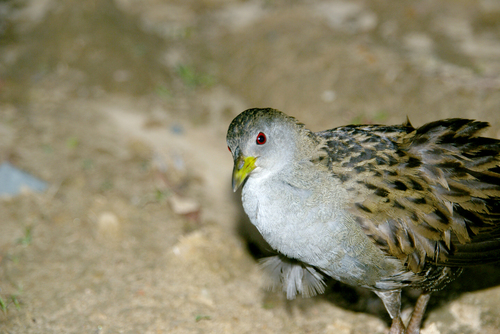
Slaty-breasted Wood-Rail

Slaty-breasted Wood-Rail

Aramides saracura

Silhouette: Sheatherius · PhyloPic

LCLeast ConcernNTVUENCR
Daily sighting probability ~30% · Possible
at Serra dos Órgãos National Park

In 3 days ~70% in a week ~90%

194 Verified sightings at Serra dos Órgãos National Park From 2019 to 2026
2,400 In all 6 parks
September Best month
☀️ Diurnal When it's spotted

About the Slaty-breasted Wood-Rail

The slaty-breasted wood rail (Aramides saracura) is a species of bird in the subfamily Rallinae of the rail, crake, and coot family Rallidae. It is found in Argentina, Brazil, and Paraguay. The slaty-breasted wood rail is monotypic.

The slaty-breasted wood rail is 34 to 37 cm (13 to 15 in) long; one male weighed 540 g (19 oz). The sexes are alike. Adults have a green bill with a bluish base, a red eye, and reddish- to yellowish brown legs and feet. Most of their head and their throat, breast, and belly are slate gray. Their nape and shoulders are chestnut, their back olive, and their tail black. Immatures and juveniles have not been described.

The slaty-breasted wood rail is found in southeastern Brazil from southern Minas Gerais and Espírito Santo south and west into eastern Paraguay and northeastern Argentina. It generally inhabits somewhat wet forest and woodland, often in swampy areas or along streams, but usually avoids open marshes.

The slaty-breasted wood rail appears to be a year-round resident throughout its range. Usually feeds earthworms, beetle larvae... Wikipedia →

Sounds

Alarm call1:04

Argentina · 2026

© Marcos E. Sosa · XC1094491 · CC BY-NC-SA 4.0

Duet0:54

Brazil · 2023

© rafarrinho · XC1041244 · CC BY-NC-SA 4.0

Call0:08

Brazil · 2021

© Ricardo José Mitidieri · XC676366 · CC BY-NC-SA 4.0

Global Distribution

Parks Where Found

# Park Country Daily sighting probability
1 Serra dos Órgãos National Park 🇧🇷 Brazil
~30%
2 Itatiaia National Park 🇧🇷 Brazil
~30%
3 Tijuca National Park 🇧🇷 Brazil
~20%
4 Iguaçu National Park 🇧🇷 Brazil
~10%
5 Iguazú National Park 🇦🇷 Argentina
~10%
6 Serra da Canastra National Park 🇧🇷 Brazil
<5%

Cities Where Found

# City Country Daily sighting probability
1 Curitiba 🇧🇷 Brazil
~50%
2 Porto Alegre 🇧🇷 Brazil
~30%
3 Rio de Janeiro 🇧🇷 Brazil
~10%
4 São Paulo 🇧🇷 Brazil
~10%
5 Campinas 🇧🇷 Brazil
~10%
6 Belo Horizonte 🇧🇷 Brazil
<5%
7 Santos 🇧🇷 Brazil
<5%

Zoos & Centres Where Found

# Zoo / Centre Country
1 Parque das Aves 🇧🇷 Brazil In captivity

Before you go

What are the chances of seeing a Slaty-breasted Wood-Rail in Serra dos Órgãos National Park?

Possible

About 30% of wildlife watchers report a Slaty-breasted Wood-Rail sighting in Serra dos Órgãos National Park on a given day, based on 194 verified sightings from GBIF citizen-science data from 2019 to 2026. It is the 83rd most-seen of the 336 birds we can rate there. Over three days the chance rises to about 70%, and over a week to about 90%, if each day is a fresh chance.

When is the best time to see a Slaty-breasted Wood-Rail in Serra dos Órgãos National Park?

September

In that month about 50% of wildlife watchers report a Slaty-breasted Wood-Rail in Serra dos Órgãos National Park on a given day, against about 10% in June, the lowest month.

What time of day is best to see a Slaty-breasted Wood-Rail?

Between 8 and 11 am

Across all the parks we cover, that three-hour window holds the most Slaty-breasted Wood-Rail sightings with a recorded time, and nearly all of them come between 6 am and 6 pm: it is a daytime animal.

Is Serra dos Órgãos National Park the best place to see a Slaty-breasted Wood-Rail?

Yes

Of the 6 parks where we can rate Slaty-breasted Wood-Rail sightings, Serra dos Órgãos National Park has the highest daily chance: about 30%. Next come Itatiaia National Park (Brazil, about 30%) and Tijuca National Park (Brazil, about 20%).

Where does the Slaty-breasted Wood-Rail sighting chance come from?

GBIF citizen-science records

It is estimated from how often the Slaty-breasted Wood-Rail is recorded against all the birds logged in Serra dos Órgãos National Park (194 verified sightings from 2019 to 2026), calibrated against known sighting rates. Figures are rounded to the nearest 10% because citizen-science data supports honest approximations, not decimals, and months with records from fewer than five people show "—". How it works.

← Back to Serra dos Órgãos National Park