Rosy Maple Moth

Rosy Maple Moth

Dryocampa rubicunda

Daily sighting probability ~20% · Possible
at Shenandoah National Park

In 3 days ~40% in a week ~70%

66 Verified sightings at Shenandoah National Park From 2019 to 2026
452 In all 6 parks
July Best month
☀️🌙 Day & Night When it's spotted

About the Rosy Maple Moth

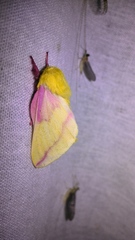
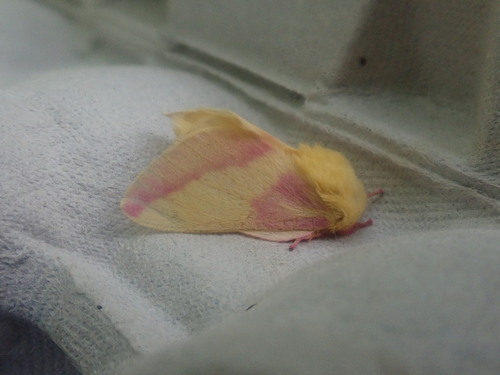
Dryocampa rubicunda, the rosy maple moth, is a small North American moth in the family Saturniidae, also known as the great silk moths. It was first described by Johan Christian Fabricius in 1793. The species is known for its wooly body and pink and yellow coloration, which varies from cream or white to bright pink or yellow. Males have bushier antennae than females, which allow them to sense female pheromones for mating.

As the common name of the species implies, the preferred host trees are maple trees. Adult females lay their yellow ovular eggs in groups of 10 to 40 on the underside of maple leaves. The emerging caterpillars, also known as the greenstriped mapleworm, mainly feed on the leaves of their host maple trees, particularly red maple, silver maple, and sugar maple. Since the caterpillars eat the entire leaf blade, in dense populations, caterpillars have been known to defoliate trees, resulting in aesthetic rather than permanent damage. However, like all other Saturniid moths, the adult moths do not eat.

The rosy maple moth is the smallest of the silk moths; males have a wingspan of 3.2 to 4.4 centimeters (1.25-1.75 in); females of 3.8 to 5 centimeters... Wikipedia →
Global Distribution

Parks Where Found

# Park Country Daily sighting probability
1 Voyageurs National Park 🇺🇸 United States
~60%
2 Great Smoky Mountains National Park 🇺🇸 United States
~30%
3 Cape Breton Highlands National Park 🇨🇦 Canada
~20%
4 Acadia National Park 🇺🇸 United States
~20%
5 Shenandoah National Park 🇺🇸 United States
~20%
6 Congaree National Park 🇺🇸 United States
~10%

Cities Where Found

# City Country Daily sighting probability
1 Washington 🇺🇸 United States
<5%

Before you go

What are the chances of seeing a Rosy Maple Moth in Shenandoah National Park?

Possible

About 20% of wildlife watchers report a Rosy Maple Moth sighting in Shenandoah National Park on a given day, based on 66 verified sightings from GBIF citizen-science data from 2019 to 2026. It is the 51st most-seen of the 723 insects we can rate there. Over three days the chance rises to about 40%, and over a week to about 70%, if each day is a fresh chance.

When is the best time to see a Rosy Maple Moth in Shenandoah National Park?

June to August

In those months about 20% of wildlife watchers report a Rosy Maple Moth in Shenandoah National Park on a given day, against under 5% in October to March, the lowest months.

What time of day is best to see a Rosy Maple Moth?

Between 10 pm and 1 am

Across all the parks we cover, that three-hour window holds the most Rosy Maple Moth sightings with a recorded time, and about half of them come between 6 am and 6 pm: it is seen both by day and at night.

Which relatives of the Rosy Maple Moth live in Shenandoah National Park?

Same family: Saturniidae

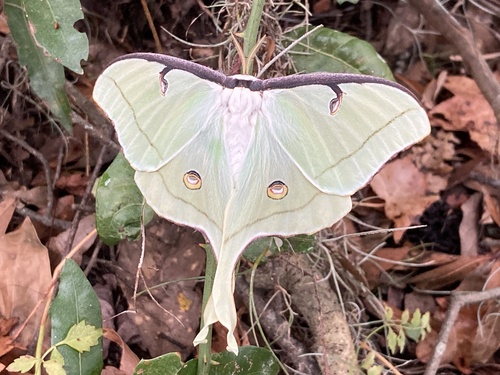
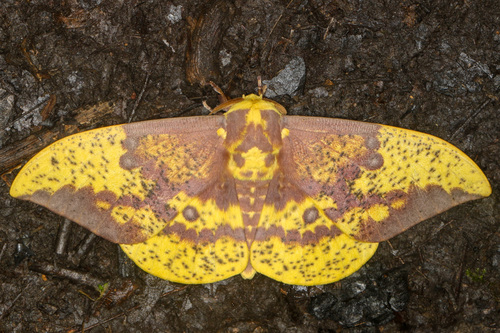
The closest relatives of the Rosy Maple Moth that you can see in Shenandoah National Park (family Saturniidae, Emperor and Giant Silk Moths) are North American Luna Moth (about 20%), Imperial Moth (about 10%) and Io Moth (about 10%), with each one's daily chance of a sighting.

Where does the Rosy Maple Moth sighting chance come from?

GBIF citizen-science records

It is estimated from how often the Rosy Maple Moth is recorded against all the insects logged in Shenandoah National Park (66 verified sightings from 2019 to 2026), calibrated against known sighting rates. Figures are rounded to the nearest 10% because citizen-science data supports honest approximations, not decimals, and months with records from fewer than five people show "—". How it works.

← Back to Shenandoah National Park