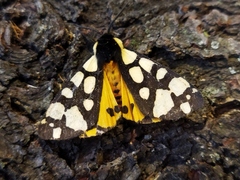
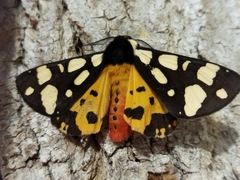
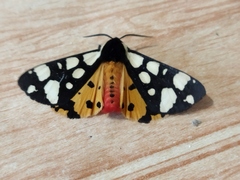
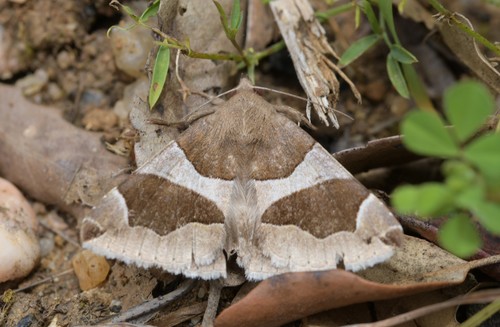
Cream-Spot Tiger

Cream-Spot Tiger

Epicallia villica

Daily sighting probability ~10% · With luck
at Sierra Nevada National Park

In 3 days ~30% in a week ~60%

16 Verified sightings at Sierra Nevada National Park From 2019 to 2026
240 In all 8 parks
May Best month
☀️🌙 Day & Night When it's spotted

About the Cream-Spot Tiger

Arctia villica, the cream-spot tiger, is a moth of the family Erebidae. The species was first described by Carl Linnaeus in his 1758 10th edition of Systema Naturae. It is distributed from the Iberian Peninsula, Anatolia, western and northern Iran, western Siberia, southwestern Asia and North Africa.

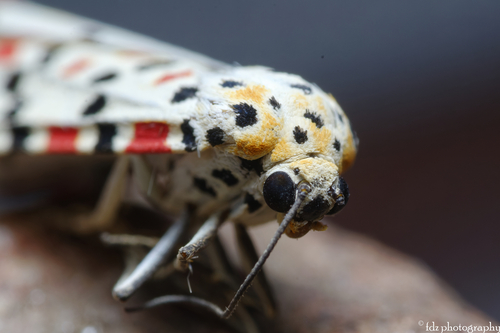
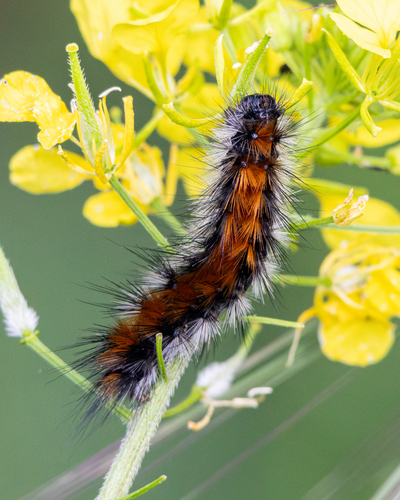
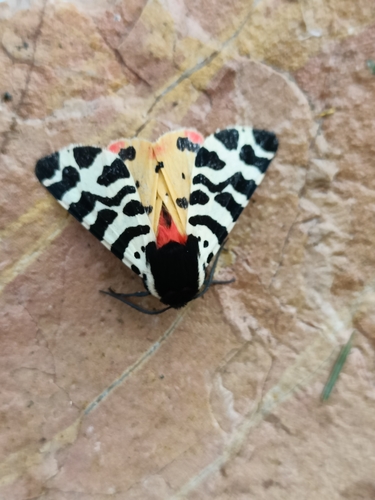
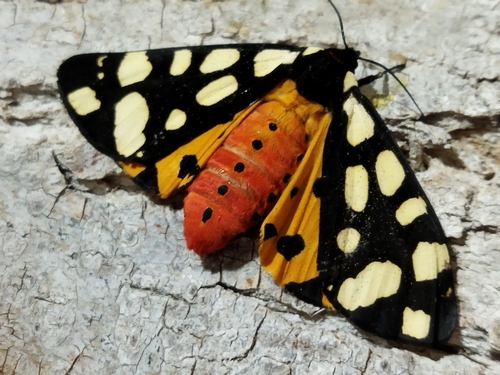
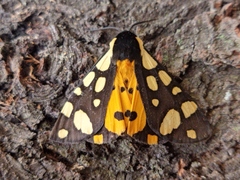
This species, along with the others of the genus Epicallia, was moved to Arctia as a result of phylogenetic research published by Rönkä et al. in 2016. The wingspan of these moths reaches 45–60 mm. They have black or greyish forewings with white and cream broad patches and spots. The bright red/orange hind wings have black spots. The thorax is black and the abdomen is reddish-orange. The highly coloured parts are bright scarlet on a newly emerged insect and tend to dull to orange with age. The caterpillars are black with light brown tufts of hairs, while the head and the legs are reddish. They can reach a length of about 12–12 mm.

The moths are nocturnal and attracted by light, but the females fly also during the day. By day these moths can be found resting on leaves. Moths of this species fly from March to July depending on the location. The caterpillars... Wikipedia →
Global Distribution

Parks Where Found

# Park Country Daily sighting probability
1 Cévennes National Park 🇫🇷 France
~20%
2 Sierra Nevada National Park 🇪🇸 Spain
~10%
3 Triglav National Park 🇸🇮 Slovenia
~10%
4 Camargue 🇫🇷 France
~10%
5 Pyrénées National Park 🇫🇷 France
~10%
6 Mercantour National Park 🇫🇷 France
~10%
7 Fertő-Hanság National Park 🇭🇺 Hungary
~10%
8 Sierra de Guadarrama National Park 🇪🇸 Spain
<5%

Cities Where Found

# City Country Daily sighting probability
1 Naples 🇮🇹 Italy
~10%
2 Rome 🇮🇹 Italy
~10%
3 Istanbul 🇹🇷 Turkey
~10%
4 Kazan 🇷🇺 Russia
<5%
5 Lisbon 🇵🇹 Portugal
<5%
6 Barcelona 🇪🇸 Spain
<5%

Before you go

What are the chances of seeing a Cream-Spot Tiger in Sierra Nevada National Park?

With luck

About 10% of wildlife watchers report a Cream-Spot Tiger sighting in Sierra Nevada National Park on a given day, based on 16 verified sightings from GBIF citizen-science data from 2019 to 2026. It is the 183rd most-seen of the 479 insects we can rate there. Over three days the chance rises to about 30%, and over a week to about 60%, if each day is a fresh chance.

When is the best time to see a Cream-Spot Tiger in Sierra Nevada National Park?

May and June

In those months about 20% of wildlife watchers report a Cream-Spot Tiger in Sierra Nevada National Park on a given day, against under 5% in July to March, the lowest months.

What time of day is best to see a Cream-Spot Tiger?

Between 10 pm and 1 am

Across all the parks we cover, that three-hour window holds the most Cream-Spot Tiger sightings with a recorded time, and about 6 in 10 of them come between 6 am and 6 pm: it is seen both by day and at night.

Is Sierra Nevada National Park the best place to see a Cream-Spot Tiger?

2nd of 8

Of the 8 parks where we can rate Cream-Spot Tiger sightings, Sierra Nevada National Park ranks 2nd at about 10%. The best odds are in Cévennes National Park (France, about 20%).

Which relatives of the Cream-Spot Tiger live in Sierra Nevada National Park?

Same family: Erebidae

The closest relatives of the Cream-Spot Tiger that you can see in Sierra Nevada National Park (family Erebidae, Underwing, Tiger, Tussock, and Allied Moths) are Drasteria cailino (about 20%), Discrete Chaperon (about 20%) and The Passenger (about 10%), with each one's daily chance of a sighting.

Where does the Cream-Spot Tiger sighting chance come from?

GBIF citizen-science records

It is estimated from how often the Cream-Spot Tiger is recorded against all the insects logged in Sierra Nevada National Park (16 verified sightings from 2019 to 2026), calibrated against known sighting rates. Figures are rounded to the nearest 10% because citizen-science data supports honest approximations, not decimals, and months with records from fewer than five people show "—". How it works.

← Back to Sierra Nevada National Park