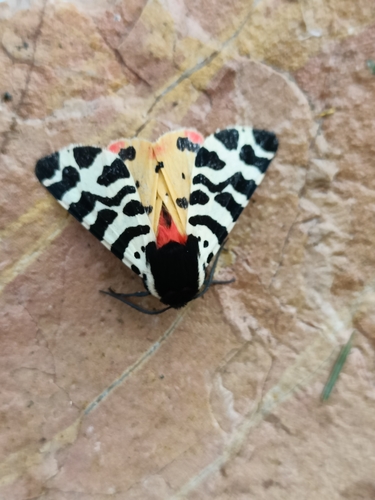
Four-Spotted Moth

Four-Spotted Moth

Tyta luctuosa

Daily sighting probability ~10% · With luck
at Sierra Nevada National Park

In 3 days ~20% in a week ~50%

6 Verified sightings at Sierra Nevada National Park From 2019 to 2026
50 In all 5 parks
May Best month
☀️🌙 Day & Night When it's spotted

About the Four-Spotted Moth

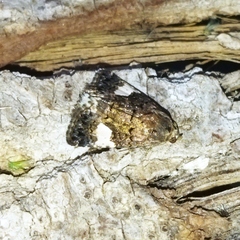
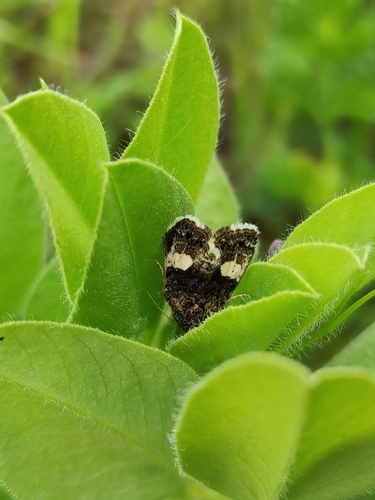
Tyta is a genus of noctuid ('owlet') moths that was erected by Gustaf Johan Billberg in 1820. It is monotypic, being represented by the single species Tyta luctuosa, commonly known as four-spotted moth and field bindweed moth. The species was first described by Michael Denis and Ignaz Schiffermüller in 1775.

This moth is native to much of the Palearctic – most of Europe east to the Caucasus, Kazakhstan and from Siberia to China and south to North Africa. The adult moth is about eleven millimeters long and dark brown with one large white spot on each of its four wings.

Its forewings are purplish fuscous, becoming paler, and more brownish, towards the termen, and sometimes at the extreme base; the lines black, fine; the inner oblique, thrice waved; the outer excurved above middle, incurved below; subterminal line pale, preceded by a darker shade; fringe white with a dark patch below middle; an abbreviated white band from costa to vein 3 beyond cell, sometimes tinged with tannish peach; hindwing with a white median band of varying width; in ab. angustifascia ab. nov. this band is greatly restricted and sometimes interrupted; the examples in which... Wikipedia →
Global Distribution

Parks Where Found

# Park Country Daily sighting probability
1 Fertő-Hanság National Park 🇭🇺 Hungary
~10%
2 Sierra Nevada National Park 🇪🇸 Spain
~10%
3 Cévennes National Park 🇫🇷 France
~10%
4 Sierra de Guadarrama National Park 🇪🇸 Spain
<5%
5 Pyrénées National Park 🇫🇷 France
<5%

Cities Where Found

# City Country Daily sighting probability
1 Budapest 🇭🇺 Hungary
~20%
2 Denver 🇺🇸 United States
~20%
3 Lyon 🇫🇷 France
~20%
4 Bucharest 🇷🇴 Romania
~10%
5 Kharkiv 🇺🇦 Ukraine
~10%
6 Vienna 🇦🇹 Austria
~10%
7 Rostov-on-Don 🇷🇺 Russia
~10%
8 Belgrade 🇷🇸 Serbia
~10%
9 Istanbul 🇹🇷 Turkey
~10%
10 Salt Lake City 🇺🇸 United States
~10%

Before you go

What are the chances of seeing a Four-Spotted Moth in Sierra Nevada National Park?

With luck

About 10% of wildlife watchers report a Four-Spotted Moth sighting in Sierra Nevada National Park on a given day, based on 6 verified sightings from GBIF citizen-science data from 2019 to 2026. It is the 330th most-seen of the 479 insects we can rate there. Over three days the chance rises to about 20%, and over a week to about 50%, if each day is a fresh chance.

When is the best time to see a Four-Spotted Moth in Sierra Nevada National Park?

May and June

In those months about 20% of wildlife watchers report a Four-Spotted Moth in Sierra Nevada National Park on a given day, against under 5% in July to April, the lowest months.

What time of day is best to see a Four-Spotted Moth?

Between 3 and 6 pm

Across all the parks we cover, that three-hour window holds the most Four-Spotted Moth sightings with a recorded time, and about 6 in 10 of them come between 6 am and 6 pm: it is seen both by day and at night.

Is Sierra Nevada National Park the best place to see a Four-Spotted Moth?

Among the best

Of the 5 parks where we can rate Four-Spotted Moth sightings, Sierra Nevada National Park ranks 2nd at about 10%, level with the leaders once rounded. The best odds are in Fertő-Hanság National Park (Hungary, about 10%).

Which relatives of the Four-Spotted Moth live in Sierra Nevada National Park?

Same family: Erebidae

The closest relatives of the Four-Spotted Moth that you can see in Sierra Nevada National Park (family Erebidae, Underwing, Tiger, Tussock, and Allied Moths) are Drasteria cailino (about 20%), Discrete Chaperon (about 20%) and The Passenger (about 10%), with each one's daily chance of a sighting.

Where does the Four-Spotted Moth sighting chance come from?

GBIF citizen-science records

It is estimated from how often the Four-Spotted Moth is recorded against all the insects logged in Sierra Nevada National Park (6 verified sightings from 2019 to 2026), calibrated against known sighting rates. Figures are rounded to the nearest 10% because citizen-science data supports honest approximations, not decimals, and months with records from fewer than five people show "—". How it works.

← Back to Sierra Nevada National Park