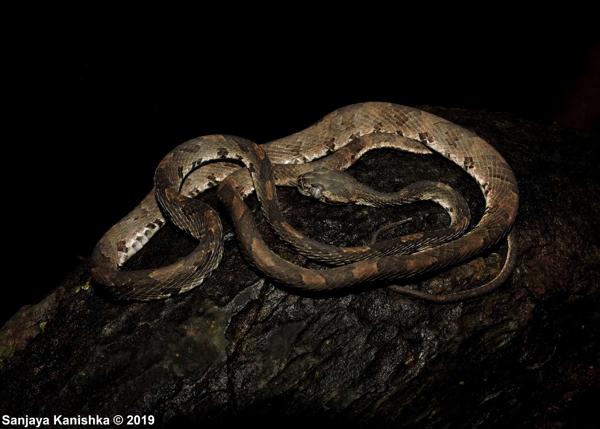

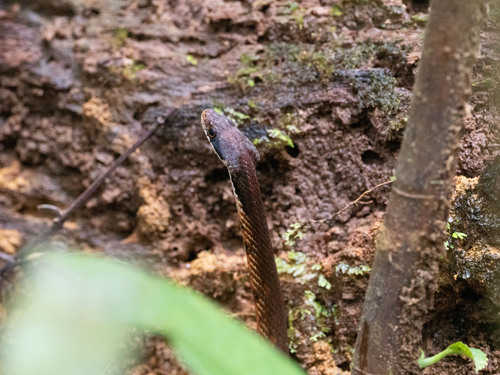
Barnes' Cat Snake

Barnes' Cat Snake

Boiga barnesii

Silhouette: Alex Slavenko · PhyloPic

LCNTVUVulnerableENCR Endemic
Daily sighting probability ~20% · Possible
at Sinharaja Forest Reserve

In 3 days ~40% in a week ~70%

17 Verified sightings at Sinharaja Forest Reserve From 2019 to 2026
17 In 1 park
August Best month
🌙 Nocturnal When it's spotted

About the Barnes' Cat Snake

Boiga barnesii is a species of cat snake endemic to Sri Lanka. It is known as Barnes' cat snake in English and panduru mapila-පදුරු මාපිලා in Sinhala. It is a member of the snake family Colubridae. It is distributed in the lowlands and midlands up to approximately 600 m (2,000 ft) above sea level, with known localities include Matale, Kandy, Gannoruwa, Gampola, Ambagamuwa, Balangoda, Labugama and Sinharaja Rain Forest. Barnes' cat snake is mainly a forest-dwelling species but may occasionally be found in human habitats. It is the smallest cat snake in Sri Lanka and grows up to a maximum of about 600 mm (24 in) in snout-vent length. Being a nocturnal and an arboreal hunter, it mainly feeds on agamid lizards and geckos. The day time is usually spent inside a tree hole or a crevice. It's a very timid and a mildly venomous snake and rarely attempts to bite.

The specific name, barnesii, is in honour of Richard Hawksworth Barnes (1831-1904), who collected specimens in Ceylon (now Sri Lanka) for the British Museum (Natural History), including the type specimen of this species.

B. barnesii has 19 scale rows at midbody. It has 2–3 preoculars. The ventrals number... Wikipedia →

Global Distribution

Parks Where Found

# Park Country Daily sighting probability
1 Sinharaja Forest Reserve 🇱🇰 Sri Lanka
~20%

More parks will be added in future updates.

Before you go

What are the chances of seeing a Barnes' Cat Snake in Sinharaja Forest Reserve?

Possible

About 20% of wildlife watchers report a Barnes' Cat Snake sighting in Sinharaja Forest Reserve on a given day, based on 17 verified sightings from GBIF citizen-science data from 2019 to 2026. It is the 23rd most-seen of the 32 reptiles we can rate there. Over three days the chance rises to about 40%, and over a week to about 70%, if each day is a fresh chance.

When is the best time to see a Barnes' Cat Snake in Sinharaja Forest Reserve?

August

In that month about 40% of wildlife watchers report a Barnes' Cat Snake in Sinharaja Forest Reserve on a given day, against under 5% in March–April and September–November, the lowest months.

What time of day is best to see a Barnes' Cat Snake?

Between 8 and 11 pm

Across all the parks we cover, that three-hour window holds the most Barnes' Cat Snake sightings with a recorded time, and about 8 in 10 of them come between 6 pm and 6 am: it is mostly seen at night.

Where else can you see a Barnes' Cat Snake?

Only Sinharaja Forest Reserve, in our data

Sinharaja Forest Reserve is the only park on Wallace's Line with enough records to rate Barnes' Cat Snake sightings: about 20% of wildlife watchers there report one on a given day.

Which relatives of the Barnes' Cat Snake live in Sinharaja Forest Reserve?

Same genus: Boiga

The closest relatives of the Barnes' Cat Snake that you can see in Sinharaja Forest Reserve (genus Boiga, Australasian Cat Snakes) are Beddome's Cat Snake (about 20%) and Sri Lanka Cat Snake (about 20%), with each one's daily chance of a sighting.

Where does the Barnes' Cat Snake sighting chance come from?

GBIF citizen-science records

It is estimated from how often the Barnes' Cat Snake is recorded against all the reptiles logged in Sinharaja Forest Reserve (17 verified sightings from 2019 to 2026), calibrated against known sighting rates. Figures are rounded to the nearest 10% because citizen-science data supports honest approximations, not decimals, and months with records from fewer than five people show "—". How it works.

← Back to Sinharaja Forest Reserve