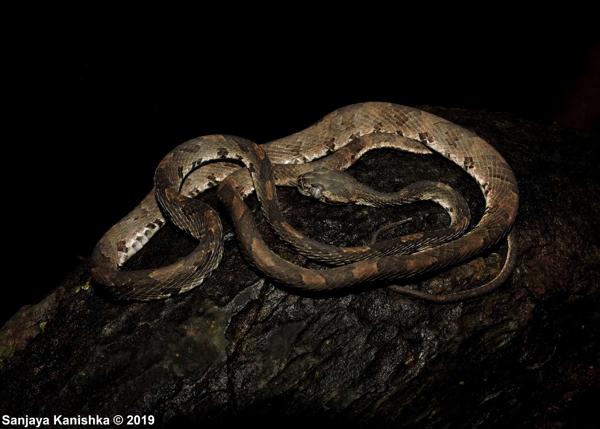
Blossom Krait

Blossom Krait

Rhabdophis ceylonensis

Silhouette: V. Deepak · PhyloPic

LCNTVUENEndangeredCR
Daily sighting probability ~20% · Possible
at Sinharaja Forest Reserve

In 3 days ~40% in a week ~70%

15 Verified sightings at Sinharaja Forest Reserve From 2019 to 2026
15 In 1 park
January Best month
☀️ Diurnal When it's spotted

About the Blossom Krait

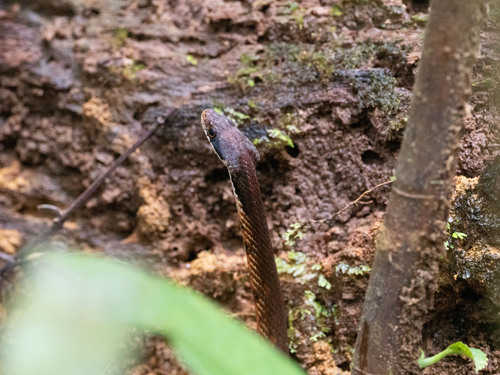
Rhabdophis ceylonensis is endemic to the island of Sri Lanka. The species is commonly known as the Sri Lanka blossom krait, the Sri Lanka keelback, and මල් කරවලා (mal karawala) or නිහලුවා (nihaluwa) in Sinhala. It is a moderately venomous snake.

Rhabdophis ceylonensis is a poorly-known snake from wet forests and some parts of intermediate forests in the lowlands and midhills of Sri Lanka. R. ceylonensis has dorsal scales in 19 rows at midbody. The ventrals number 131-141, the anal scale is divided, and the subcaudals number 40-54.

R. ceylonensis is a slow-moving snake. When threatened, it raises the anterior part of its body, which it inflates to expose the red skin between the dorsal scales on its neck. Its diet consists of frogs, while hatchlings are known to eat orthopterans.

R. ceylonensis is oviparous. About 7 eggs are produced at a time, measuring 19-22 × 9.5-13.2mm (about.75 x.5 inch). They hatch in March to produce young measuring about 102 mm (4.0 in) including tail. R. ceylonensis has a head distinct from the neck. The eye is large, with a round pupil. Its dorsal side is olive... Wikipedia →
Global Distribution

Parks Where Found

# Park Country Daily sighting probability
1 Sinharaja Forest Reserve 🇱🇰 Sri Lanka
~20%

More parks will be added in future updates.

Before you go

What are the chances of seeing a Blossom Krait in Sinharaja Forest Reserve?

Possible

About 20% of wildlife watchers report a Blossom Krait sighting in Sinharaja Forest Reserve on a given day, based on 15 verified sightings from GBIF citizen-science data from 2019 to 2026. It is the 28th most-seen of the 32 reptiles we can rate there. Over three days the chance rises to about 40%, and over a week to about 70%, if each day is a fresh chance.

When is the best time to see a Blossom Krait in Sinharaja Forest Reserve?

January

In that month about 30% of wildlife watchers report a Blossom Krait in Sinharaja Forest Reserve on a given day, against under 5% in April, June–July and September, the lowest months. That is one of Sinharaja Forest Reserve's driest months, with about 170 mm of rain against 490 mm in November.

What time of day is best to see a Blossom Krait?

Between 11 am and 2 pm

Across all the parks we cover, that three-hour window holds the most Blossom Krait sightings with a recorded time, and about 9 in 10 of them come between 6 am and 6 pm: it is a daytime animal.

Where else can you see a Blossom Krait?

Only Sinharaja Forest Reserve, in our data

Sinharaja Forest Reserve is the only park on Wallace's Line with enough records to rate Blossom Krait sightings: about 20% of wildlife watchers there report one on a given day.

Which relatives of the Blossom Krait live in Sinharaja Forest Reserve?

Same family: Colubridae

The closest relatives of the Blossom Krait that you can see in Sinharaja Forest Reserve (family Colubridae, Colubrid Snakes) are Green Vine Snake (about 80%), Boulenger's Keelback (about 50%) and Stripe-Tailed Bronzeback (about 40%), with each one's daily chance of a sighting.

Where does the Blossom Krait sighting chance come from?

GBIF citizen-science records

It is estimated from how often the Blossom Krait is recorded against all the reptiles logged in Sinharaja Forest Reserve (15 verified sightings from 2019 to 2026), calibrated against known sighting rates. Figures are rounded to the nearest 10% because citizen-science data supports honest approximations, not decimals, and months with records from fewer than five people show "—". How it works.

← Back to Sinharaja Forest Reserve