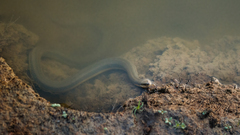

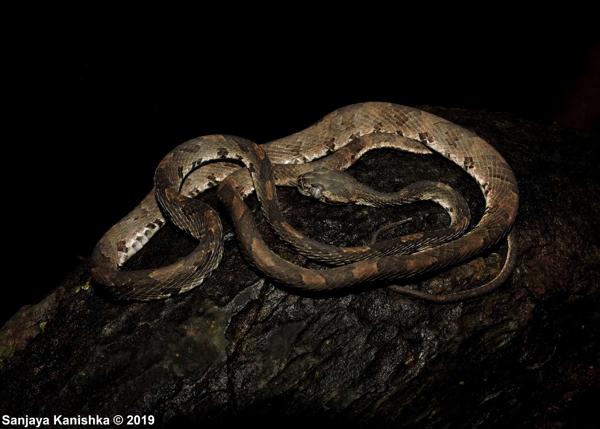
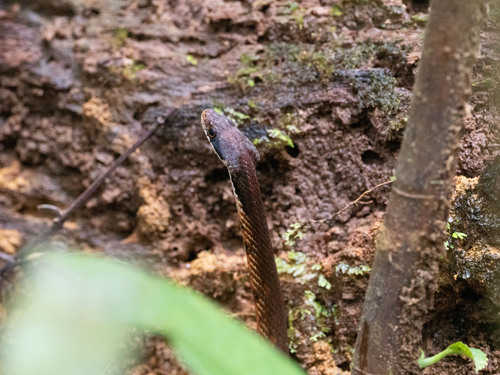
Split Keelback

Split Keelback

Atretium schistosum

Silhouette: Alex Slavenko · PhyloPic

LCLeast ConcernNTVUENCR
Daily sighting probability ~20% · Possible
at Sinharaja Forest Reserve

In 3 days ~40% in a week ~70%

7 Verified sightings at Sinharaja Forest Reserve From 2019 to 2026
7 In 1 park
September Best month
☀️🌙 Day & Night When it's spotted

About the Split Keelback

Atretium schistosum, also known commonly as the split keelback and the olive keelback wart snake, is a species of snake in the subfamily Natricinae of the family Colubridae. The species, which is the sole species in the genus Atretium, is native to South Asia.

It is a common and harmless watersnake. A. schistosum is found in Sri Lanka, India, Bangladesh and Nepal. In India it occurs in peninsular India south of latitude 15 degrees north and along the east coast to Uttarakhand. It is reported to be very common around Bangalore, North Arcot district (Tamil Nadu) and Kakinada area in Andhra Pradesh. Occurs up to 1000 m (3280 ft) above sea level. Absent from most of North India.

A. schistosum is a small, robust snake with thin head, short snout and slit nostrils placed rather high. The snake is olive-green and yellow to orange below. It is sometimes tinged with pink or purplish on the flanks. The length of the tail is one third to one-fourth of the total length.

The dorsal scales are rough because they are keeled. Specimens from South India have a distinct reddish line along the 5th and 6th or the 4th and 5th up to the vent. This line is brighter... Wikipedia →

Global Distribution

Parks Where Found

# Park Country Daily sighting probability
1 Sinharaja Forest Reserve 🇱🇰 Sri Lanka
~20%

More parks will be added in future updates.

Before you go

What are the chances of seeing a Split Keelback in Sinharaja Forest Reserve?

Possible

About 20% of wildlife watchers report a Split Keelback sighting in Sinharaja Forest Reserve on a given day, based on 7 verified sightings from GBIF citizen-science data from 2019 to 2026. It is the 24th most-seen of the 32 reptiles we can rate there. Over three days the chance rises to about 40%, and over a week to about 70%, if each day is a fresh chance.

When is the best time to see a Split Keelback in Sinharaja Forest Reserve?

May and August–September

In those months about 30% of wildlife watchers report a Split Keelback in Sinharaja Forest Reserve on a given day, against under 5% in March–April, June–July and October–December, the lowest months.

What time of day is best to see a Split Keelback?

Between 7 and 10 pm

Across all the parks we cover, that three-hour window holds the most Split Keelback sightings with a recorded time, and about half of them come between 6 am and 6 pm: it is seen both by day and at night.

Where else can you see a Split Keelback?

Only Sinharaja Forest Reserve, in our data

Sinharaja Forest Reserve is the only park on Wallace's Line with enough records to rate Split Keelback sightings: about 20% of wildlife watchers there report one on a given day.

Which relatives of the Split Keelback live in Sinharaja Forest Reserve?

Same family: Colubridae

The closest relatives of the Split Keelback that you can see in Sinharaja Forest Reserve (family Colubridae, Colubrid Snakes) are Green Vine Snake (about 80%), Boulenger's Keelback (about 50%) and Stripe-Tailed Bronzeback (about 40%), with each one's daily chance of a sighting.

Where does the Split Keelback sighting chance come from?

GBIF citizen-science records

It is estimated from how often the Split Keelback is recorded against all the reptiles logged in Sinharaja Forest Reserve (7 verified sightings from 2019 to 2026), calibrated against known sighting rates. Figures are rounded to the nearest 10% because citizen-science data supports honest approximations, not decimals, and months with records from fewer than five people show "—". How it works.

← Back to Sinharaja Forest Reserve