Templeton's Kukri Snake

Templeton's Kukri Snake

Oligodon calamarius

Silhouette: Alex Slavenko · PhyloPic

LCNTVUENEndangeredCR Endemic
Daily sighting probability ~10% · With luck
at Sinharaja Forest Reserve

In 3 days ~40% in a week ~60%

5 Verified sightings at Sinharaja Forest Reserve From 2019 to 2026
5 In 1 park
March Best month
☀️ Diurnal When it's spotted

About the Templeton's Kukri Snake

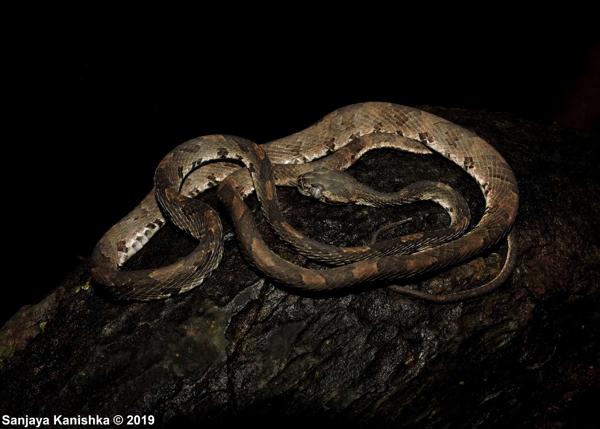
Oligodon calamarius is a species of nonvenomous colubrid endemic to Sri Lanka. It is known as කබර දත්-කැටියා (kabara dath ketiya) in Sinhala. Oligodon templetoni, now a junior synonym of Oligodon calamarius, was named in honour of Irish naturalist Dr. Robert Templeton who obtained the first known specimen.

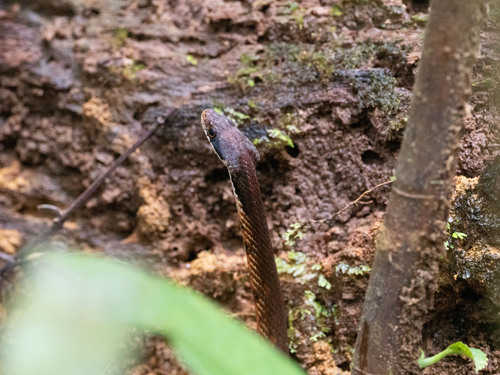
O. calamarius is a terrestrial snake from lowlands of the wet zone, reaching montane limits, up to 1,800 m (5,900 ft). The head is short, scarcely distinct from the neck. The pupil of the eye is round. The dorsum is light brown with a light vertebral stripe. There are 18–24 narrow dark brown, light-edged cross-bands that are either complete or half-way cross the back. The venter is cream, with square black markings. The forehead has a dark crescentric marking and an elongated spot behind it.

O. calamarius is known from Udugama in the Southern Province, Hewissa and Mathugama in the Western Province, Ratnapura and Balangoda in the Sabaragamuwa Province, and Peradeniya in Central Province. Boulenger, George A. (1890). The Fauna of British India, Including Ceylon and Burma. Reptilia and Batrachia... Wikipedia →

Global Distribution

Parks Where Found

# Park Country Daily sighting probability
1 Sinharaja Forest Reserve 🇱🇰 Sri Lanka
~10%

More parks will be added in future updates.

Before you go

What are the chances of seeing a Templeton's Kukri Snake in Sinharaja Forest Reserve?

With luck

About 10% of wildlife watchers report a Templeton's Kukri Snake sighting in Sinharaja Forest Reserve on a given day, based on 5 verified sightings from GBIF citizen-science data from 2019 to 2026. It is the 32nd most-seen of the 32 reptiles we can rate there. Over three days the chance rises to about 40%, and over a week to about 60%, if each day is a fresh chance.

When is the best time to see a Templeton's Kukri Snake in Sinharaja Forest Reserve?

March

In that month about 30% of wildlife watchers report a Templeton's Kukri Snake in Sinharaja Forest Reserve on a given day, against under 5% in January–February and May–November, the lowest months. That is one of Sinharaja Forest Reserve's driest months, with about 150 mm of rain against 490 mm in November.

What time of day is best to see a Templeton's Kukri Snake?

Between 9 am and noon

Across all the parks we cover, that three-hour window holds the most Templeton's Kukri Snake sightings with a recorded time, and about 9 in 10 of them come between 6 am and 6 pm: it is a daytime animal.

Where else can you see a Templeton's Kukri Snake?

Only Sinharaja Forest Reserve, in our data

Sinharaja Forest Reserve is the only park on Wallace's Line with enough records to rate Templeton's Kukri Snake sightings: about 10% of wildlife watchers there report one on a given day.

Where does the Templeton's Kukri Snake sighting chance come from?

GBIF citizen-science records

It is estimated from how often the Templeton's Kukri Snake is recorded against all the reptiles logged in Sinharaja Forest Reserve (5 verified sightings from 2019 to 2026), calibrated against known sighting rates. Figures are rounded to the nearest 10% because citizen-science data supports honest approximations, not decimals, and months with records from fewer than five people show "—". How it works.

← Back to Sinharaja Forest Reserve