Boulenger's Keelback

Boulenger's Keelback

Fowlea asperrimus

Silhouette: Alex Slavenko · PhyloPic

Daily sighting probability ~50% · Likely
at Sinharaja Forest Reserve

In 3 days ~90% in a week >90%

58 Verified sightings at Sinharaja Forest Reserve From 2019 to 2026
58 In 1 park
August Best month
🌅 Crepuscular When it's spotted

About the Boulenger's Keelback

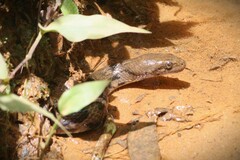
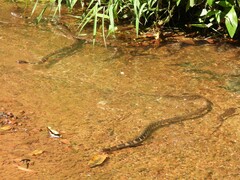
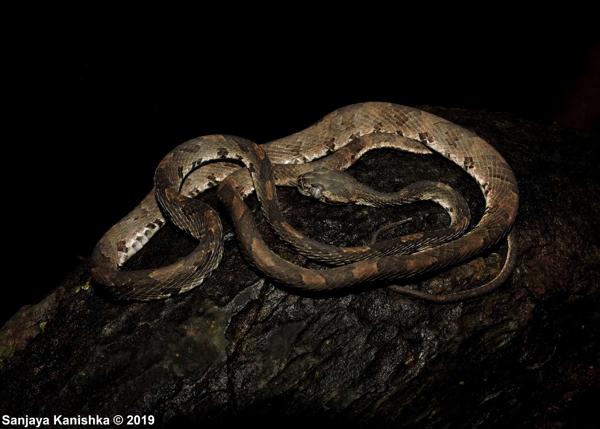
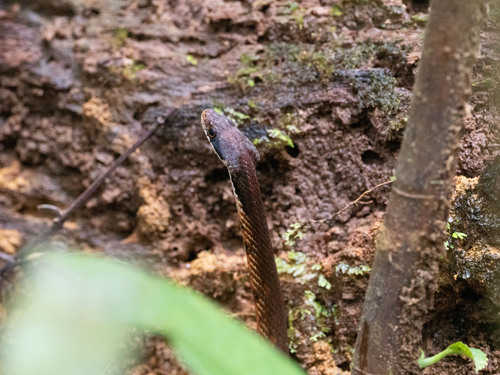
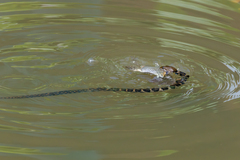
Boulenger's keelback (Fowlea asperrima), also known commonly as the Sri Lankan keelback, is a species of water snake in the family Colubridae. The species is endemic to Sri Lanka. The common name "Boulenger's keelback" is in honour of Belgian-born British herpetologist George Albert Boulenger.

F. asperrima is found in Sri Lanka, in both dry and wet climatic zones up to 1,000 m (3,300 ft) above mean sea level. It is abundant in waterways, such as flooded rice fields, ponds, lakes, marshes, rivers and streams. The body of F. asperrima is short and cylindrical, and has a clear neck and slightly pointed head. The eyes have rounded pupils, and the nostrils are narrow, directed slightly upwards. The tail is long. At hatching, it is 10 cm (3.9 in) long and grows to an adult length of 40–70 cm (16–28 in). The female is longer.

F. asperrima has one pair of internasals; the posterior parts are narrow. One loreal, preocular, postocular and three temporals are found. Of the 9 supralabials, 4 and 6 connect with the eye. Ventrals number 131–146, and the undivided subcaudals are 73–93 in count. At midbody there are 19 rows of dorsal... Wikipedia →

Global Distribution

Parks Where Found

# Park Country Daily sighting probability
1 Sinharaja Forest Reserve 🇱🇰 Sri Lanka
~50%

More parks will be added in future updates.

Cities Where Found

# City Country Daily sighting probability
1 Colombo [Sri Jayawardenepura Kotte] 🇱🇰 Sri Lanka
~20%

Before you go

What are the chances of seeing a Boulenger's Keelback in Sinharaja Forest Reserve?

Likely

About 50% of wildlife watchers report a Boulenger's Keelback sighting in Sinharaja Forest Reserve on a given day, based on 58 verified sightings from GBIF citizen-science data from 2019 to 2026. It is the 6th most-seen of the 32 reptiles we can rate there. Over three days the chance rises to about 90%, and over a week to over 90%, if each day is a fresh chance.

When is the best time to see a Boulenger's Keelback in Sinharaja Forest Reserve?

March and August

In those months about 70% of wildlife watchers report a Boulenger's Keelback in Sinharaja Forest Reserve on a given day, against about 30% in September, the lowest month.

What time of day is best to see a Boulenger's Keelback?

Between 4 and 7 am

Across all the parks we cover, that three-hour window holds the most Boulenger's Keelback sightings with a recorded time, and about 7 in 10 of them come between 6 am and 6 pm: it is most active around dawn and dusk.

Where else can you see a Boulenger's Keelback?

Only Sinharaja Forest Reserve, in our data

Sinharaja Forest Reserve is the only park on Wallace's Line with enough records to rate Boulenger's Keelback sightings: about 50% of wildlife watchers there report one on a given day.

Which relatives of the Boulenger's Keelback live in Sinharaja Forest Reserve?

Same family: Colubridae

The closest relatives of the Boulenger's Keelback that you can see in Sinharaja Forest Reserve (family Colubridae, Colubrid Snakes) are Green Vine Snake (about 80%), Stripe-Tailed Bronzeback (about 40%) and Ceylon Wolf Snake (about 40%), with each one's daily chance of a sighting.

Where does the Boulenger's Keelback sighting chance come from?

GBIF citizen-science records

It is estimated from how often the Boulenger's Keelback is recorded against all the reptiles logged in Sinharaja Forest Reserve (58 verified sightings from 2019 to 2026), calibrated against known sighting rates. Figures are rounded to the nearest 10% because citizen-science data supports honest approximations, not decimals, and months with records from fewer than five people show "—". How it works.

← Back to Sinharaja Forest Reserve