
Ceylon Wolf Snake

Ceylon Wolf Snake

Lycodon carinatus

Silhouette: Alex Slavenko · PhyloPic

LCNTVUENEndangeredCR Endemic
Daily sighting probability ~40% · Likely
at Sinharaja Forest Reserve

In 3 days ~80% in a week >90%

30 Verified sightings at Sinharaja Forest Reserve From 2019 to 2026
30 In 1 park
September Best month
🌅 Crepuscular When it's spotted

About the Ceylon Wolf Snake

Lycodon carianatus is a snake of the Colubridae family. It is endemic to the island of Sri Lanka. The snake is commonly known as the Ceylon wolf snake, and as දාර කරවලා (Daara Karawala) or දාර රදනකයා (daara radanakayaa) in Sinhala.

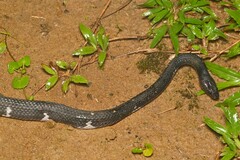
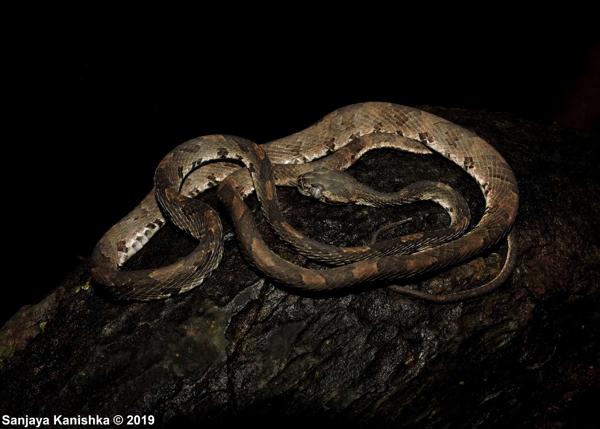
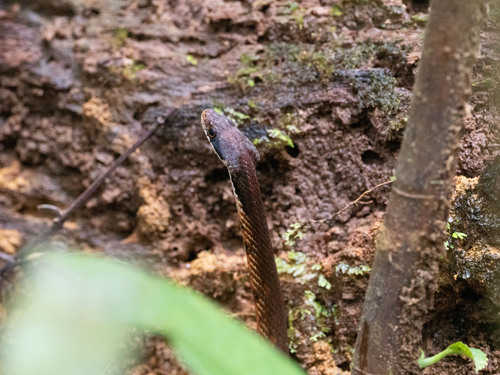
Dorsal side black with 19 distinct white rings. These may be reduced or completely absent in adults. Black bands extend to venter, but are fairly diffuse. Scales are keeled and dull in appearance. Midbody scale rows 17-19. Ventrals 180-202. Subcaudals entire 42-64.

Nocturnal and terrestrial, hiding under rubble in forests during the day. Diet comprises frogs, geckos, skinks and small non-venomous snakes. Lycodon carinatus is oviparous, laying 4 to 7 eggs at a time. This species has been shifted to the genus Lycodon in 2013 (PYRON et al. 2013) from previously known genus Cercaspis

http://animaldiversity.ummz.umich.edu/accounts/Cercaspis/classification/ http://reptile-database.reptarium.cz/species?genus=Lycodon&species=carinatus https://www.inaturalist.org/taxa/27353-Cercaspis-carinatus http://eol.org/pages/795452/names/synonyms

http://reptile-database.reptarium.cz/species... Wikipedia →

Global Distribution

Parks Where Found

# Park Country Daily sighting probability
1 Sinharaja Forest Reserve 🇱🇰 Sri Lanka
~40%

More parks will be added in future updates.

Before you go

What are the chances of seeing a Ceylon Wolf Snake in Sinharaja Forest Reserve?

Likely

About 40% of wildlife watchers report a Ceylon Wolf Snake sighting in Sinharaja Forest Reserve on a given day, based on 30 verified sightings from GBIF citizen-science data from 2019 to 2026. It is the 10th most-seen of the 32 reptiles we can rate there. Over three days the chance rises to about 80%, and over a week to over 90%, if each day is a fresh chance.

When is the best time to see a Ceylon Wolf Snake in Sinharaja Forest Reserve?

September and October

In those months about 50% of wildlife watchers report a Ceylon Wolf Snake in Sinharaja Forest Reserve on a given day, against under 5% in June and August, the lowest months.

What time of day is best to see a Ceylon Wolf Snake?

Between 4 and 7 pm

Across all the parks we cover, that three-hour window holds the most Ceylon Wolf Snake sightings with a recorded time, and about half of them come between 6 am and 6 pm: it is most active around dawn and dusk.

Where else can you see a Ceylon Wolf Snake?

Only Sinharaja Forest Reserve, in our data

Sinharaja Forest Reserve is the only park on Wallace's Line with enough records to rate Ceylon Wolf Snake sightings: about 40% of wildlife watchers there report one on a given day.

Which relatives of the Ceylon Wolf Snake live in Sinharaja Forest Reserve?

Same family: Colubridae

The closest relatives of the Ceylon Wolf Snake that you can see in Sinharaja Forest Reserve (family Colubridae, Colubrid Snakes) are Green Vine Snake (about 80%), Boulenger's Keelback (about 50%) and Stripe-Tailed Bronzeback (about 40%), with each one's daily chance of a sighting.

Where does the Ceylon Wolf Snake sighting chance come from?

GBIF citizen-science records

It is estimated from how often the Ceylon Wolf Snake is recorded against all the reptiles logged in Sinharaja Forest Reserve (30 verified sightings from 2019 to 2026), calibrated against known sighting rates. Figures are rounded to the nearest 10% because citizen-science data supports honest approximations, not decimals, and months with records from fewer than five people show "—". How it works.

← Back to Sinharaja Forest Reserve