
Sri Lanka Cat Snake

Sri Lanka Cat Snake

Boiga ceylonensis

Silhouette: Alex Slavenko · PhyloPic

LCLeast ConcernNTVUENCR
Daily sighting probability ~20% · Possible
at Sinharaja Forest Reserve

In 3 days ~50% in a week ~80%

12 Verified sightings at Sinharaja Forest Reserve From 2019 to 2026
12 In 1 park
July Best month
☀️🌙 Day & Night When it's spotted

About the Sri Lanka Cat Snake

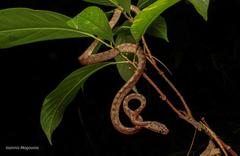
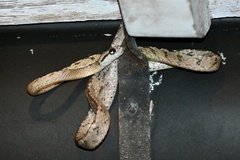
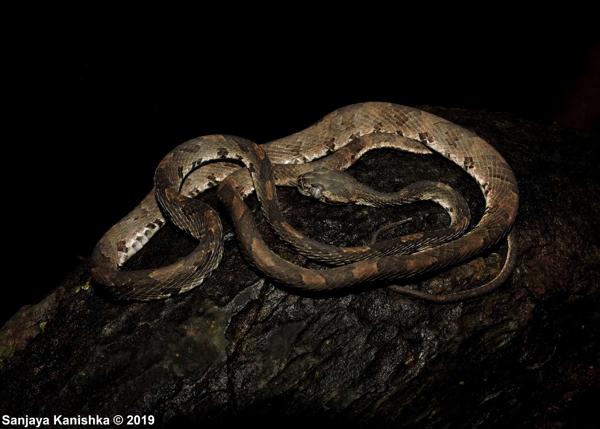
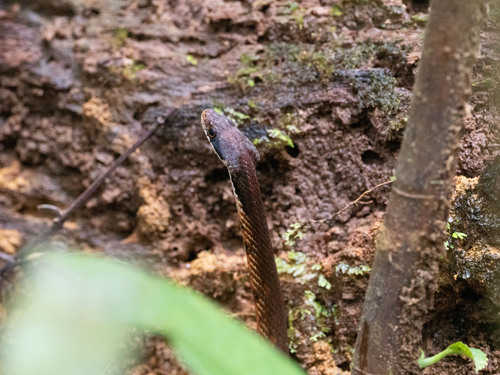
Boiga ceylonensis (Sri Lanka cat snake) is a species of rear-fanged, mildly venomous, nocturnal, arboreal colubrid snake endemic to Sri Lanka. This is a thin-bodied, elongate, slim, tree snake. Taxonomic features: Dorsal Scales in 19 rows, oblique; scales along the vertebral row much enlarged, and at mid body nearly as broad as long. Ventrals scales 217–237; the anals are undivided, subcaudals 95–109. The colour is brown or greyish above, with a series of blackish transverse cross bands; nape with a blackish blotch, or three blackish longitudinal streaks, or a transverse bar; a more or less distinct brown crown marking on top of head and a thick streak from the eye to the angle of the mouth; lower parts yellowish, dotted with brown, usually with a lateral series of small brown dots. They are about 4 feet long from tip to tip with the tail 10 inches.

It is an endemic species to Sri Lanka. Previously believed to occur in the Western Ghats of India, but was falsified by recent studies. This snake frequently ventures into human dwellings in search of prey such as geckos. It has a somewhat aggressive disposition and... Wikipedia →

Global Distribution

Parks Where Found

# Park Country Daily sighting probability
1 Sinharaja Forest Reserve 🇱🇰 Sri Lanka
~20%

More parks will be added in future updates.

Before you go

What are the chances of seeing a Sri Lanka Cat Snake in Sinharaja Forest Reserve?

Possible

About 20% of wildlife watchers report a Sri Lanka Cat Snake sighting in Sinharaja Forest Reserve on a given day, based on 12 verified sightings from GBIF citizen-science data from 2019 to 2026. It is the 18th most-seen of the 32 reptiles we can rate there. Over three days the chance rises to about 50%, and over a week to about 80%, if each day is a fresh chance.

When is the best time to see a Sri Lanka Cat Snake in Sinharaja Forest Reserve?

July and August

In those months about 40% of wildlife watchers report a Sri Lanka Cat Snake in Sinharaja Forest Reserve on a given day, against under 5% in October and November, the lowest months.

What time of day is best to see a Sri Lanka Cat Snake?

Between 8 and 11 pm

Across all the parks we cover, that three-hour window holds the most Sri Lanka Cat Snake sightings with a recorded time, and about 7 in 10 of them come between 6 pm and 6 am: it is seen both by day and at night.

Where else can you see a Sri Lanka Cat Snake?

Only Sinharaja Forest Reserve, in our data

Sinharaja Forest Reserve is the only park on Wallace's Line with enough records to rate Sri Lanka Cat Snake sightings: about 20% of wildlife watchers there report one on a given day.

Which relatives of the Sri Lanka Cat Snake live in Sinharaja Forest Reserve?

Same genus: Boiga

The closest relatives of the Sri Lanka Cat Snake that you can see in Sinharaja Forest Reserve (genus Boiga, Australasian Cat Snakes) are Beddome's Cat Snake (about 20%) and Barnes' Cat Snake (about 20%), with each one's daily chance of a sighting.

Where does the Sri Lanka Cat Snake sighting chance come from?

GBIF citizen-science records

It is estimated from how often the Sri Lanka Cat Snake is recorded against all the reptiles logged in Sinharaja Forest Reserve (12 verified sightings from 2019 to 2026), calibrated against known sighting rates. Figures are rounded to the nearest 10% because citizen-science data supports honest approximations, not decimals, and months with records from fewer than five people show "—". How it works.

← Back to Sinharaja Forest Reserve