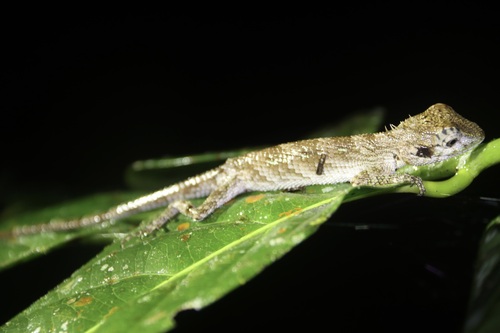
Hump Snout Lizard

Hump Snout Lizard

Lyriocephalus scutatus

Silhouette: Michael Scroggie · PhyloPic

LCNTVUVulnerableENCR Endemic
Daily sighting probability ~60% · Likely
at Sinharaja Forest Reserve

In 3 days ~90% in a week >90%

346 Verified sightings at Sinharaja Forest Reserve From 2019 to 2026
346 In 1 park
August Best month
☀️ Diurnal When it's spotted

About the Hump Snout Lizard

Lyriocephalus is a genus of lizard within the agamid family, with the sole species Lyriocephalus scutatus. It is the largest agamid endemic to Sri Lanka and lives in dense wet zone forests. It is also called the hump-nosed lizard, hump snout lizard or the lyreshead lizard.

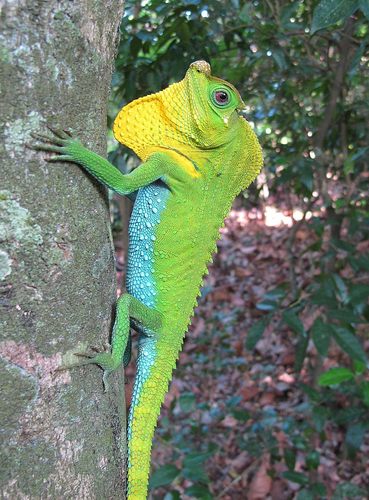
A large agamid lizard, widespread in the wet lowlands and the midhills of Sri Lanka, from 25m up to elevation of 1650m. It is easily sighted at the Pitadeniya area of the Sinharaja World Heritage Site. Body is laterally compressed. Pair of small spines present at back of the head. Dorso-nuchal crest developed. Forehead scales keeled. A distinct bony arch or hump appears on the head of adults, giving it its name. Tympanum absent. A V-shaped gular sac present. Large, keeled gular scales can be seen. Tail is short and compressed with a blunt tip. Dorsum is light green, throat yellow. The rest of the venter is cream colored.

The males are bright green with a yellow throat pouch and neck sail. Although the females can also exhibit this colouration, normally they are brown, especially when a male is present. Juveniles are brown. Inhabits forests with... Wikipedia →

Global Distribution

Parks Where Found

# Park Country Daily sighting probability
1 Sinharaja Forest Reserve 🇱🇰 Sri Lanka
~60%

More parks will be added in future updates.

Before you go

What are the chances of seeing a Hump Snout Lizard in Sinharaja Forest Reserve?

Likely

About 60% of wildlife watchers report a Hump Snout Lizard sighting in Sinharaja Forest Reserve on a given day, based on 346 verified sightings from GBIF citizen-science data from 2019 to 2026. It is the 5th most-seen of the 32 reptiles we can rate there. Over three days the chance rises to about 90%, and over a week to over 90%, if each day is a fresh chance.

When is the best time to see a Hump Snout Lizard in Sinharaja Forest Reserve?

May and August

In those months about 80% of wildlife watchers report a Hump Snout Lizard in Sinharaja Forest Reserve on a given day, against about 10% in September, the lowest month.

What time of day is best to see a Hump Snout Lizard?

Between 5 and 8 am

Across all the parks we cover, that three-hour window holds the most Hump Snout Lizard sightings with a recorded time, and about 8 in 10 of them come between 6 am and 6 pm: it is a daytime animal.

Where else can you see a Hump Snout Lizard?

Only Sinharaja Forest Reserve, in our data

Sinharaja Forest Reserve is the only park on Wallace's Line with enough records to rate Hump Snout Lizard sightings: about 60% of wildlife watchers there report one on a given day.

Which relatives of the Hump Snout Lizard live in Sinharaja Forest Reserve?

Same family: Agamidae

The closest relatives of the Hump Snout Lizard that you can see in Sinharaja Forest Reserve (family Agamidae, Dragons) are Wiegmann's Agama (about 90%), Common Green Forest Lizard (about 90%) and Sri Lanka Agama (about 30%), with each one's daily chance of a sighting.

Where does the Hump Snout Lizard sighting chance come from?

GBIF citizen-science records

It is estimated from how often the Hump Snout Lizard is recorded against all the reptiles logged in Sinharaja Forest Reserve (346 verified sightings from 2019 to 2026), calibrated against known sighting rates. Figures are rounded to the nearest 10% because citizen-science data supports honest approximations, not decimals, and months with records from fewer than five people show "—". How it works.

← Back to Sinharaja Forest Reserve