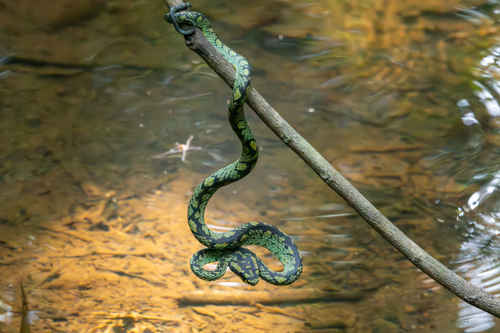
Sri Lanka Agama

Sri Lanka Agama

Calotes liolepis

Silhouette: Vijay Karthick · PhyloPic

LCLeast ConcernNTVUENCR
Daily sighting probability ~30% · Possible
at Sinharaja Forest Reserve

In 3 days ~70% in a week ~90%

49 Verified sightings at Sinharaja Forest Reserve From 2019 to 2026
49 In 1 park
September Best month
☀️ Diurnal When it's spotted

About the Sri Lanka Agama

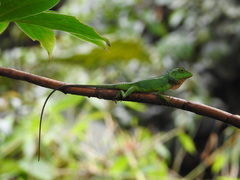
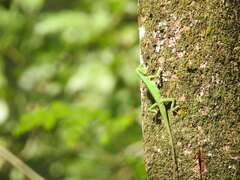
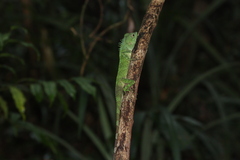
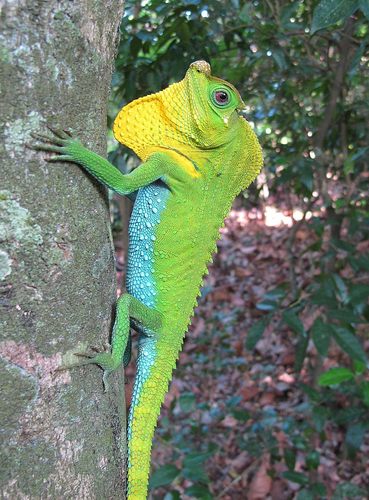
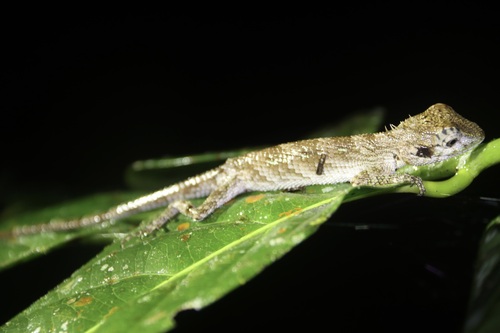
The whistling lizard or Sri Lanka agama (Calotes liolepis) is a species of lizard in the family Agamidae. It is one of seven Calotes species endemic to Sri Lanka. Restricted to submontane forests below 100 m (330 ft), and found in forested areas and plantations. Widely distributed but frequently found in the central hills of Sri Lanka, including Knuckles, Kotmale, Sinharaja, Talawakele, Hanguranketha, Kanneliya, Galle, Kandy, Dambulla, Peradeniya, Namunukula, and Gampola.

Whistling lizards are able to camouflage, changing color from green to brown to match their environment. The species has a relatively long head and tail, the latter often double the length of its body. A series of spines on the nape make up the dorso-nuchal crest in males, while both males and females possess scales on the dorsum of the body. Ventral scales as large as those on its flanks. The forehead is pale brown, with pale inter-orbital bands, and the dorsum is pale gray with dark gray bands. The limbs and tail are similarly dark-banded.

Unusual among agamid lizards is its habit of uttering a high-pitched whistle when alarmed. It feeds on insects and ants. Gravid... Wikipedia →
Global Distribution

Parks Where Found

# Park Country Daily sighting probability
1 Sinharaja Forest Reserve 🇱🇰 Sri Lanka
~30%

More parks will be added in future updates.

Before you go

What are the chances of seeing a Sri Lanka Agama in Sinharaja Forest Reserve?

Possible

About 30% of wildlife watchers report a Sri Lanka Agama sighting in Sinharaja Forest Reserve on a given day, based on 49 verified sightings from GBIF citizen-science data from 2019 to 2026. It is the 12th most-seen of the 32 reptiles we can rate there. Over three days the chance rises to about 70%, and over a week to about 90%, if each day is a fresh chance.

When is the best time to see a Sri Lanka Agama in Sinharaja Forest Reserve?

September

In that month about 50% of wildlife watchers report a Sri Lanka Agama in Sinharaja Forest Reserve on a given day, against about 20% in June, August and October, the lowest months.

What time of day is best to see a Sri Lanka Agama?

Between 5 and 8 am

Across all the parks we cover, that three-hour window holds the most Sri Lanka Agama sightings with a recorded time, and about 7 in 10 of them come between 6 am and 6 pm: it is a daytime animal.

Where else can you see a Sri Lanka Agama?

Only Sinharaja Forest Reserve, in our data

Sinharaja Forest Reserve is the only park on Wallace's Line with enough records to rate Sri Lanka Agama sightings: about 30% of wildlife watchers there report one on a given day.

Which relatives of the Sri Lanka Agama live in Sinharaja Forest Reserve?

Same genus: Calotes

The closest relatives of the Sri Lanka Agama that you can see in Sinharaja Forest Reserve (genus Calotes, Oriental Forest Lizards) are Common Green Forest Lizard (about 90%) and Oriental Garden Lizard (about 30%), with each one's daily chance of a sighting.

Where does the Sri Lanka Agama sighting chance come from?

GBIF citizen-science records

It is estimated from how often the Sri Lanka Agama is recorded against all the reptiles logged in Sinharaja Forest Reserve (49 verified sightings from 2019 to 2026), calibrated against known sighting rates. Figures are rounded to the nearest 10% because citizen-science data supports honest approximations, not decimals, and months with records from fewer than five people show "—". How it works.

← Back to Sinharaja Forest Reserve