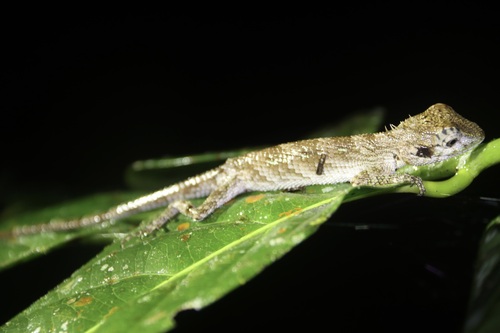
Wiegmann's Agama

Wiegmann's Agama

Otocryptis wiegmanni

Silhouette: Michael Scroggie · PhyloPic

LCLeast ConcernNTVUENCR Endemic
Daily sighting probability ~90% · Very likely
at Sinharaja Forest Reserve

In 3 days >90%

472 Verified sightings at Sinharaja Forest Reserve From 2019 to 2026
472 In 1 park
September Best month
🌅 Crepuscular When it's spotted

About the Wiegmann's Agama

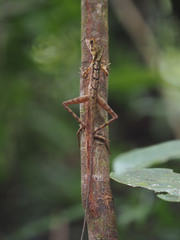
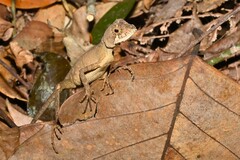
Otocryptis wiegmanni, commonly called the brown-patched kangaroo lizard, Sri Lankan kangaroo lizard or Wiegmann's agama, is a small, ground-dwelling agamid lizard endemic to Sri Lanka.In Sinhalese language it is known as "Kala Katussa - කලා කටුස්සා", "Pinum Katussa - පිනුම් කටුස්සා" and "Gomu Thali Katussa - ගොමු තැලි කටුස්සා"

The specific name, wiegmanni, is in honour of German herpetologist Arend Friedrich August Wiegmann. The preferred habitat of O. wiegmanni is the wet zone forests and lower mountain forests (rainfall >2000 mm), up to 1,300 m (4,300 ft), of Sri Lanka. It is commonly seen in the leaf litter of shady rain forests.

When perceiving danger, O. wiegmanni spurts away quickly on its large hind legs and might eventually climb up a sapling or tree. O. wiegmanni feeds on small insects, grubs, and tender shoots. O. wiegmanni is closely related to the Indian kangaroo lizard (O. beddomii ) of the rain forests of South India.

O. wiegmanni may grow to an adult body size of about 7 cm (2.8 in) snout-to-vent length (SVL), plus a tail 15 cm (5.9 in) long. Its colour ranges from dark... Wikipedia →

Global Distribution

Parks Where Found

# Park Country Daily sighting probability
1 Sinharaja Forest Reserve 🇱🇰 Sri Lanka
~90%

More parks will be added in future updates.

Before you go

What are the chances of seeing a Wiegmann's Agama in Sinharaja Forest Reserve?

Very likely

About 90% of wildlife watchers report a Wiegmann's Agama sighting in Sinharaja Forest Reserve on a given day, based on 472 verified sightings from GBIF citizen-science data from 2019 to 2026. It is the most-seen of the 32 reptiles we can rate there. Over three days the chance rises to over 90%, if each day is a fresh chance.

When is the best time to see a Wiegmann's Agama in Sinharaja Forest Reserve?

January–February, April–May and July–November

In those months about 90% of wildlife watchers report a Wiegmann's Agama in Sinharaja Forest Reserve on a given day, against about 80% in March, June and December, the lowest months.

What time of day is best to see a Wiegmann's Agama?

Between 4 and 7 am

Across all the parks we cover, that three-hour window holds the most Wiegmann's Agama sightings with a recorded time, and about 6 in 10 of them come between 6 am and 6 pm: it is most active around dawn and dusk.

Where else can you see a Wiegmann's Agama?

Only Sinharaja Forest Reserve, in our data

Sinharaja Forest Reserve is the only park on Wallace's Line with enough records to rate Wiegmann's Agama sightings: about 90% of wildlife watchers there report one on a given day.

Which relatives of the Wiegmann's Agama live in Sinharaja Forest Reserve?

Same family: Agamidae

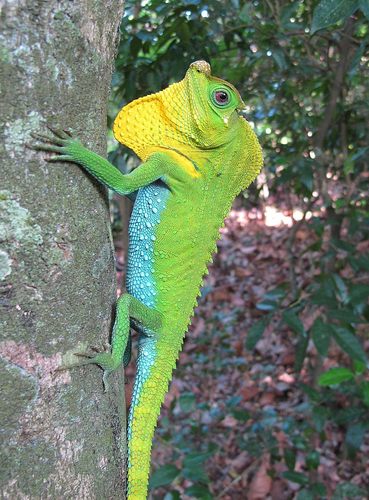
The closest relatives of the Wiegmann's Agama that you can see in Sinharaja Forest Reserve (family Agamidae, Dragons) are Common Green Forest Lizard (about 90%), Hump Snout Lizard (about 60%) and Sri Lanka Agama (about 30%), with each one's daily chance of a sighting.

Where does the Wiegmann's Agama sighting chance come from?

GBIF citizen-science records

It is estimated from how often the Wiegmann's Agama is recorded against all the reptiles logged in Sinharaja Forest Reserve (472 verified sightings from 2019 to 2026), calibrated against known sighting rates. Figures are rounded to the nearest 10% because citizen-science data supports honest approximations, not decimals, and months with records from fewer than five people show "—". How it works.

← Back to Sinharaja Forest Reserve