Ceylon Pit Viper

Ceylon Pit Viper

Craspedocephalus trigonocephalus

Silhouette: Vijay Karthick · PhyloPic

Endemic
Daily sighting probability ~80% · Very likely
at Sinharaja Forest Reserve

In 3 days >90%

277 Verified sightings at Sinharaja Forest Reserve From 2019 to 2026
277 In 1 park
September Best month
🌅 Crepuscular When it's spotted

About the Ceylon Pit Viper

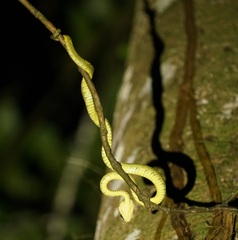
Craspedocephalus trigonocephalus, the Sri Lankan pit viper, Ceylon pit viper, Sri Lankan green pitviper or locally, pala polonga, (Sinhala: පළා පොළඟා) is a venomous pit viper species endemic to Sri Lanka. No subspecies are currently recognized.

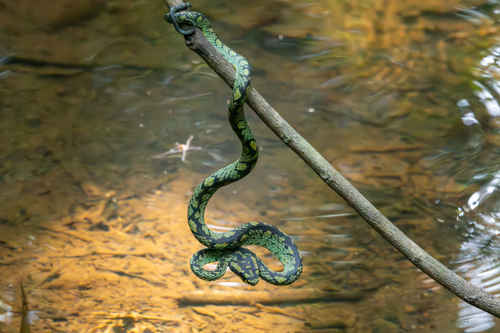
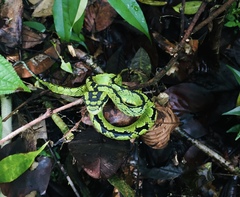
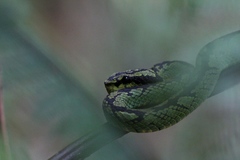
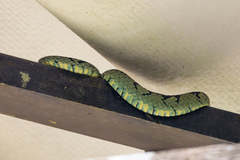
Craspedocephalus trigonocephalus is a sexually dimorphic, mid-sized, cylindrical species. These snakes measure 20–25 cm (7.9–9.8 in) at birth, and males grow to a maximum total length of 60–75 cm (24–30 in). The neck is distinct from the flattened, triangular head. There is a loreal pit on each side of the head. Mid-sized eyes and a short, rounded, broad snout are present. The males are considerably smaller than females, which can grow up to 130 cm (51 in) in total length. The ground color of the snake is variable and cryptic. Typically, it is a green snake with a black variegated pattern, and a black temporal line is usually present. The wet zone snakes have these black patterns more clearly marked. The vertebral area has a tinge of yellow. The tail is black. The ventral scales are light greenish-yellow or may even be grey. Some snakes have only the black temporal line and the black tail, with the rest of the body being green... Wikipedia →

Global Distribution

Parks Where Found

# Park Country Daily sighting probability
1 Sinharaja Forest Reserve 🇱🇰 Sri Lanka
~80%

More parks will be added in future updates.

Zoos & Centres Where Found

# Zoo / Centre Country
1 Skansen 🇸🇪 Sweden In captivity
2 Central Florida Zoo and Botanical Gardens 🇺🇸 United States In captivity
3 Audubon Zoo 🇺🇸 United States In captivity
4 Oklahoma City Zoo and Botanical Garden 🇺🇸 United States In captivity
5 Fort Worth Zoo 🇺🇸 United States In captivity
6 Wilhelma 🇩🇪 Germany In captivity
7 Zoo Atlanta 🇺🇸 United States In captivity
8 Faunia 🇪🇸 Spain In captivity
9 Reptile Gardens 🇺🇸 United States In captivity
10 Staten Island Zoo 🇺🇸 United States In captivity
11 Baltic Sea Science Center 🇸🇪 Sweden In captivity

Before you go

What are the chances of seeing a Ceylon Pit Viper in Sinharaja Forest Reserve?

Very likely

About 80% of wildlife watchers report a Ceylon Pit Viper sighting in Sinharaja Forest Reserve on a given day, based on 277 verified sightings from GBIF citizen-science data from 2019 to 2026. It is the 3rd most-seen of the 32 reptiles we can rate there. Over three days the chance rises to over 90%, if each day is a fresh chance.

When is the best time to see a Ceylon Pit Viper in Sinharaja Forest Reserve?

January–February, April–May, July, September and November

In those months about 90% of wildlife watchers report a Ceylon Pit Viper in Sinharaja Forest Reserve on a given day, against about 80% in March, June, August, October and December, the lowest months.

What time of day is best to see a Ceylon Pit Viper?

Between 5 and 8 am

Across all the parks we cover, that three-hour window holds the most Ceylon Pit Viper sightings with a recorded time, and about 6 in 10 of them come between 6 am and 6 pm: it is most active around dawn and dusk.

Where else can you see a Ceylon Pit Viper?

Only Sinharaja Forest Reserve, in our data

Sinharaja Forest Reserve is the only park on Wallace's Line with enough records to rate Ceylon Pit Viper sightings: about 80% of wildlife watchers there report one on a given day.

Which relatives of the Ceylon Pit Viper live in Sinharaja Forest Reserve?

Same family: Viperidae

The closest relatives of the Ceylon Pit Viper that you can see in Sinharaja Forest Reserve (family Viperidae, Vipers) are Lowland Hump-nosed Viper (about 50%) and Russell's Viper (about 20%), with each one's daily chance of a sighting.

Where does the Ceylon Pit Viper sighting chance come from?

GBIF citizen-science records

It is estimated from how often the Ceylon Pit Viper is recorded against all the reptiles logged in Sinharaja Forest Reserve (277 verified sightings from 2019 to 2026), calibrated against known sighting rates. Figures are rounded to the nearest 10% because citizen-science data supports honest approximations, not decimals, and months with records from fewer than five people show "—". How it works.

← Back to Sinharaja Forest Reserve