Rough Nose Horned Lizard

Rough Nose Horned Lizard

Ceratophora aspera

Silhouette: PhyloPic

LCNTVUENEndangeredCR Endemic
Daily sighting probability ~20% · Possible
at Sinharaja Forest Reserve

In 3 days ~50% in a week ~80%

23 Verified sightings at Sinharaja Forest Reserve From 2019 to 2026
23 In 1 park
May Best month
☀️ Diurnal When it's spotted

About the Rough Nose Horned Lizard

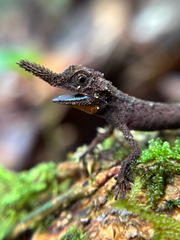
The rough-nosed horned lizard or Sri Lanka horned agama (Ceratophora aspera) is an Agamid lizard from Sri Lanka in lowland dipterocarp forests and secondary forests in the wet zone. It is distinguished from all the other Ceratophora species by the presence of a complex rostral appendage, comprising more scales than rostral scale alone. The lateral body scales are small and more or less regular shape.In Sinhalese language it is known as "Ralu An Katussa - රළු අං කටුස්සා" and "Punchi An Katussa - පුංචි අං කටුස්සා"

The rough-nosed horned lizard has an X-shaped dorsal ridge at back of its head. Tympanum hidden under the skin. A weak dorso-nuchal crest confined to the neck region. Gular fold absent. Body slightly compressed. Lamellae under fourth toe counts 11-14.

Males are dark brown or brick-red dorsally and on the flanks. Females may be similar to males in coloration and can be lighter, with some individuals have four diamond-shaped marks and black spots or longitudinal lines on dorsum.

A terrestrial species, it is found on leaf litter in well-shaded forests, usually in pairs. Two soft-shelled eggs are laid. A ground... Wikipedia →

Global Distribution

Parks Where Found

# Park Country Daily sighting probability
1 Sinharaja Forest Reserve 🇱🇰 Sri Lanka
~20%

More parks will be added in future updates.

Before you go

What are the chances of seeing a Rough Nose Horned Lizard in Sinharaja Forest Reserve?

Possible

About 20% of wildlife watchers report a Rough Nose Horned Lizard sighting in Sinharaja Forest Reserve on a given day, based on 23 verified sightings from GBIF citizen-science data from 2019 to 2026. It is the 21st most-seen of the 32 reptiles we can rate there. Over three days the chance rises to about 50%, and over a week to about 80%, if each day is a fresh chance.

When is the best time to see a Rough Nose Horned Lizard in Sinharaja Forest Reserve?

May

In that month about 40% of wildlife watchers report a Rough Nose Horned Lizard in Sinharaja Forest Reserve on a given day, against under 5% in October and December, the lowest months. That is one of Sinharaja Forest Reserve's wettest months, with about 460 mm of rain against 150 mm in March.

What time of day is best to see a Rough Nose Horned Lizard?

Between 8 and 11 am

Across all the parks we cover, that three-hour window holds the most Rough Nose Horned Lizard sightings with a recorded time, and about 8 in 10 of them come between 6 am and 6 pm: it is a daytime animal.

Where else can you see a Rough Nose Horned Lizard?

Only Sinharaja Forest Reserve, in our data

Sinharaja Forest Reserve is the only park on Wallace's Line with enough records to rate Rough Nose Horned Lizard sightings: about 20% of wildlife watchers there report one on a given day.

Where does the Rough Nose Horned Lizard sighting chance come from?

GBIF citizen-science records

It is estimated from how often the Rough Nose Horned Lizard is recorded against all the reptiles logged in Sinharaja Forest Reserve (23 verified sightings from 2019 to 2026), calibrated against known sighting rates. Figures are rounded to the nearest 10% because citizen-science data supports honest approximations, not decimals, and months with records from fewer than five people show "—". How it works.

← Back to Sinharaja Forest Reserve