Indian Swiftlet

Indian Swiftlet

Aerodramus unicolor

Silhouette: Aviceda (vectorized by T. Michael Keesey) · PhyloPic

LCLeast ConcernNTVUENCR
Daily sighting probability ~30% · Possible
at Sinharaja Forest Reserve

In 3 days ~70% in a week ~90%

568 Verified sightings at Sinharaja Forest Reserve From 2019 to 2026
2,295 In all 11 parks
November Best month
🌅 Crepuscular When it's spotted

About the Indian Swiftlet

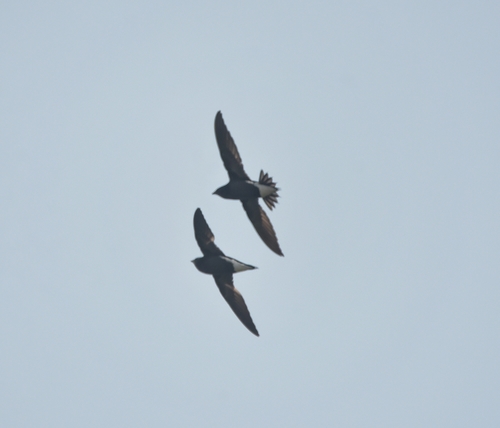
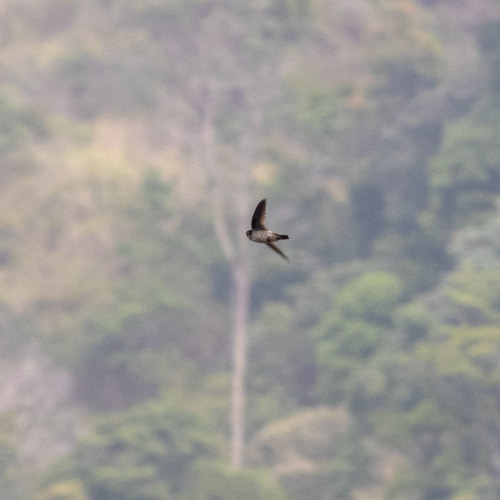
The Indian Swiftlet or Indian Edible-Nest Swiftlet (Aerodramus unicolor) is a small swift. It is a common resident colonial breeder in the hills of Sri Lanka and southwest India. The half-cup nest is built on a vertical surface, often in a cave. The male swift uses thick saliva to construct the white, shiny nest into which two eggs are laid.

The relatively tasteless nests are harvested, and mixed with chicken, spices, and other flavours as bird's nest soup, a supposed aphrodisiac. This 12 cm long species is mainly dark brown above and paler brown below. It has swept-back wings that resemble a crescent or a boomerang. The body is slender, and the tail is short and only slightly indented.

Both sexes and young birds are similar. The Indian swiftlet has very short legs which it uses only for clinging to vertical surfaces, since swifts never settle voluntarily on the ground. These swifts spend most of their lives in the air, living on the insects they catch in their bills, and they drink on the wing.

Grimmett, Inskipp and Inskipp, Birds of India ISBN 0-691-04910-6 Chantler, Paul and Driessens, Gerald, Swifts ISBN 1-873403-83-6 Wikipedia →
Sounds

Call0:59

India · 2011

© Mathias Ritschard · XC100795 · CC BY-NC-ND 2.5

Call0:20

India · 2002

© David Farrow · XC19740 · CC BY-NC-SA 3.0

Call0:33

India · 2017

© Peter Boesman · XC369037 · CC BY-NC-ND 4.0

Global Distribution

Parks Where Found

# Park Country Daily sighting probability
1 Sinharaja Forest Reserve 🇱🇰 Sri Lanka
~30%
2 Mudumalai National Park 🇮🇳 India
~30%
3 Udawalawe National Park 🇱🇰 Sri Lanka
~30%
4 Horton Plains National Park 🇱🇰 Sri Lanka
~20%
5 Periyar National Park 🇮🇳 India
~20%
6 Bandipur National Park 🇮🇳 India
~10%
7 Eravikulam National Park 🇮🇳 India
~10%
8 Nagarhole National Park 🇮🇳 India
~10%
9 Yala National Park 🇱🇰 Sri Lanka
~10%
10 Minneriya National Park 🇱🇰 Sri Lanka
~10%
11 Wilpattu National Park 🇱🇰 Sri Lanka
~10%

Cities Where Found

# City Country Daily sighting probability
1 Colombo [Sri Jayawardenepura Kotte] 🇱🇰 Sri Lanka
~10%
2 Kozhikode 🇮🇳 India
~10%
3 Thiruvananthapuram 🇮🇳 India
<5%
4 Thrissur 🇮🇳 India
<5%
5 Kochi 🇮🇳 India
<5%
6 Coimbatore 🇮🇳 India
<5%
7 Kollam 🇮🇳 India
<5%
8 Mysuru 🇮🇳 India
<5%

Before you go

What are the chances of seeing an Indian Swiftlet in Sinharaja Forest Reserve?

Possible

About 30% of wildlife watchers report an Indian Swiftlet sighting in Sinharaja Forest Reserve on a given day, based on 568 verified sightings from GBIF citizen-science data from 2019 to 2026. It is the 41st most-seen of the 156 birds we can rate there. Over three days the chance rises to about 70%, and over a week to about 90%, if each day is a fresh chance.

When is the best time to see an Indian Swiftlet in Sinharaja Forest Reserve?

May–June and November–January

In those months about 40% of wildlife watchers report an Indian Swiftlet in Sinharaja Forest Reserve on a given day, against about 10% in July, the lowest month.

What time of day is best to see an Indian Swiftlet?

Between 3 and 6 am

Across all the parks we cover, that three-hour window holds the most Indian Swiftlet sightings with a recorded time, and about half of them come between 6 pm and 6 am: it is most active around dawn and dusk.

Is Sinharaja Forest Reserve the best place to see an Indian Swiftlet?

Yes

Of the 11 parks where we can rate Indian Swiftlet sightings, Sinharaja Forest Reserve has the highest daily chance: about 30%. Next come Mudumalai National Park (India, about 30%) and Udawalawe National Park (Sri Lanka, about 30%).

Which relatives of the Indian Swiftlet live in Sinharaja Forest Reserve?

Same family: Apodidae

The closest relatives of the Indian Swiftlet that you can see in Sinharaja Forest Reserve (family Apodidae, Swifts) are Asian Palm-Swift (about 20%), Little Swift (about 10%) and Brown-backed Needletail (about 10%), with each one's daily chance of a sighting.

Where does the Indian Swiftlet sighting chance come from?

GBIF citizen-science records

It is estimated from how often the Indian Swiftlet is recorded against all the birds logged in Sinharaja Forest Reserve (568 verified sightings from 2019 to 2026), calibrated against known sighting rates. Figures are rounded to the nearest 10% because citizen-science data supports honest approximations, not decimals, and months with records from fewer than five people show "—". How it works.

← Back to Sinharaja Forest Reserve