
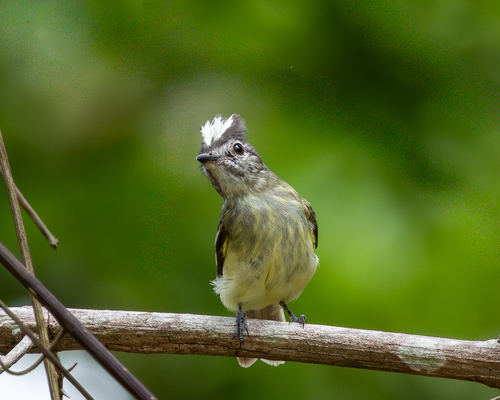
Sibilant Sirystes

Sibilant Sirystes

Sirystes sibilator

Silhouette: Emily Willoughby · PhyloPic

LCLeast ConcernNTVUENCR
Daily sighting probability <5% · Rare
at Soberanía National Park

In 3 days <5%

6 Verified sightings at Soberanía National Park From 2019 to 2026
2,690 In all 8 parks
April Best month
☀️ Diurnal When it's spotted

About the Sibilant Sirystes

The sibilant sirystes (Sirystes sibilator) is a species of bird in the family Tyrannidae, the tyrant flycatchers. It is found in Argentina, Bolivia, Brazil, and Paraguay. The sibilant sirystes was originally described as Muscicapa sibilator, mistakenly placing it with the Old World flycatchers. In 1860 the genus Sirystes was erected for it. Some authors included the genus in family Cotingidae but by the 1930s it was placed in its current family. The sibilant sirystes was eventually expanded by what are now the white-rumped sirystes (S. albocinereus) and Todd's sirystes (S. subcanescens); some systems also included what is now the Choco sirystes (S. albogriseus). The combined species was simply called "sirystes". As a result of a study published in 2013, "sirystes" was split into four species.

The sibilant sirystes is 18 to 18.5 cm (7.1 to 7.3 in) long and weighs about 26 to 28 g (0.92 to 0.99 oz). The sexes have the same plumage. Adults of the nominate subspecies have a black crown with a slight crest. The rest... Wikipedia →

Sounds

Recording0:11

Argentina · 2026

© Faustino Hollmann · XC1176773 · CC BY-NC-SA 4.0

Song1:10

Brazil · 2026

© JAYRSON ARAUJO DE OLIVEIRA · XC1162259 · CC BY-NC-SA 4.0

Call1:10

Brazil · 2020

© Ciro Albano · XC579255 · CC BY-NC-SA 4.0

Global Distribution

Parks Where Found

# Park Country Daily sighting probability
1 Iguazú National Park 🇦🇷 Argentina
~20%
2 Iguaçu National Park 🇧🇷 Brazil
~20%
3 Itatiaia National Park 🇧🇷 Brazil
~20%
4 Darién National Park 🇵🇦 Panama
~10%
5 Chapada dos Guimarães National Park 🇧🇷 Brazil
~10%
6 Serra da Canastra National Park 🇧🇷 Brazil
<5%
7 Chapada Diamantina National Park 🇧🇷 Brazil
<5%
8 Soberanía National Park 🇵🇦 Panama
<5%

Before you go

What are the chances of seeing a Sibilant Sirystes in Soberanía National Park?

Rare

Under 5% of wildlife watchers report a Sibilant Sirystes sighting in Soberanía National Park on a given day, based on 6 verified sightings from GBIF citizen-science data from 2019 to 2026. It is the 437th most-seen of the 449 birds we can rate there. Over three days the chance rises to under 5%, if each day is a fresh chance.

When is the best time to see a Sibilant Sirystes in Soberanía National Park?

Any time of year

In every month with enough records, under 5% of wildlife watchers report a Sibilant Sirystes in Soberanía National Park on a given day, so our monthly data shows no clear season.

What time of day is best to see a Sibilant Sirystes?

Between 9 am and noon

Across all the parks we cover, that three-hour window holds the most Sibilant Sirystes sightings with a recorded time, and about 9 in 10 of them come between 6 am and 6 pm: it is a daytime animal.

Is Soberanía National Park the best place to see a Sibilant Sirystes?

8th of 8

Of the 8 parks where we can rate Sibilant Sirystes sightings, Soberanía National Park ranks 8th at under 5%. The best odds are in Iguazú National Park (Argentina, about 20%), Iguaçu National Park (Brazil, about 20%) and Itatiaia National Park (Brazil, about 20%).

Which relatives of the Sibilant Sirystes live in Soberanía National Park?

Same family: Tyrannidae

The closest relatives of the Sibilant Sirystes that you can see in Soberanía National Park (family Tyrannidae, Tyrant Flycatchers) are Tropical Kingbird (about 60%), Social Flycatcher (about 50%) and Great Kiskadee (about 40%), with each one's daily chance of a sighting.

Where does the Sibilant Sirystes sighting chance come from?

GBIF citizen-science records

It is estimated from how often the Sibilant Sirystes is recorded against all the birds logged in Soberanía National Park (6 verified sightings from 2019 to 2026), calibrated against known sighting rates. Figures are rounded to the nearest 10% because citizen-science data supports honest approximations, not decimals, and months with records from fewer than five people show "—". How it works.

← Back to Soberanía National Park