
Song Wren

Song Wren

Cyphorhinus phaeocephalus

Silhouette: Matt Wilkins · PhyloPic

LCLeast ConcernNTVUENCR
Daily sighting probability ~30% · Possible
at Soberanía National Park

In 3 days ~60% in a week ~90%

2,777 Verified sightings at Soberanía National Park From 2019 to 2026
4,545 In all 13 parks
September Best month
☀️ Diurnal When it's spotted

About the Song Wren

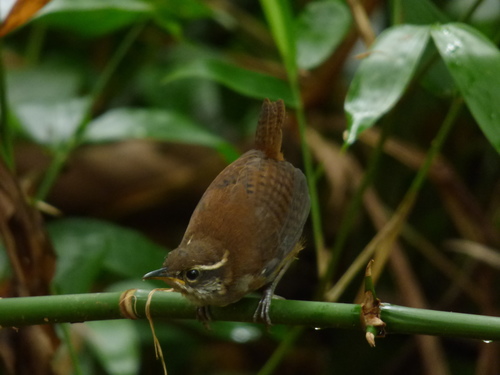
The song wren (Cyphorhinus phaeocephalus) is a species of bird in the family Troglodytidae. It is found in Colombia, Costa Rica, Ecuador, Honduras, Nicaragua, and Panama. At one time the song wren and the musician wren (Cyphorhinus arada) were considered conspecific. They, and possibly chestnut-breasted wren (C. thoracicus), form a superspecies.

The International Ornithological Committee (IOC) and BirdLife International (BLI) recognize the six subspecies listed below. Its body is nearly uniformly brown, though sometimes paler on the breast. It has a chestnut throat and black bars on the wings and its very short tail. It has a patch of bare blue skin around the eye. The subspecies have some variations in color and intensity, and extensive descriptive details can be found in Pollock... Wikipedia →

Sounds

Song1:26

Ecuador · 2019

© rudy gelis · XC821979 · CC BY-NC-SA 4.0

Subsong0:32

Panama · 2022

© Teus Luijendijk · XC712243 · CC BY-NC-ND 4.0

Alarm call0:52

Panama · 2020

© William Adsett · XC639641 · CC BY-NC-SA 4.0

Global Distribution

Parks Where Found

# Park Country Daily sighting probability
1 Soberanía National Park 🇵🇦 Panama
~30%
2 San Lorenzo Protected Forest 🇵🇦 Panama
~10%
3 Chagres National Park 🇵🇦 Panama
~10%
4 Arenal Volcano National Park 🇨🇷 Costa Rica
~10%
5 Tenorio Volcano National Park 🇨🇷 Costa Rica
<5%
6 Rincón de la Vieja National Park 🇨🇷 Costa Rica
<5%
7 Braulio Carrillo National Park 🇨🇷 Costa Rica
<5%
8 Tapantí-Macizo de la Muerte National Park 🇨🇷 Costa Rica
<5%
9 Gandoca-Manzanillo Wildlife Refuge 🇨🇷 Costa Rica
<5%
10 La Amistad International Park (Panama) 🇵🇦 Panama
<5%
11 Tortuguero National Park 🇨🇷 Costa Rica
<5%
12 Parque Natural Metropolitano 🇵🇦 Panama
<5%
13 Monteverde Cloud Forest Reserve 🇨🇷 Costa Rica
<5%

Before you go

What are the chances of seeing a Song Wren in Soberanía National Park?

Possible

About 30% of wildlife watchers report a Song Wren sighting in Soberanía National Park on a given day, based on 2,777 verified sightings from GBIF citizen-science data from 2019 to 2026. It is the 92nd most-seen of the 449 birds we can rate there. Over three days the chance rises to about 60%, and over a week to about 90%, if each day is a fresh chance.

When is the best time to see a Song Wren in Soberanía National Park?

January–February, May–June, September and November

In those months about 30% of wildlife watchers report a Song Wren in Soberanía National Park on a given day, against about 20% in March–April, July–August, October and December, the lowest months.

What time of day is best to see a Song Wren?

Between 8 and 11 am

Across all the parks we cover, that three-hour window holds the most Song Wren sightings with a recorded time, and about 9 in 10 of them come between 6 am and 6 pm: it is a daytime animal.

Is Soberanía National Park the best place to see a Song Wren?

Yes

Of the 13 parks where we can rate Song Wren sightings, Soberanía National Park has the highest daily chance: about 30%. Next come San Lorenzo Protected Forest (Panama, about 10%) and Chagres National Park (Panama, about 10%).

Which relatives of the Song Wren live in Soberanía National Park?

Same family: Troglodytidae

The closest relatives of the Song Wren that you can see in Soberanía National Park (family Troglodytidae, Wrens) are Southern House Wren (about 30%), Buff-breasted Wren (about 20%) and Black-bellied Wren (about 20%), with each one's daily chance of a sighting.

Where does the Song Wren sighting chance come from?

GBIF citizen-science records

It is estimated from how often the Song Wren is recorded against all the birds logged in Soberanía National Park (2,777 verified sightings from 2019 to 2026), calibrated against known sighting rates. Figures are rounded to the nearest 10% because citizen-science data supports honest approximations, not decimals, and months with records from fewer than five people show "—". How it works.

← Back to Soberanía National Park