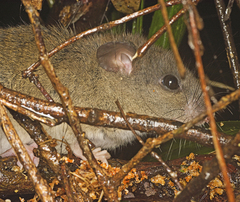
Fawn-footed Melomys

Fawn-footed Melomys

Melomys cervinipes

Silhouette: T. Michael Keesey · PhyloPic

LCLeast ConcernNTVUENCR Endemic
Daily sighting probability ~10% · With luck
at Springbrook National Park

In 3 days ~20% in a week ~40%

5 Verified sightings at Springbrook National Park From 2019 to 2026
61 In all 3 parks
February Best month
🌙 Nocturnal When it's spotted

About the Fawn-footed Melomys

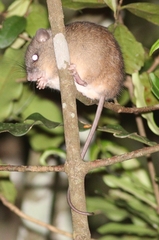
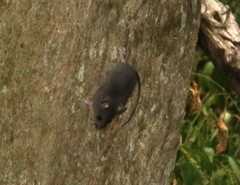
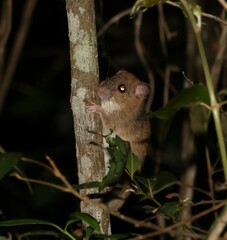
The fawn-footed mosaic-tailed rat, or fawn-footed melomys (Melomys cervinipes) is a species of rodent in the family Muridae. It is found along eastern coastal regions of Australia. The upper parts of this species are a sandy-brown colour, the mottling at the lower parts is grey and whitish. The tail is hairless, the skin of which has a purplish tone. The superficial distinguishing characteristics include soft and short fur, lacking the long guard hairs of other species and adpressed against the body. John Gould proposed the epithet cervinipes for the "fawn-like colouring" of the feet and tarsi, assigning it to the genus Mus and giving an English name of "Buff-footed Rat".

Gould received his specimens from the early natural history collector Frederick Strange, who labelled the collections as being "Stradbrook Island, Moreton Bay, where it is called Corrill by the natives,—Richmond River, where the Aborigines term it Cunduoo,—and the plains bordering the upper parts of the River Brisbane."

This species is commonly known by the descriptive English common name fawn-footed melomys, but during the 1990s proposals emerged to restore indigenous Australian names. Accordingly, in 1995, the Australian Nature Conservation Agency published recommendations for the common names of rodents. They compiled two indigenous Australian names for this species: corrill, recorded from Stradbroke Island; and cunduoo, recorded from the vicinity of the Richmond River. They recommended the adoption of the former of these names, but with the orthography korril. However, this recommendation was not prescriptive, and to what extent it will be adopted remains to be seen. Wikipedia →

Global Distribution

Parks Where Found

# Park Country Daily sighting probability
1 Daintree National Park 🇦🇺 Australia
~20%
2 Lamington National Park 🇦🇺 Australia
~20%
3 Springbrook National Park 🇦🇺 Australia
~10%

Before you go

What are the chances of seeing a Fawn-footed Melomys in Springbrook National Park?

With luck

About 10% of wildlife watchers report a Fawn-footed Melomys sighting in Springbrook National Park on a given day, based on 5 verified sightings from GBIF citizen-science data from 2019 to 2026. It is the 20th most-seen of the 22 mammals we can rate there. Over three days the chance rises to about 20%, and over a week to about 40%, if each day is a fresh chance.

When is the best time to see a Fawn-footed Melomys in Springbrook National Park?

February

In that month about 20% of wildlife watchers report a Fawn-footed Melomys in Springbrook National Park on a given day, against under 5% in January, March, May–September and November, the lowest months. That is one of Springbrook National Park's wettest months, with about 210 mm of rain against 45 mm in August.

What time of day is best to see a Fawn-footed Melomys?

Between 7 and 10 pm

Across all the parks we cover, that three-hour window holds the most Fawn-footed Melomys sightings with a recorded time, and about 8 in 10 of them come between 6 pm and 6 am: it is mostly seen at night.

Is Springbrook National Park the best place to see a Fawn-footed Melomys?

3rd of 3

Of the 3 parks where we can rate Fawn-footed Melomys sightings, Springbrook National Park ranks 3rd at about 10%. The best odds are in Daintree National Park (Australia, about 20%) and Lamington National Park (Australia, about 20%).

Where does the Fawn-footed Melomys sighting chance come from?

GBIF citizen-science records

It is estimated from how often the Fawn-footed Melomys is recorded against all the mammals logged in Springbrook National Park (5 verified sightings from 2019 to 2026), calibrated against known sighting rates. Figures are rounded to the nearest 10% because citizen-science data supports honest approximations, not decimals, and months with records from fewer than five people show "—". How it works.

← Back to Springbrook National Park