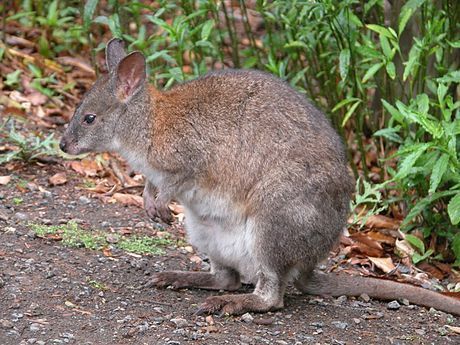
Common Ringtail Possum

Common Ringtail Possum

Pseudocheirus peregrinus

Silhouette: Michael Scroggie · PhyloPic

LCLeast ConcernNTVUENCR Endemic
Daily sighting probability ~20% · Possible
at Springbrook National Park

In 3 days ~40% in a week ~70%

27 Verified sightings at Springbrook National Park From 2019 to 2026
523 In all 9 parks
April Best month
☀️🌙 Day & Night When it's spotted

About the Common Ringtail Possum

The common ringtail possum (Pseudocheirus peregrinus, Greek for "false hand" and Latin for "pilgrim" or "alien") is an Australian marsupial. The possum lives in a variety of habitats and eats a variety of leaves of both native and introduced plants, as well as flowers, fruits and sap. It also consumes caecotropes, which are material fermented in the caecum and expelled during the daytime when it is resting in a nest. This behaviour is called caecotrophy and is similar to that seen in rabbits.

The possum carries its young in a pouch, where it develops for 120–130 days before leaving. They are affected by land clearing, which destroys their habitat. The red fox is an introduced invasive species and predator that negatively impacts the possum.

The common ringtail possum is currently classified as one of the two living species in the genus Pseudocheirus; the species of Pseudochirulus and other ringtail genera were formerly also classified in Pseudocheirus. Several subspecies have been described:

Pseudocheirus peregrinus pereginus, the type subspecies based on a collection made at Endeavour River Pseudocheirus peregrinus convolutor, (Eastern ringtail possum or Southeastern... Wikipedia →

Sounds

Call0:29

Australia · 2025

© Marc Anderson · XC1162877 · CC BY-NC-ND 4.0

Recording0:16

Australia · 2025

© ericboy · iNaturalist · CC BY-NC 4.0

Recording1:18

Australia · 2026

© Blake · iNaturalist · CC BY-NC 4.0

Global Distribution

Parks Where Found

# Park Country Daily sighting probability
1 Lamington National Park 🇦🇺 Australia
~40%
2 Noosa National Park 🇦🇺 Australia
~30%
3 Royal National Park 🇦🇺 Australia
~30%
4 Great Otway National Park 🇦🇺 Australia
~30%
5 Maria Island National Park 🇦🇺 Australia
~30%
6 Blue Mountains National Park 🇦🇺 Australia
~30%
7 Cradle Mountain-Lake St Clair National Park 🇦🇺 Australia
~20%
8 Grampians National Park 🇦🇺 Australia
~20%
9 Springbrook National Park 🇦🇺 Australia
~20%

Cities Where Found

# City Country Daily sighting probability
1 Brisbane 🇦🇺 Australia
~40%
2 Melbourne 🇦🇺 Australia
~40%
3 Sydney 🇦🇺 Australia
~30%
4 Hobart 🇦🇺 Australia
~20%

Zoos & Centres Where Found

# Zoo / Centre Country
1 Australia Zoo 🇦🇺 Australia In captivity
2 Taronga Zoo 🇦🇺 Australia In captivity
3 Cleland Wildlife Park 🇦🇺 Australia In captivity
4 Sydney Zoo 🇦🇺 Australia In captivity
5 Bonorong Wildlife Sanctuary 🇦🇺 Australia In captivity
6 Sea Life Paris Val d'Europe 🇫🇷 France In captivity

Before you go

What are the chances of seeing a Common Ringtail Possum in Springbrook National Park?

Possible

About 20% of wildlife watchers report a Common Ringtail Possum sighting in Springbrook National Park on a given day, based on 27 verified sightings from GBIF citizen-science data from 2019 to 2026. It is the 11th most-seen of the 22 mammals we can rate there. Over three days the chance rises to about 40%, and over a week to about 70%, if each day is a fresh chance.

When is the best time to see a Common Ringtail Possum in Springbrook National Park?

April and September

In those months about 30% of wildlife watchers report a Common Ringtail Possum in Springbrook National Park on a given day, against under 5% in July, the lowest month.

What time of day is best to see a Common Ringtail Possum?

Between 7 and 10 pm

Across all the parks we cover, that three-hour window holds the most Common Ringtail Possum sightings with a recorded time, and about 7 in 10 of them come between 6 pm and 6 am: it is seen both by day and at night.

Where does the Common Ringtail Possum sighting chance come from?

GBIF citizen-science records

It is estimated from how often the Common Ringtail Possum is recorded against all the mammals logged in Springbrook National Park (27 verified sightings from 2019 to 2026), calibrated against known sighting rates. Figures are rounded to the nearest 10% because citizen-science data supports honest approximations, not decimals, and months with records from fewer than five people show "—". How it works.

← Back to Springbrook National Park