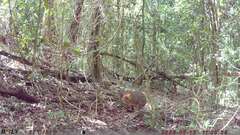
Red-necked Pademelon

Red-necked Pademelon

Thylogale thetis

Silhouette: Kawinwit Kittipalawattanapol · PhyloPic

LCLeast ConcernNTVUENCR Endemic
Daily sighting probability ~50% · Likely
at Springbrook National Park

In 3 days ~80% in a week >90%

191 Verified sightings at Springbrook National Park From 2019 to 2026
519 In all 2 parks
February Best month
☀️ Diurnal When it's spotted

About the Red-necked Pademelon

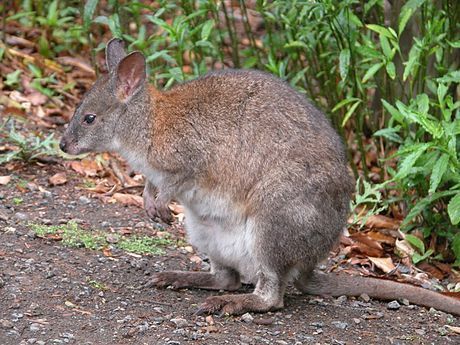
The red-necked pademelon (Thylogale thetis) is a forest-dwelling marsupial living in the eastern coastal region of Australia between extreme south-east Queensland and central eastern New South Wales. A small species of macropod, it has a head and body length of 29–62 cm, a tail length of 27–51 cm and mean weight of 3.8 kg for females and 7.0 kg for males. Mainly crepuscular, the red-necked pademelon is very shy and generally inhabits temperate forests near grassland, hiding in the forests by day and emerging into the grasslands to graze in the dusk.

The red-necked pademelon is brown-grey with a cream underbelly and a red-tinted neck and shoulders. It breeds in the autumn and spring in northern Australia, and in the summer in southern Australia. Predators include the dingo and the red fox, however habitat destruction, particularly through land clearance, is currently the largest threat to the species. The red-necked pademelon is not currently listed as an endangered species.

This species is closely related to the red-legged pademelon. Wikipedia →
Global Distribution

Parks Where Found

# Park Country Daily sighting probability
1 Lamington National Park 🇦🇺 Australia
~60%
2 Springbrook National Park 🇦🇺 Australia
~50%

Zoos & Centres Where Found

# Zoo / Centre Country
1 Taronga Zoo 🇦🇺 Australia In captivity
2 Featherdale Sydney Wildlife Park 🇦🇺 Australia In captivity
3 放牧區 🇹🇼 Taiwan In captivity

Before you go

What are the chances of seeing a Red-necked Pademelon in Springbrook National Park?

Likely

About 50% of wildlife watchers report a Red-necked Pademelon sighting in Springbrook National Park on a given day, based on 191 verified sightings from GBIF citizen-science data from 2019 to 2026. It is the 3rd most-seen of the 22 mammals we can rate there. Over three days the chance rises to about 80%, and over a week to over 90%, if each day is a fresh chance.

When is the best time to see a Red-necked Pademelon in Springbrook National Park?

February

In that month about 60% of wildlife watchers report a Red-necked Pademelon in Springbrook National Park on a given day, against about 40% in July, September–October and December–January, the lowest months. That is one of Springbrook National Park's wettest months, with about 210 mm of rain against 45 mm in August.

What time of day is best to see a Red-necked Pademelon?

Between 3 and 6 pm

Across all the parks we cover, that three-hour window holds the most Red-necked Pademelon sightings with a recorded time, and about 8 in 10 of them come between 6 am and 6 pm: it is a daytime animal.

Is Springbrook National Park the best place to see a Red-necked Pademelon?

2nd of 2

Of the 2 parks where we can rate Red-necked Pademelon sightings, Springbrook National Park ranks 2nd at about 50%. The best odds are in Lamington National Park (Australia, about 60%).

Where does the Red-necked Pademelon sighting chance come from?

GBIF citizen-science records

It is estimated from how often the Red-necked Pademelon is recorded against all the mammals logged in Springbrook National Park (191 verified sightings from 2019 to 2026), calibrated against known sighting rates. Figures are rounded to the nearest 10% because citizen-science data supports honest approximations, not decimals, and months with records from fewer than five people show "—". How it works.

← Back to Springbrook National Park